Covering genealogy, family history, historical events and places, and anything else related!

Saturday, October 11, 2014

Sibling Saturday: Carl Joseph and John William Schneider

For a long time, I did not know that my Schneider ancestors had family in St. Louis when they arrived. My great-great-grandparents Carl Joseph and Christina (Nagel) Schneider and their children (including my great-grandfather John Schneider) left Remagen, Ahrweiler, Rheinland-Pfalz, Germany in 1892 and settled in St. Louis. Christina's brother Mathias Nagel had been living in Jefferson City, Missouri, but had moved to Santa Fe, New Mexico in 1891.

While searching the Missouri History Museum's Genealogy and Local History Index, I found an entry for Carl J. Schneider from the weekly periodical Squib. He was mentioned in a biographical sketch. I requested a photocopy from the Missouri History Museum. Although Schneider is a common surname, I thought there was a chance that the entry referred to my great-great grandfather, or to his grandson with the same name (my maternal grandmother's brother). It did not refer to either of them. It was a biographical sketch of a man named John William Schneider. One of his sons was named Carl J. Schneider. The Missouri History Museum thoughtfully included extra information about John William Schneider; they also sent his death certificate and a copy of his death notice.

I looked over the information, and a theory began to form. The biographical sketch said that John William Schneider was born in Erpil, Germany on 25 December 1856. My great-great-grandfather Carl Joseph Schneider was born in Erpel, Neuwied, Rheinland-Pfalz, Germany on 22 January 1855. "Erpil" looked like a misspelling of "Erpel." The two men were close in age. John William Schneider's death notice mentioned that he was an uncle, and his oldest son shared a first name and middle initial with my great-great-grandfather. His death certificate stated that his father was William Schneider, born in Germany (likely Wilhelm), and his mother was unknown. Carl Joseph Schneider's father was Johann Wilhelm Schneider, and he was called Wilhelm. His mother was Sibylle Lindlohr, who had died in Erpel on 2 April 1862, when she was only 38 years old. John William Schneider had died of chronic hypertrophic cirrhosis of the liver, but gastric carcinoma was listed as a contributory cause of death. Carl Joseph Schneider had died of stomach cancer. When Carl Joseph Schneider wrote a letter to his wife and children while visiting Germany in 1900, he mentioned receiving "brother's letter." This statement implied that his brother was not living in Germany. I suspected that his brother was John William Schneider. However, I could not prove it right away. Catholic church records from Erpel are not available through the Family History Library. I had information about Carl Joseph Schneider's parents and maternal grandparents from the book Familienbuch der katholischen Pfarrei Sankt Peter und Paul Remagen, 1649 bis 1899, by Gerhard Hentschel (Köln: Westdeutsche Gesellschaft für Familienkunde, 2007). However, the book only listed one child for them: a daughter, Maria Anna, who died in 1863 when she was not quite a year old and was buried in Remagen. Carl Joseph Schneider was not even listed as their son, but I knew that he was their son; his marriage certificate names his parents. He was born in Erpel (just across the Rhine River), so he was not recorded in the Remagen book.

In 2010, the book Familienbuch der katholischen Pfarrei Sankt Severin Erpel 1615-1875 (Köln: Westdeutsche Gesellschaft für Familienkunde), by Gerhard Hentschel's wife Renate, was published. I obtained a copy, and finally found the proof that I had been searching for. In the list of children of my my 3rd-great-grandparents Johann Wilhelm Schneider and Anna Sibylle Lindlohr, underneath the entry for my great-great-grandfather, was one for Johann Wilhelm Schneider, born 24 December 1856 in Erpel. The two men were brothers.

Carl Joseph Schneider's father-in-law Johann Nagel, his children's only living grandparent, died in Remagen on 15 February 1891. The following year, Carl and his wife and children moved to St. Louis, Missouri to join his brother, his only living full sibling.

I believe that John William Schneider wanted to be found. If I had not received the information from the Missouri History Library, I probably would not have found him. Even though I still would have learned about him from the Erpel Familienbuch, I would not have known that he went to St. Louis. Although researching others with the same surname can lead to finding relatives, this approach does not work so well with common surnames like Schneider, especially in an area like St. Louis, with a large German population. And after learning that his son Ferdinand had died in World War I, I believe that John wanted me to find him too.

Biographical sketch of John William Schneider. Squib, circa 1911. From the collection of the Missouri Historical Society.

John William Schneider. Squib, circa 1911. From the collection of the Missouri Historical Society.

Carl Joseph Schneider. Photo taken at Pietz, 1630 Franklin Ave., St. Louis, Missouri.

Family of Johann Wilhelm Schneider and Anna Sibylle Lindlohr. Hentschel, Renate. Familienbuch der katholischen Pfarrei Sankt Severin Erpel 1615-1875. Köln: Westdeutsche Gesellschaft für Familienkunde, 2010.
Certificate of death, Carl Joseph Schneider, 5 November 1901. Ancestry.com. Missouri, Death Records, 1834-1910 [database on-line]. Provo, UT, USA: Ancestry.com Operations, Inc., 2008. Original data: Missouri Death Records. Jefferson City, MO, USA: Missouri State Archives. Microfilm.

John W. Schneider death certificate, 27 August 1934. Missouri State Board of Health. Bureau of Vital Statistics.

Friday, October 10, 2014

Schnitzelbank Song

Postcard from Mader's Restaurant, Milwaukee, Wisconsin

The “Schnitzelbank Song” is a German folk song with humorous rhymes which is sometimes used to teach children German words and phrases. It is also a drinking song which was traditionally sung at  pre-Lenten festivities (called Fasching, Fastnacht, or Karneval) in southwestern Germany and Switzerland. Nearly all German-heritage breweries have created posters with images of the items named in the song. There are German steins with images and lyrics from the song. The first published version of the song was printed around 1830 in Karlsruhe. In the mid-1800s, German immigrants brought the song to America.

A Schnitzelbank is a “shaving horse,” a type of woodworking bench. It could be used by farmers, basketmakers, wheelwrights, and coopers. It could be used to make barrels that hold beer; coopers used the shaving horse to shave barrel staves.

Traditionally, one person would hold a pointer and call out each item, and the crowd would then respond. The song begins with the words “Ist das nicht eine Schnitzelbank?” The crowd then replies with “Ja, das ist eine Schnitzelbank!” The chorus of the song is then sung: “O Die Schönheit an der Wand, Ja das ist eine Schnitzelbank.” The next verse would then begin: “Ist das nicht ein...?”

A rough English translation is provided by Polly Campbell in the Cincinnati Enquirer. Another translation is provided by Joe Thiel.

My maternal grandmother Margaret (Schneider) Boe was the daughter of German immigrants. I remember hearing this song from her when I was growing up. When I was a child, I found the “Haufen Mist" part of the song especially humorous.“Haufen Mist” is “manure pile,” although I believe my grandmother told me it was “horse manure.”

A version of the song can be heard here.

References
Getting to Gemütlichkeit: German History and Culture in Southeast Louisiana
Ist das nicht eine Schnitzelbank?
More Schnitzelbank info
Music to My Beers 
Prepare Yourself for Singalongs: Tunes Lose Something in Translation to English
Schnitzelbank 
Schnitzelbank Carves One Great German Song 
A Schnitzelbank Stein

Thursday, October 9, 2014

Leif Erikson Day

Leiv Eiriksson Discovers North America. Painting by Christian Krohg, 1893 [Public domain]. Available from Wikimedia Commons.

October 9 is Leif Erikson Day. The day honors Leif Erikson, the Norseman who was the first European to explore North America. Leif Erikson is believed to have been born in Iceland in the 970s. He traveled from Greenland to Norway in 999 and became a hirdman (member of a royal household) for King Olaf Tryggvason. According to the Saga of Icelanders, he established a settlement at Vinland. The archaeological site L'Anse aux Meadows, located at the northern tip of Newfoundland, may be the site of Vinland; it was a Norse village that dates to about the year 1000.

Rasmus B. Anderson, author of the book America Not Discovered By Columbus, led the movement to establish a holiday to honor Leif Erikson. A Leif Erikson festival was held in Minneapolis, Minnesota on 9 October 1928. On 10 May 10, 1929 Governor Walter Kohler of Wisconsin signed the bill which established October 9 as Leif Erikson Day. On 7 April 1931, Governor Floyd B. Olson signed the bill which established October 9 as Leif Erikson Day in Minnesota. The main sponsors of the bill, Senator A. O. Devold and representative J. O. Melby, and Ola Johann Særvold, president of the Minneapolis Norwegian National League, were present when the bill was signed. By 1956, Leif Erikson Day was a state holiday in Wisconsin, Minnesota, South Dakota, Illinois, Colorado, Washington, and California, and was also a holiday in Saskatchewan, Canada.

On 2 September 1964, Congress approved Public Law 88-566, and President Lyndon B. Johnson issued Proclamation 3610, which designated October 9 as Leif Erikson Day. The date was chosen because the first organized group of immigrants from Norway sailed from Stavanger on the ship Restauration and arrived in New York Harbor on 9 October 1825.

The Leif Ericson Viking Ship has an annual ceremony which includes a ship sailing and a banquet, and features a Scandinavian country. Sweden is the featured country at this year's celebration.

Leif Erikson, Reykjavik, Iceland. Photo by Anthony Inswasty (Own work) [CC-BY-SA-4.0 (http://creativecommons.org/licenses/by-sa/4.0)], 28 December 2013. Available from Wikimedia Commons.

Territories and Voyages of the Vikings. Map by Bogdan Giuşcă [CC-BY-SA-3.0 (http://creativecommons.org/licenses/by-sa/3.0/), CC-BY-SA-2.5 (http://creativecommons.org/licenses/by-sa/2.5/)]. Available from Wikimedia Commons.

References
Carl G.O. Hansen, My Minneapolis, 1956: 91. Leif Erikson Comes to the Front
L'Anse aux Meadows
Leif Ericson Viking Ship 
Leif Erikson
Leif Erikson Day
Presidential Proclamation -- Leif Erikson Day, 2014
Proclamation 3610 - Leif Erikson Day, 1964
Rasmus B. Anderson

Wednesday, October 8, 2014

Great Chicago Fire

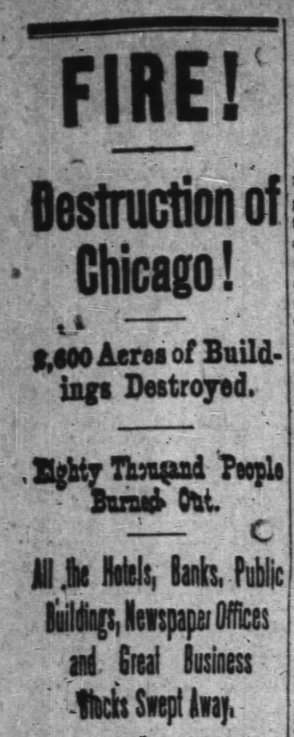
Chicago Tribune, 11 October 1871

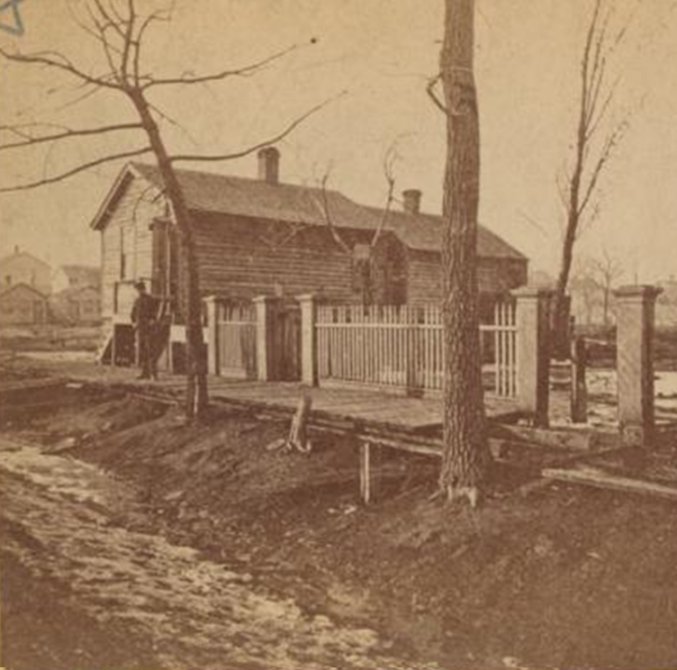
At about 9:00 PM on 8 October 1871, a fire broke out in Patrick and Catherine O'Leary's barn behind 137 DeKoven Street, at the corner of Jefferson Street. Mrs. O'Leary's cow was blamed for starting the fire; it had allegedly kicked over a lantern. Mrs. O'Leary denied this claim; she stated that she had been in bed at the time the fire started. The true cause of the fire is unknown, but it did start in the O'Learys' barn. The legend of Mrs. O'Leary's cow has persisted in popular culture. The Web of Memory section of The Great Chicago Fire & the Web of Memory includes images from popular culture, advertisements based on the legend, and a satirical poem published by the Insurance Monitor in 1872.

An image of Catherine O'Leary's cottage on DeKoven Street in Chicago, 1871. By A.H. Abbott, Photographer (Stereoptican card) [Public domain]. Available from Wikimedia Commons.

Chicago had experienced a hot, dry, summer. There had been little rainfall since July 4, and there was only 0.11 inch of rain between September 17 and October 8. Homes and buildings were made of wood. Strong winds from the southwest rapidly spread the fire through the poor Irish neighborhood Conley's Patch, and then through the Chicago business district. 

The Great Chicago Fire, an artists rendering, Chicago in Flames -- The Rush for Lives Over Randolph Street Bridge. By John R. Chapin, died 1907 (Originally from Harper's Weekly, 1871.) [Public domain]. Available from Wikimedia Commons.

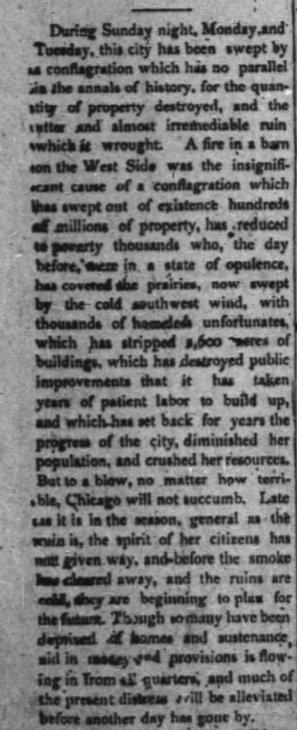
Chicago Tribune, 11 October 1871

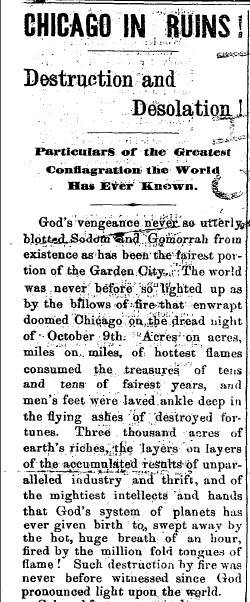
Prairie Farmer, 14 October 1871. Available from Illinois Digital Newspaper Collections.

By the evening of October 9, it began to rain and the fire had started to burn itself out. The burned area of the city was four miles long and one mile wide. 17,500 buildings were destroyed. 90,000 people were left homeless.

My 3rd-great-grandparents John Bennet Winters and Anna "Ann" (Walker) Winters and their daughter, my 2nd-great-grandmother Catherine Elizabeth Winters, had lived at 247 S. Jefferson before the fire, but were not found at that address after the fire. They lived at the edge of the burnt district. They were probably affected by the fire and had to move.

My Graham ancestors may have been affected as well. I still do not have enough evidence to be sure that I have found the right family, but if I have, my 2nd-great-grandfather James Graham's father was William M. Graham, and the family was living at 97 W. Harrison in 1870.

To the Homeless of the Chicago Fire.Chicago History Museum. [Public domain.] Available from Wikimedia Commons.

Prairie Farmer, 16 December 1871. Available from Illinois Digital Newspaper Collections.

References
Bales, Richard F. The Great Chicago Fire and the Myth of Mrs. O'Leary's Cow. Jefferson, NC: McFarland, 2002.
Sawislak, Karen. Smoldering City: Chicagoans and the Great Fire, 1871-1874. Chicago: University of Chicago Press, 1995.

Tuesday, October 7, 2014

Travel Tuesday: Margaret (Schneider) Boe's Trip to Mexico After the Death of Her Brother, 1974

After her brother Carl died in Ciudad Mante, Tamaulipas, Mexico in 1974, my maternal grandmother Margaret (Schneider) Boe traveled to Mexico. She flew alone to Texas, and then flew to Mexico on a smaller plane which, according to my aunt Joan, she had described as a "Piper Cub." She brought her brother's will with her. She met Guadalupe Sanchez, who said she was Carl's wife, and made a settlement with her. My family is not sure that Carl and Guadalupe were actually married; she was a much younger woman, and may have claimed to be his wife because she wanted to collect his benefits. According to the report of Carl's death, he and his wife were separated and her address was unknown, so there could be some truth to this claim.

One of Carl's few possessions was a gold watch. My grandmother thought it might be the watch that he had inherited from their father, but it turned not to be valuable. My grandparents described it as a "bar watch."

Report of the Death of an American Citizen, 6 November 1975. Carl J. Schneider. Ancestry.com. Reports of Deaths of American Citizens Abroad, 1835-1974 [database on-line]. Provo, UT, USA: Ancestry.com Operations, Inc., 2010. Original data: Reports of the Deaths of American Citizens, compiled 01/1835-12/1974. Publication A1 566. ARC ID: 613857. Record Group 59. National Archives at College Park, Maryland, U.S.A.

Monday, October 6, 2014

German-American Day

Flags of the United States of America and the Federal Republic of Germany. Photo by Tvabutzku1234 (Own work) [CC0]. Available from Wikimedia Commons.

Map of the United States with the flag of Germany. By Porsche997SBS (wp: Porsche997SBS) (NA) [Public domain]. Available from Wikimedia Commons.

October 6 is German-American Day. The holiday honors the contributions of German immigrants to the United States. On 6 October 1683, thirteen German families from Krefeld arrived in Philadelphia. These families established the first German settlement at Germantown, Pennsylvania. German settlers had first arrived at Jamestown, Virginia on the ship Mary and Margaret around 1 October 1608.

German-American Day was celebrated in the 19th century, but died out during World War I because of anti-German sentiment. In 1983, President Ronald Reagan proclaimed 1983 as the Tricentennial Anniversary Year of German Settlement in America. Public Law 100-104, approved on 18 August 1987, designated October 6 as German-American Day. On 2 October 1987, President Ronald Reagan issued Proclamation 5719 at a ceremony in the White House Rose Garden.

In The German-American Experience, Don Heinrich Tolzmann includes a six-page appendix which lists prominent German-Americans, including the following people:

Josef Albers: painter
John Jacob Astor: businessman, investor, fur trader, and the first multi-millionaire in the United States
Leon "Bix" Beiderbecke: jazz musician
Walter P. Chrysler: automobile manufacturer and founder of the Chrysler Corporation
George Armstrong Custer:  Civil War and frontier general
Marlene Dietrich: actress and singer
Theodore Dreiser: novelist
Albert Einstein:  physicist
Dwight D. Eisenhower: 34th President of the United States
Henry Louis "Lou" Gehrig: baseball player (first baseman)
Oscar Hammerstein I: producer of grand opera and vaudeville
Oscar Hammerstein II: lyricist
Henry J. Heinz: businessman and founder of the H. J. Heinz Company
Herbert Hoover: 31st President of the United States
Abraham Jacobi: pioneer of pediatrics; opened the first children's clinic in the United States
Henry Kissinger: statesman
Mary Ludwig: fought in the Battle of Monmouth; known as "Molly Pitcher"
Anna Ottendorfer: publisher of the New Yorker Staats-Zeitung
John J. Pershing: World War I general
Edward V. "Eddie" Rickenbacker: World War I aviator
David Rittenhouse: astronomer, inventor, and mathematician; first director of the United States Mint
John D. Rockefeller: industrialist and philanthropist; co-founder of the Standard Oil Company
John A. Roebling: civil engineer; designed the Brooklyn  Bridge
George Herman "Babe" Ruth: baseball player (outfielder and pitcher)
Elisabeth Schumann: grand opera soprano
John Steinbeck: author
Henry E. Steinway: founder of the piano company Steinway & Sons
Levi Strauss: founded the first company to manufacture blue jeans
Clement Studebaker: wagon and carriage manufacturer; co-founder of the H & C Studebaker Company
Paul Tillich: theologian
John Peter Zenger: printer of the New York Weekly Journal; his trial established the principle of freedom of the press

October is German-American Heritage Month.

References
German-American Day
German-American Day: A Short History
German-American Day October 6 - US Customs and Border Protection
German-American Heritage Month: 25th Anniversary 
Tolzmann, Don Heinrich. The German-American Experience. Amherst, NY: Humanity Books, 2000.
Tricentennial Anniversary Year of German Settlement in America 

Sunday, October 5, 2014

52 Ancestors: #40 Louise Margaret Gray

Louise Margaret Gray was born on 6 December 1906 in Nashville, Tennessee. She was the daughter of Margaret Tarkington, my great-grandmother's sister. According to her Social Security account application, her father was Frank Gray. I suspect that Louise's parents never married. Margaret Tarkington appears in Nashville, Tennessee city directories in 1906 and 1908 under her maiden name. She was not listed in 1907, but she was probably home taking care of her baby daughter, not working as a telephone operator. I cannot find Louise in the 1910 United States census. She is not listed in her mother's household.which also included Margaret's mother, brother, and one of her sisters. she may have been living in her mother's home, but not mentioned because she was illegitimate.

In 1920, Louise and her mother Margaret lived in Chicago, Illinois, where my great-grandmother Gertrude (Tarkington) Gatlin (her sister) was living with her husband and son (my great-grandfather and my paternal grandfather). Margaret was using the surname Gray, and was widowed according to the 1920 United States census. However, in Nashville she had been Margaret Tarkington. Margaret worked as a maid, and she and Louise lived with Laurence and Mildred Moore.

By 1924, Louise's mother Margaret had married John Joseph Berberick, a pharmacist's mate in the United States Navy, and the family was living in Buffalo, New York. In 1925, she was working as a saleslady. On 24 July 1926 in Buffalo, Louise married Fredrick Plaumann. In 1930, she lived with her husband and his parents and siblings in Buffalo.

Her mother and stepfather had moved to Cedarville, Columbia, Herkimer County, New York. Louise's mother Margaret died there on 12 January 1929. After 1930, Louise moved to Cedarville. Her maternal grandmother Anna Malvina "Annie" (Binkley) Tarkington had lived there part-time with her son-in-law John Joseph Berberick. Louise probably lived with them too. Annie died on 24 January 1935 in Memphis, Tennessee while staying with another of her granddaughters, Nina (Leech) Clark. In 1936, Louise married her stepfather John Joseph Berberick in Boston, Massachusetts. They continued to live in Cedarville until John Joseph Berberick died on 2 October 1939. Two months later, Louise filled out an application for a Social Security account. She was living at 4710 No. Wolcott Av., Chicago, Illinois. That was my great-grandmother's address. Louise had gone to stay with her aunt after the death of her husband.

By the time of the 1940 United States census, Louise had returned to Cedarville. Her occupation was "new worker." By 1947, Louise had moved to Little Falls, Herkimer County, New York.

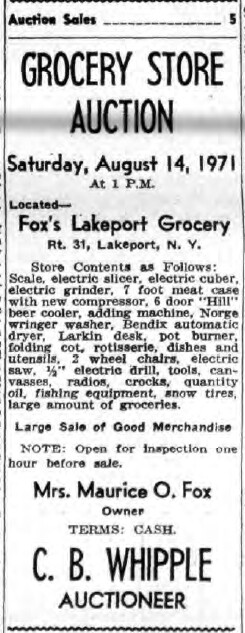
Louise married Leonard D. Smith, and they ran the Lakeport Grocrery Store in Lakeport, Madison County, New York. Leonard died on 17 March 1964. Louise's last husband was Maurice O. Fox. She probably met him through Leonard's sister, Elsie (Smith) Fox. She continued to run the grocery store with her new husband. Maurice Fox died on 9 February 1975. Louise died on 28 July 1979 in Utica, New York. She was buried in Cedarville Cemetery, West Winfield, New York, next to her husband Leonard D. Smith.

When I started researching the Tarkington family, I did not know that Margaret Tarkington had a daughter. When I found her husband John Joseph Berberick's obituary, it mentioned that his second wife (and his widow) was Louise Plaumann. I remembered seeing the name Louise Berberick in my father's baby book; she, my great-grandmother, and the man that became my great-grandmother's second husband had given my father a gift for his first birthday. I wondered why my great-grandmother was so close to her sister's widower's second wife, and did more research on her. I came across a newspaper item which mentioned that Louise Plaumann had learned of the death of her great-grandmother, Mrs. Annie Tarkington. WHAT? I searched for more information and found an "in memoriam" notice placed for Margaret Tarkington Berberick by Joe Berberick and Louise Plaumann, husband and daughter. That's when I realized that Margaret had had a daughter, and that Louise had married her stepfather.

Since I could not find Louise in the 1910 United States census, I assumed that she had been born after 1910. I took a to Cedarville Cemetery to see the graves of my great-grandmother and her sister Margaret. While I was there, I noticed that the stone next to the gravestone for my great-grandmother and her second husband was of a similar style. It was on the grave of Louise G. Smith, born 1906, and Leonard D. Smith, born 1907. Although I thought that Louise had probably been born after 1910, I took a picture of the stone anyway. I am so glad that I did! When the 1940 United States census became available, I searched for Louise Berberick and found her. She had been born about 1907.

I searched for the obituary of Leonard D. Smith, and it mentioned that he was survived by his wife Louise. When I obtained the obituary of Laura (Tarkington) Leech, another of my great-grandmother's sisters, it mentioned many surviving family members, including nieces. One was Mrs. Maurice Fox of New York. She was the only person listed that I could not identify, and she was in the same state that Louise had lived in. I wondered if Louise had married again. I found a Louise Fox, born 1906, in the Social Security Death Index. I searched for an obituary for her; when I found one, it stated that she was a native of Nashville, Tennessee. I ordered her Social Security application. On the application, she stated that her parents were Frank Gray and Margaret Tarkington. I had found Louise.

The entry in my father's baby book that made me wonder about the relationship between my great-grandmother and Louise 

Utica Observer-Dispatch, 27 January 1935, page 7. When I found this item, I learned that Louise was my relative.

Utica Daily Press, 12 January 1931. When I found this item, I learned that Louise was Margaret's daughter. Margaret had actually passed away two years before the notice was published, not six.

Steber's Little Falls and Dolgeville (Herkimer County, N.Y.) City Directory, 1947

Madison County Times, Chittenango, Madison County, NY, 1 July 1960, page 6

Daily Sentinel, Rome, NY, 11 August 1971

Chittenango-Bridgeport Times, 1 August 1979

Louise G. and Leonard D. Smith gravestone, Cedarville Cemetery