Covering genealogy, family history, historical events and places, and anything else related!

Showing posts with label New York. Show all posts

Tuesday, January 29, 2019

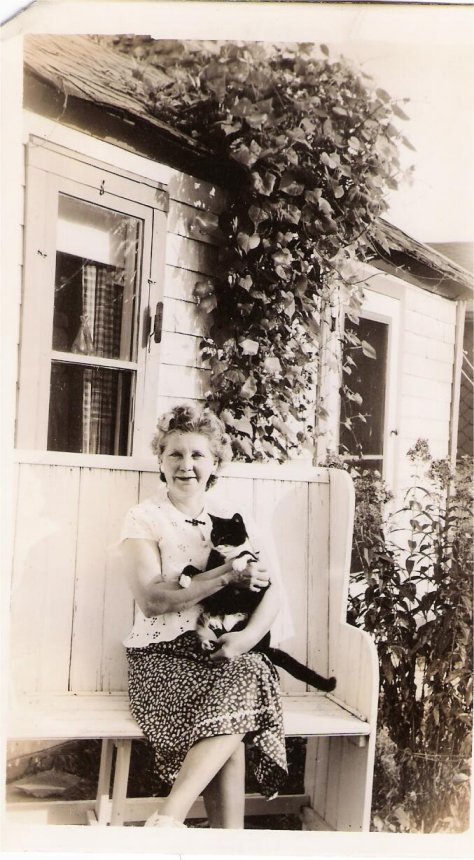
52 Ancestors: Week 4 "I'd Like to Meet": Gertrude Tarkington

Ever since I was a little girl, I have been a cat person. The photo of my great-grandmother Gertrude Tarkington holding a cat gives me a good feeling about her. She looks like a nice woman, and I get the feeling that I would have liked her.

Although my father knew her, he didn't see her that often, since she lived in New York when he was growing up. She must have been a good mother; there was a history of violence and abuse on my great-grandfather's side of the family, but my grandfather was a good man. Clearly she raised him right.

Sunday, November 27, 2016

Mary Winters

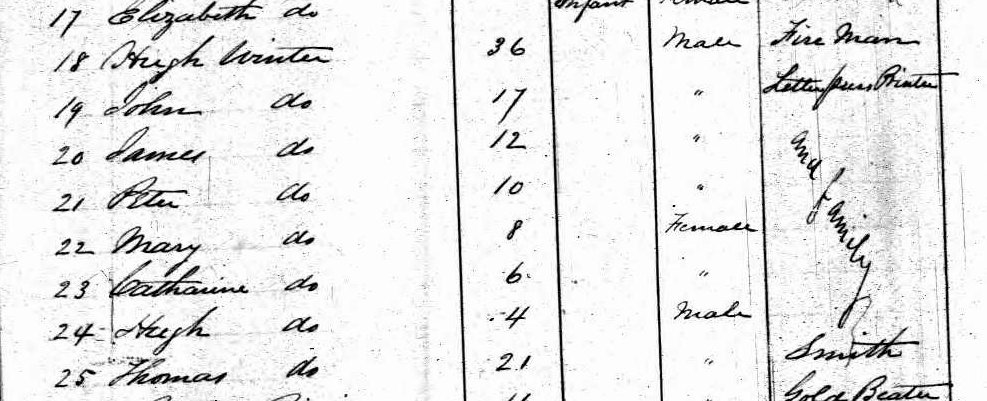
Mary Winters, the daughter of my 4th-great-grandparents Hugh Winters and Mary Bennet, was born 176 years ago today, on 27 November 1840. She was baptized on 13 December 1840 at St. Mary's Cathedral, Edinburgh, Scotland. The baptismal sponsors were John Finegan and Cath Boylan.

She arrived in New York, New York on 12 June 1849 on the Pursuit with her father and most of her siblings.

Passenger manifest, Pursuit, 12 June 1849. Passenger Lists of Vessels Arriving at New York, New York, 1820-1897. Microfilm Publication M237, 675 rolls. Records of the U.S. Customs Service, Record Group 36. National Archives at Washington, D.C. Year: 1849; Arrival: New York, New York; Microfilm Serial: M237, 1820-1897; Microfilm Roll: Roll 080; List Number: 706. Ancestry.com. New York, Passenger Lists, 1820-1957 [database on-line]. Provo, UT, USA: Ancestry.com Operations, Inc., 2010. 

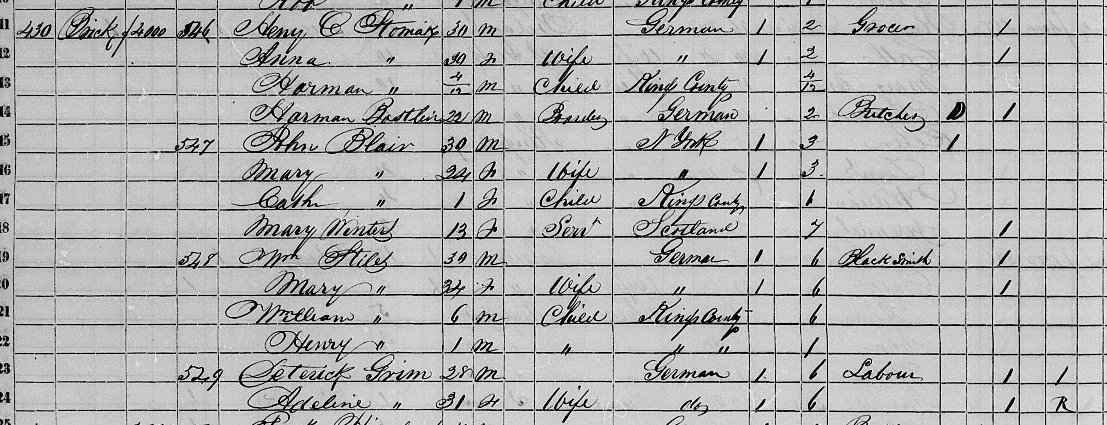
Mary's mother and sister Margaret apparently traveled separately, but the whole family was together in Brooklyn, New York by 1850.

1850 United States census, Brooklyn Ward 10, Kings County, New York, population schedule, p. 131A. Ancestry.com. 1850 United States Federal Census [database on-line]. Provo, UT, USA: Ancestry.com Operations, Inc., 2009.

In 1855, Mary was a servant in the home of John and Mary Blair. Her mother had apparently died by this time.

New York State Census, 1855, database with images, FamilySearch (https://familysearch.org/ark:/61903/1:1:K6W3-Z9M : 19 November 2014), Mary Winters in household of John Blair, E.D. 2, Ward 12, Brooklyn City, Kings, New York, United States; count clerk offices, New York; FHL microfilm 1,930,199.

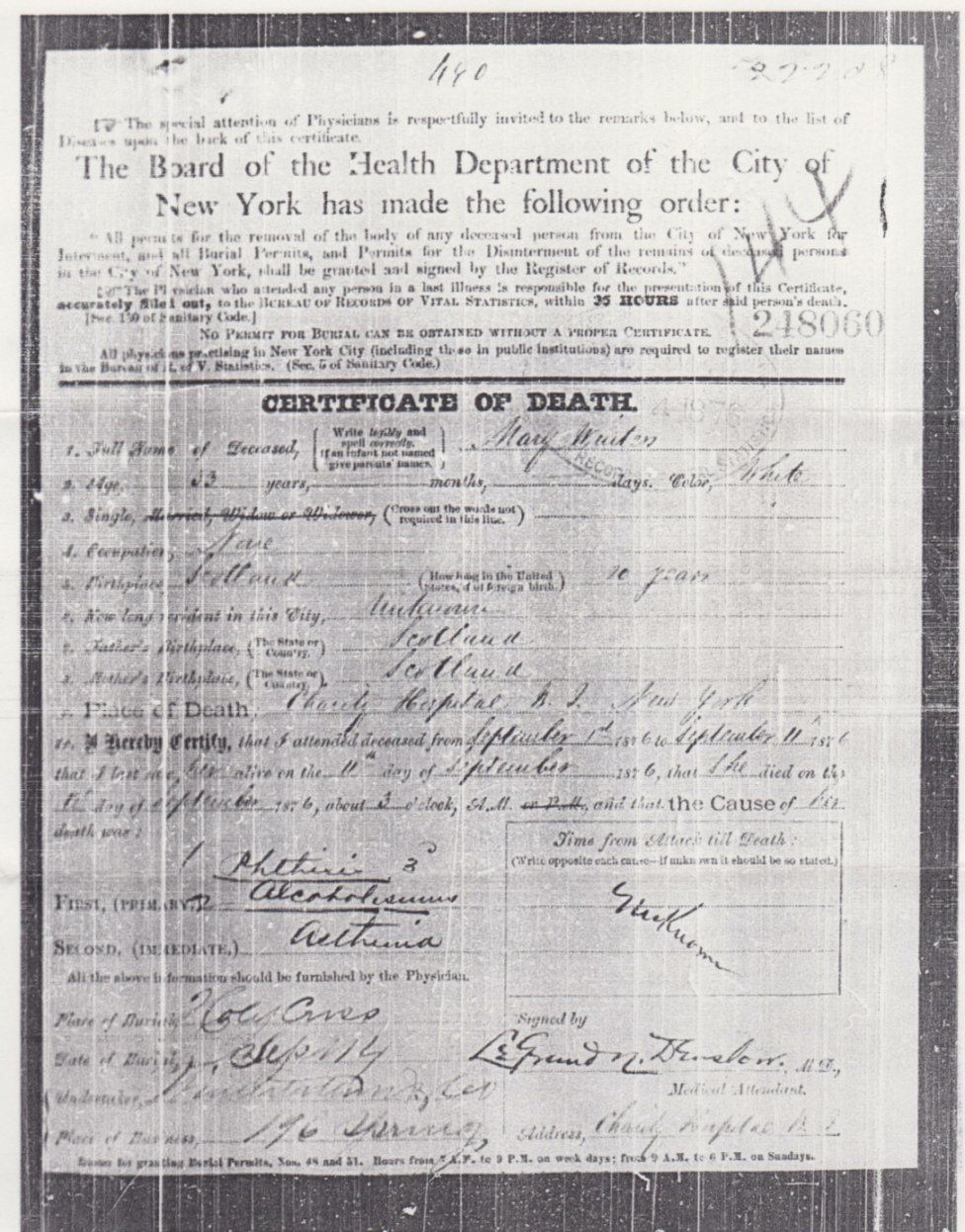
Mary died on 12 September 1876 in Charity Hospital, Blackwell's Island, New York, New York. The causes of death were phthisis (pulmonary tuberculosis) and alcoholism. Asthma was a contributing cause. She was buried in Holy Cross Cemetery, Brooklyn, New York.

New York, New York. Board of the Health Department. Death certificate no. 248060, Mary Winters, 1876.

Tuesday, September 13, 2016

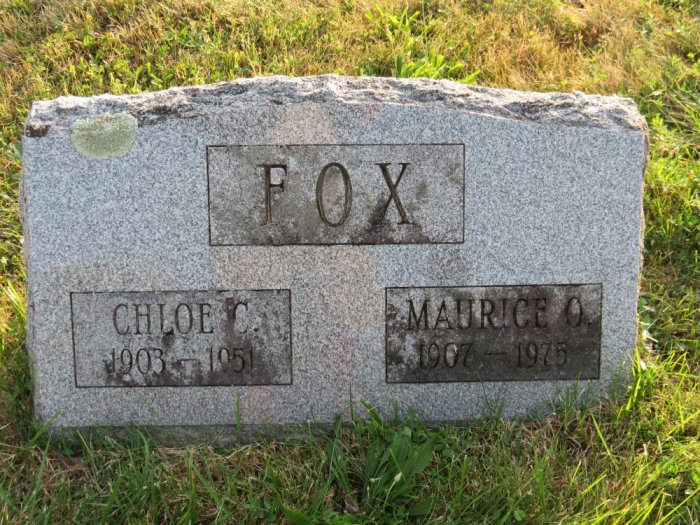
Tombstone Tuesday: Chloe (Cromp) and Maurice O. Fox

Photo by SkipAZ - Find A Grave contributor

Maurice Otis Fox was born in New York on 18 March 1907. He was the son of Charles and Ruth Fox. He lived in Madison County, New York all his life. He worked for the Penn Central Railroad, and worked for the Thruway Restaurant in Canastota, Madison County, New York for five years.

Maurice's first wife was Chloe Cromp. She was born in New York on 29 July 1903. Her first husband was Lester Russell. She and Lester had four children. Chloe died on 6 June 1951.

Maurice's second wife was my first cousin twice removed Louise Margaret Gray. After their marriage, he helped her run Lakeport Grocery in Lakeport, Madison County New York.

Maurice died on 9 February 1975. He and Chloe were buried in Collamar Cemetery, DeWitt, Onondaga County, New York.

Saturday, June 11, 2016

Tappan, New York

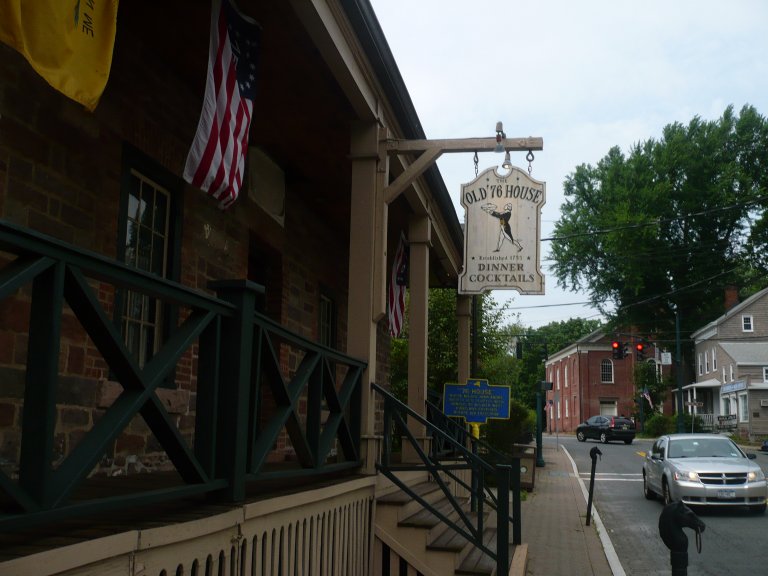
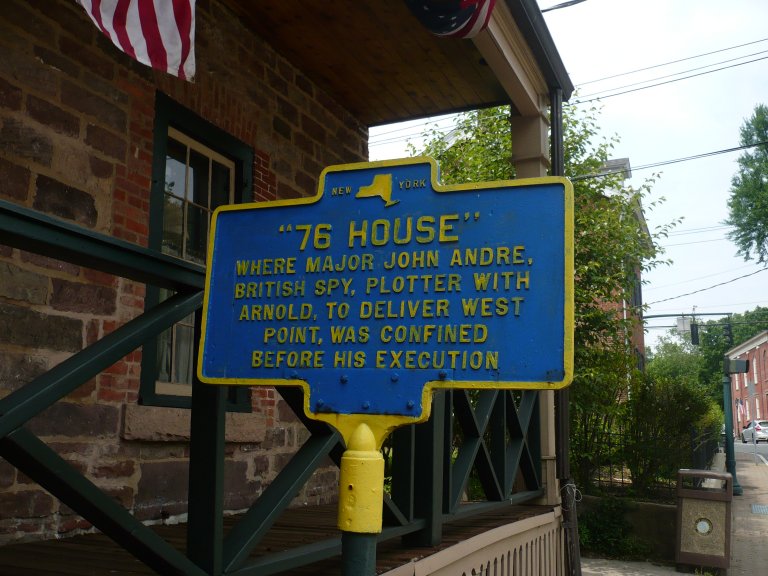
Today I visited Tappan, Rockland County, New York. I had lunch at the '76 House, the oldest tavern in New York. Major John André, who was a British spy and plotted with Benedict Arnold, was held prisoner at the '76 House before he was executed.


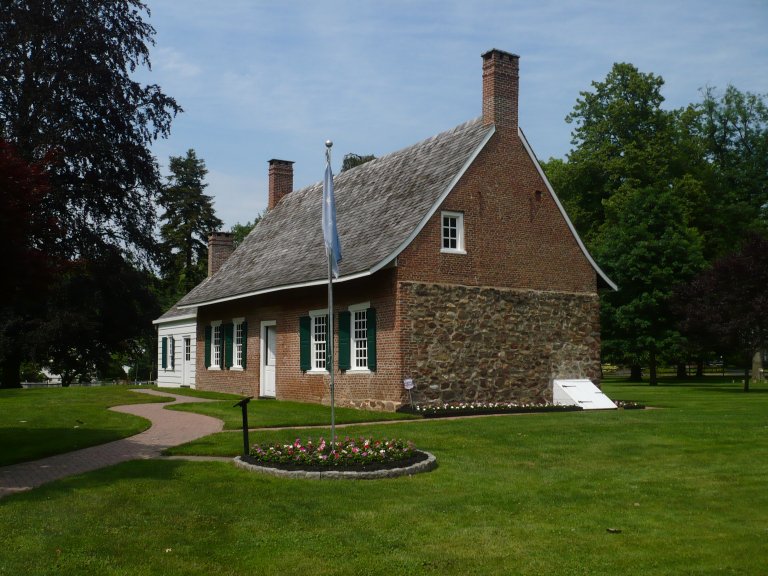
I also visited the DeWint House, the oldest surviving structure in Rockland County, New York. It was George Washington's temporary headquarters four times during the American Revolution.


The coat rack in the DeWint House is the original one that was used when George Washington visited.


The Carriage House was built in the mid-1800s.


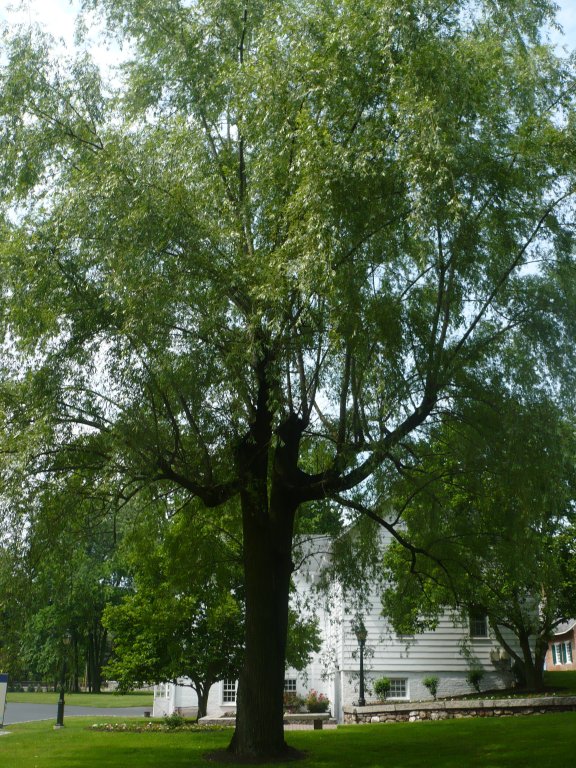
The weeping willow tree on the grounds is a shoot from the largest weeping willow tree in the United States.

Monday, May 16, 2016

Mystery Monday: Winters Wives

How many wives did my 4th-great-grandfather Hugh Winters have? Did his sons have any wives that I do not know about? What were the maiden names of these women? I am still trying to identify some Winters women, most or all of whom married into the family.

Hugh Winters married my 4th-great-grandmother Mary Bennet on 24 January 1831 at St. Mary's Church in Edinburgh, Scotland. In 1849, Hugh and his most of his family sailed from Glasgow to New York City on the Pursuit; they arrived on 12 June 1849, and settled in Brooklyn. His wife Mary and daughter Margaret did not go with them. They apparently traveled separately, since they were enumerated with the family in the 1850 U.S. Census. Hugh and Mary's last child, Elizabeth, was born on 12 January 1851 and baptized at St. Paul's Roman Catholic Church in Brooklyn on 18 January 1851.

Ancestry.com. Brooklyn, New York, St. Paul's Catholic Church Baptism Records, 1837-1900 [database on-line]. Provo, UT, USA: Ancestry.com Operations, Inc., 2008. Original data: James R Reilly, comp. St. Paul's Roman Catholic Church, Brooklyn, New York, Baptism and Marriage Records, Volumes I-II. Salt Lake City, UT, USA: Redmond Press, 1996.

Two additional Winters children were baptized at St. Paul's Roman Catholic Church in Brooklyn. Their parents were John Winters and Mary Mitchell. Did my 3rd-great-grandfather John Bennet Winters have a previous wife? He married my 3rd-great-grandmother Anna "Ann" Walker in Tonawanda, Erie County, New York on 10 October 1859. Or is this John Winters the brother of Hugh Winters? His brother John, also known as Owen, married Elizabeth Hamell on 13 October 1835 in Glasgow, Lanarkshire, Scotland. He married his second wife, Elizabeth Baillie, on 7 December 1845 in Leith, Midlothian, Scotland. Did he also come to New York? Did he marry a third time?  Or is this John Winters another relative, or someone unrelated?

Hugh's wife Mary probably died between 1851 and 1855. In the 1855 New York State Census, Hugh was enumerated as a boarder in the home of John and Rosey Moran, and none of his children were living with him. His daughter Mary was a servant in the home of John and Mary Blair, and his son Hugh and daughter Margaret were in the nursery in Flatbush, New York.

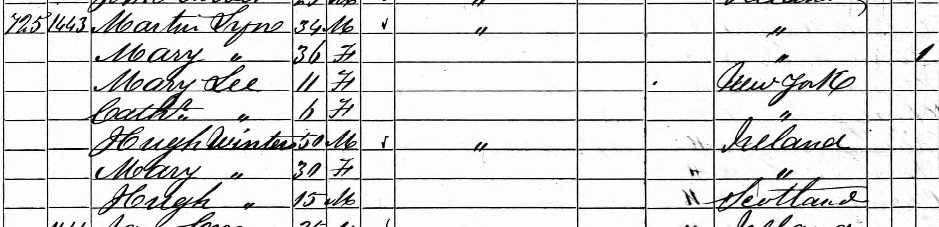
In 1860, an Irish-born woman named Mary Winters, age 30, lived with Hugh Winters and his son Hugh. Who was she? Hugh's daughter Mary was born in Scotland and was not quite 20 years old. Are her age and birthplace incorrect in this census record? Did Hugh remarry? Is this Mary his wife? Is she a younger sister, niece, or cousin who left Ireland and moved in with the family? Is she Mary (Mitchell) Winters?

1860 United States Census, Brooklyn Ward 6, District 1, Kings County, New York, population schedule, page 649. Ancestry.com. 1860 United States Federal Census [database on-line]. Provo, UT, USA: Ancestry.com Operations, Inc., 2009. Original data: 1860 U.S. census, population schedule. NARA microfilm publication M653, 1,438 rolls. Washington, D.C.: National Archives and Records Administration, n.d.

The 1865 New York State Census gives relationships. According to the census enumeration for Hugh's family, Hugh was married to Margaret Winters, age 38, born in Scotland.

 1865 New York State Census, Brooklyn, Kings County, New York, 6th Ward, page 26. Ancestry.com. New York, State Census, 1865 [database on-line]. Provo, UT, USA: Ancestry.com Operations, Inc., 2014. Original data: Census of the state of New York, for 1865. Microfilm. New York State Archives, Albany, New York.

The 1870 U.S. Census enumeration for the Winters family shows that Hugh was married to Eliza Winters. She was 40 years old and born in Ireland.

1870 United States Census, Brooklyn Ward 6, Kings County, New York, population schedule, page 183. Ancestry.com. 1870 United States Federal Census [database on-line]. Provo, UT, USA: Ancestry.com Operations, Inc., 2009. Original data: 1870 U.S. census, population schedules. NARA microfilm publication M593, 1,761 rolls. Washington, D.C.: National Archives and Records Administration, n.d.

What happened to Margaret? When did he marry Eliza?

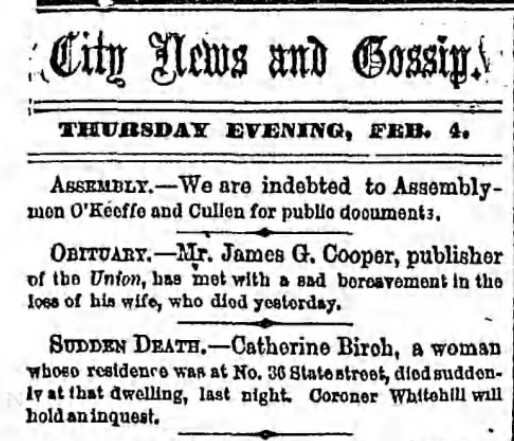
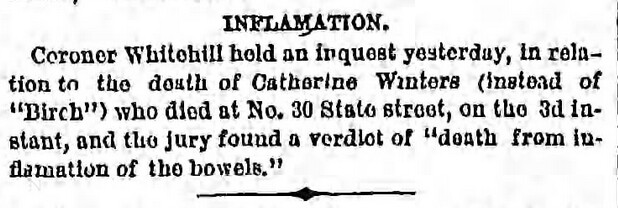
Eliza died in Kings County, New York on 5 April 1874. I have not found evidence of later wives. However, I did run across something interesting in the February 4-5, 1869 issues of the Brooklyn Daily Eagle:

Brooklyn Daily Eagle, 4 February 1869, page 3

Brooklyn Daily Eagle, 5 February 1869, page 3

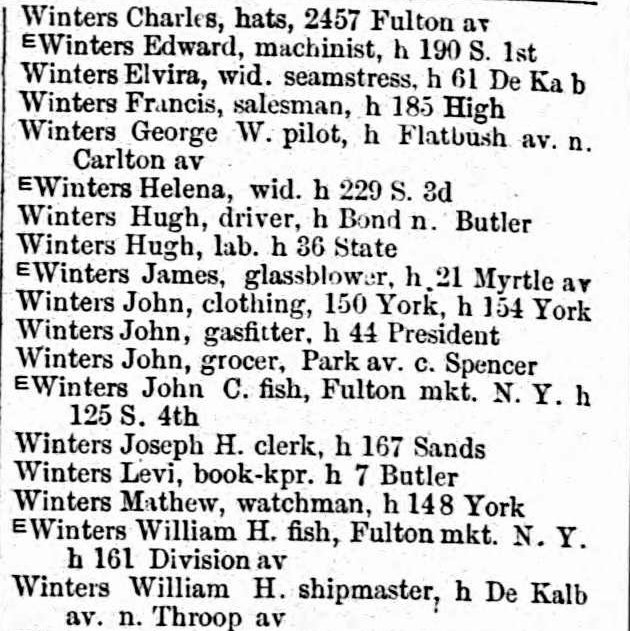
Hugh Winters lived at 36 State Street in 1869. Although two men by that name were listed in the 1869 Brooklyn city directory, my Hugh Winters was consistently listed as a laborer.

Brooklyn City and Business Directory for the Year Ending May 1st, 1869, Containing Also a Street and Avenue Directory and an Appendix. Compiled by Geo T. Lain. Brooklyn and New York, NY: Lain & Company. Ancestry.com. U.S. City Directories, 1822-1995 [database on-line]. Provo, UT, USA: Ancestry.com Operations, Inc., 2011. 

Who was Catherine? She was not Hugh's daughter Catherine, who married Joshua Hunt Thomas on 17 March 1872 and died in Providence, Rhode Island on 14 February 1931. Was she another wife of Hugh's?

Sunday, May 8, 2016

Mother's Day


In honor of Mother's Day, I am posting this picture of my mother and me on the day of my graduation from Skidmore College, Saratoga Springs, New York.

Thursday, February 25, 2016

Thriller Thursday: Murder Near Tonawanda, New York

Atlas and Argus (Albany, NY), 20 October 1860, page 2

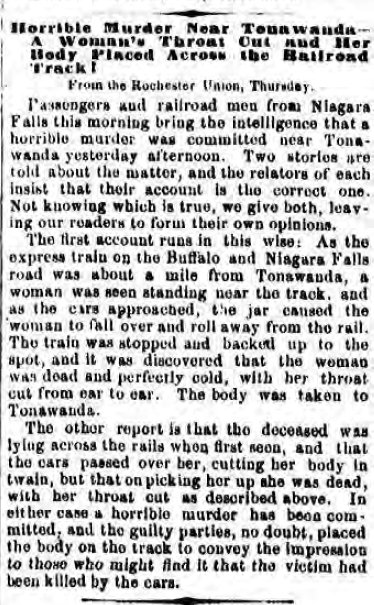
On 17 October 1860, a woman's body was found on the tracks of the Buffalo and Niagara Falls road, about a mile from Tonawanda, Erie County, New York. One person reported that the woman was standing near the track and fell over as a train approached. The train stopped, and it was discovered that the woman was dead. Her throat had been cut. Another person reported that the woman's body was lying on the tracks and was run over by a train. Her body was cut into two, but it was discovered that her throat had previously been cut. Either way, the killer apparently wanted the woman's death to seem to be the result of a railroad accident.

My 3rd-great-grandparents John and Ann (Walker) Winters were living in Tonawanda at the time that the murder took place.They probably heard about it.

Wednesday, February 24, 2016

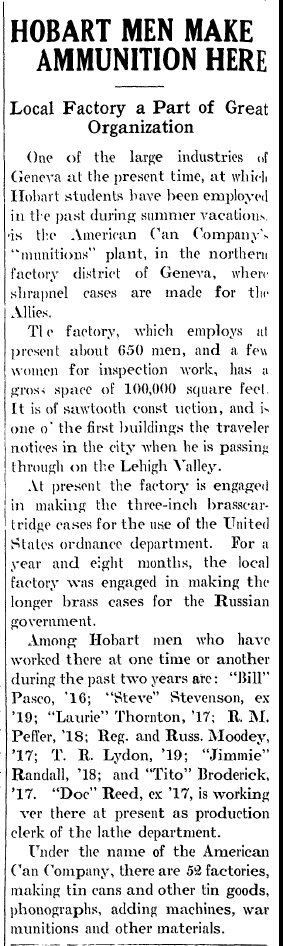
Workday Wednesday: American Can Co. Munitions Plant

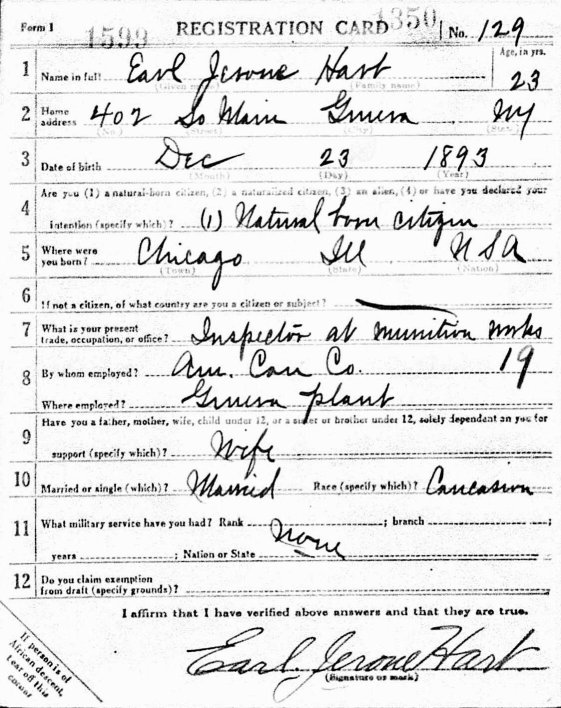
In 1917, my second cousin twice removed Earl Jerome Hart (the grandson of my 2nd-great-grandmother's brother Elias Erickson) worked as an inspector at American Can Company's munition works in Geneva, New York.

World War I draft registration card, Earl Jerome Hart. Ancestry.com. U.S., World War I Draft Registration Cards, 1917-1918 [database on-line]. Provo, UT, USA: Ancestry.com Operations Inc, 2005. Original data: United States, Selective Service System. World War I Selective Service System Draft Registration Cards, 1917-1918. Washington, D.C.: National Archives and Records Administration. M1509, 4,582 rolls. Imaged from Family History Library microfilm. 

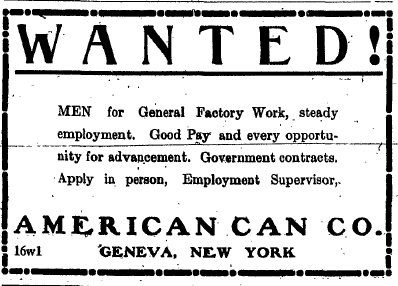
The American Can Company had government contracts to produce munitions for World War I.

 Newark Union- Gazette (Newark, NY), 20 April 1918, page 9

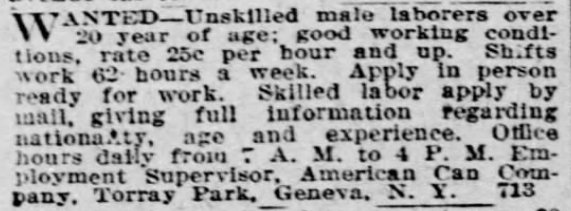
In 1917, the men were paid at least 25 cents per hour, and they worked 62 hours per week.

Rochester Democrat and Chronicle, 9 May 1917, page 5

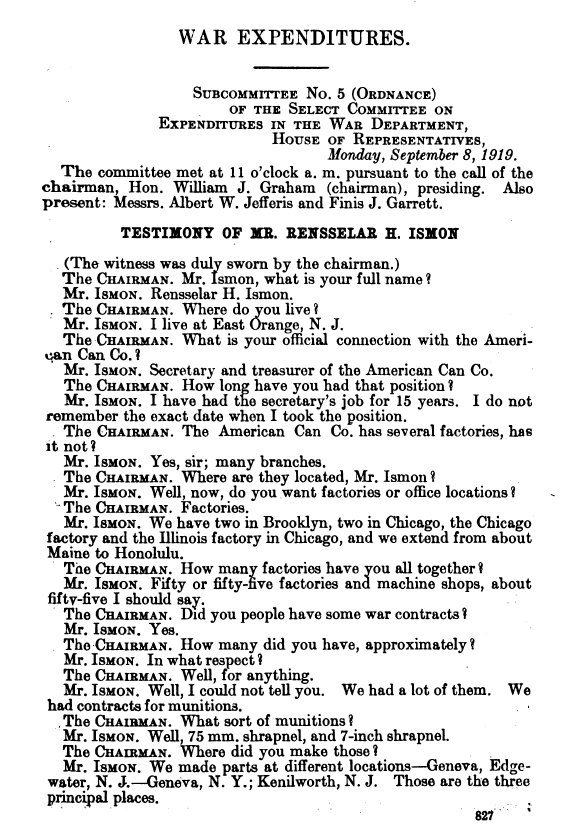
75 mm and 7-inch shrapnel were produced at American Can Co.'s factories.

United States. Congress. House. Select Committee on Expenditures in the War Department. War Expenditures: Hearings Before Subcommittee No. 5 (Ordnance) of the Select Committee on Expenditures in the War Department, House of Representatives, Sixty-sixth Congress, First session on War Expenditures. Washington, DC: Government Printing Office, 1919. Available from Google Books.

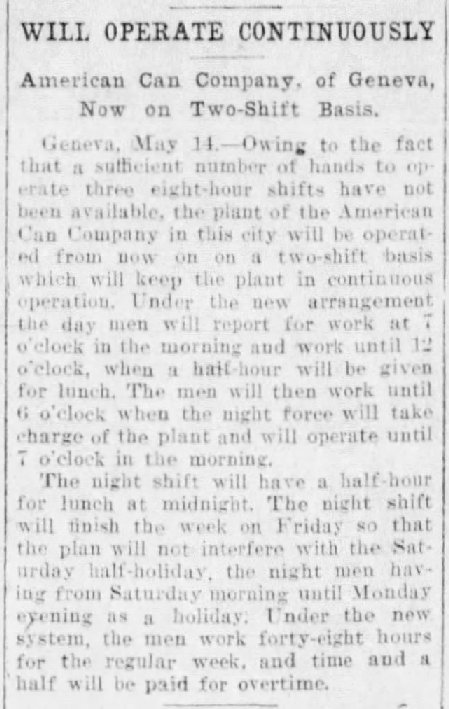
In 1916, the Geneva plant operated continuously, and there were two shifts. They had a half hour lunch break.

Rochester Democrat and Chronicle, 15 May 1916, page 5

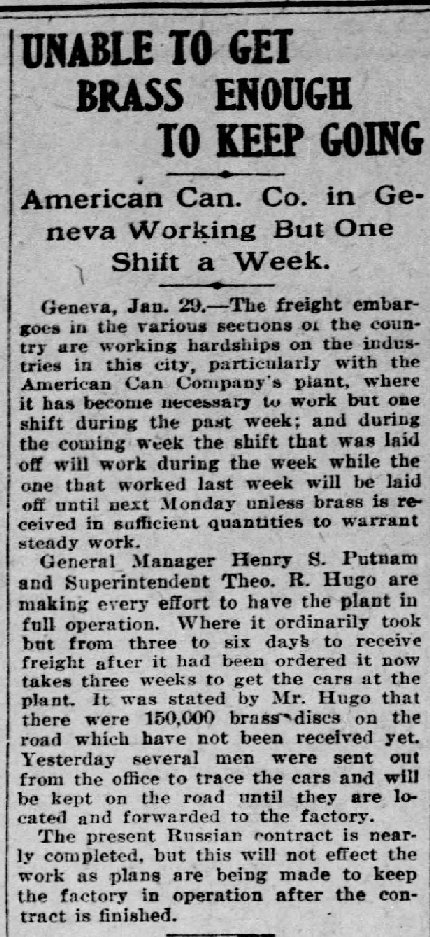
In January 1917, only one shift worked each week due to a shortage of brass. The two shifts alternated weeks. At this time, the men were producing brass shrapnel cases for the Russian government.

Rochester Democrat and Chronicle, 30 January 1917, page 4

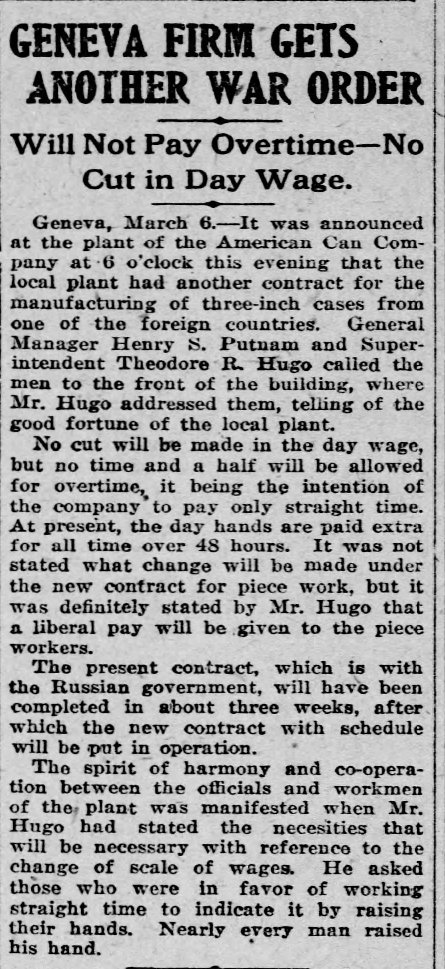
In March 1917, the plant began manufacturing three-inch shrapnel cases after getting another contract. The workers' wages were not cut, but they were not paid time and a half for overtime.

 Rochester Democrat and Chronicle, 7 March 1917, page 4

During summer vacations, Hobart College students worked in the munitions plant.

 Hobart Herald, 6 October 1917, page 2

About 650 men worked at the Geneva plant in 1917. A few women worked as inspectors, along with my cousin Earl Jerome Hart.

Monday, January 18, 2016

Martin Luther King, Jr. Day Reflections

Many of Martin Luther King. Jr.'s speeches are well-known, such as his famous "I Have a Dream" speech (which brings to mind a memory of my maternal grandmother Margaret Ann (Schneider) Boe). But several years ago, a tape was discovered in the archives of the New School, a university in New York City where two of my relatives are members of the faculty. On 6 February 1964, King gave the inaugural speech of a lecture series, "The American Race Crisis." Although a recording of the speech itself has not been found, an audiotape of a 15-minute question-and-answer session was discovered. Experts had not previously known about the speech, in which King compared the situation of African-Americans to the "untouchable" castes in India. This was a significant discovery, and since it took place at an institution where two family members were working, there is a bit of a family history connection.

Source: El Naggar, Mona. Found After Decades, a Forgotten Tape of King 'Thinking on His Feet'. 22 August 2013.

Saturday, January 9, 2016

Shopping Saturday: Lakeport Grocery

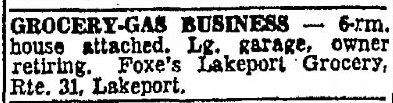
My first cousin twice removed Louise Margaret Gray owned Lakeport Grocery in Lakeport, New York. I am not sure when she purchased the store, but I know that she owned it while she was married to her third husband Leonard D. Smith. The store was later known as Fox's Lakeport Grocery after she married her fourth husband Maurice Otis Fox.

The store was a grocery and a service station. A 6-room house was attached to the store.

Post-Standard (Syracuse, NY), 2 August 1968

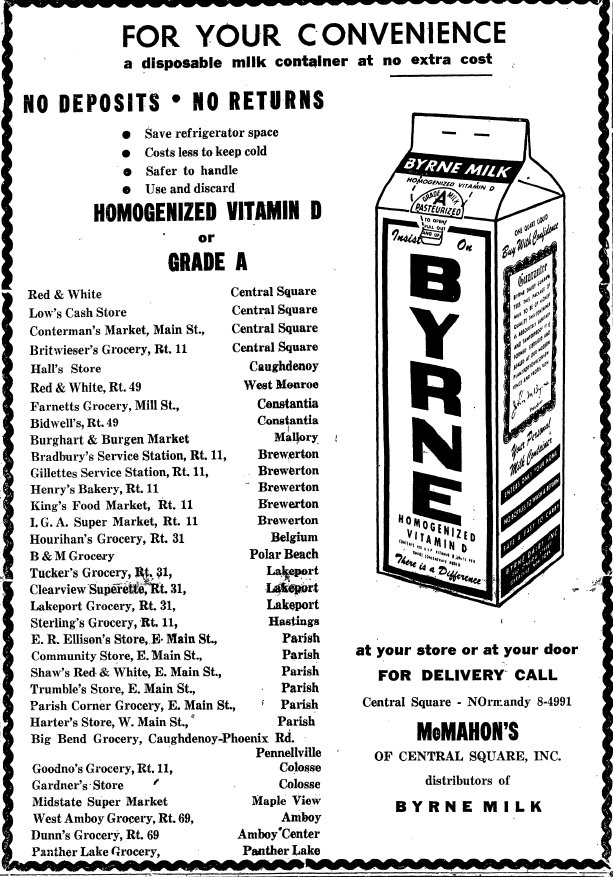
Milk was available in disposable containers.

Mexico Independent (Mexico, NY), 29 August 1955

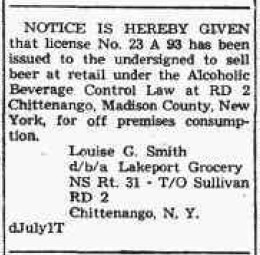
Beer was also available for purchase.

Madison County Times (Chittenango, NY), 1 July 1960

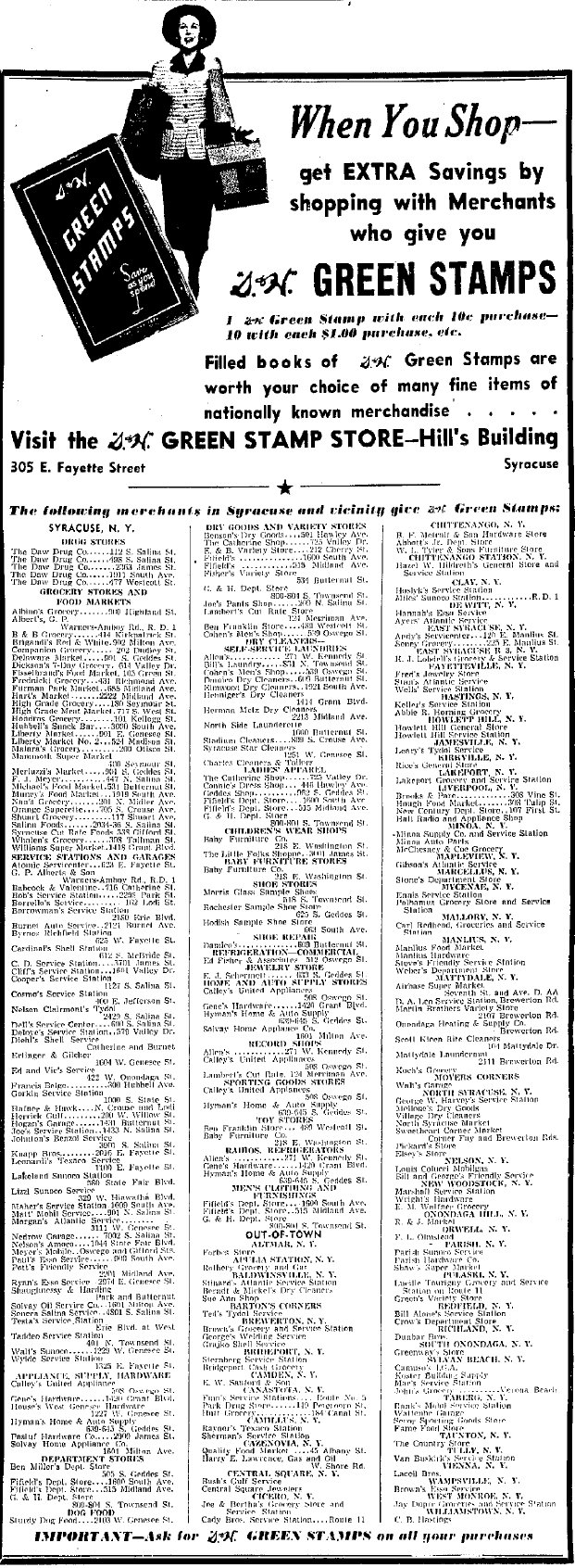
S&H Green Stamps were given to the store's customers.

Post-Standard (Syracuse, NY), 16 February 1950

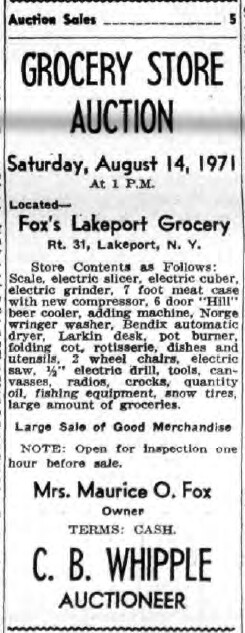
When Louise was in the process of retiring, a grocery store auction was held. The ad for the sale included a list of the store's contents.

Daily Sentinel (Rome, NY), 11 August 1971

Louise owned the store until at least 1973.

Friday, January 1, 2016

Ellis Island Opens

First Ellis Island Immigration Station in New York Harbor. Public domain. Available from Wikimedia Commons.

On 1 January 1892, Ellis Island opened. On that day, 700 immigrants arrived on three ships. The first immigrant processed was Annie Moore, an Irish teenager who arrived with her brothers Anthony and Philip. The original immigration station was destroyed by a fire on 15 June 1897. The second immigration station opened on 17 December 1900. Before it was completed, the passengers were processed at the Barge Office.

Ellis Island closed on 12 November 1954. More than twelve hundred immigrants had arrived at the port, which is shared by New York and New Jersey.

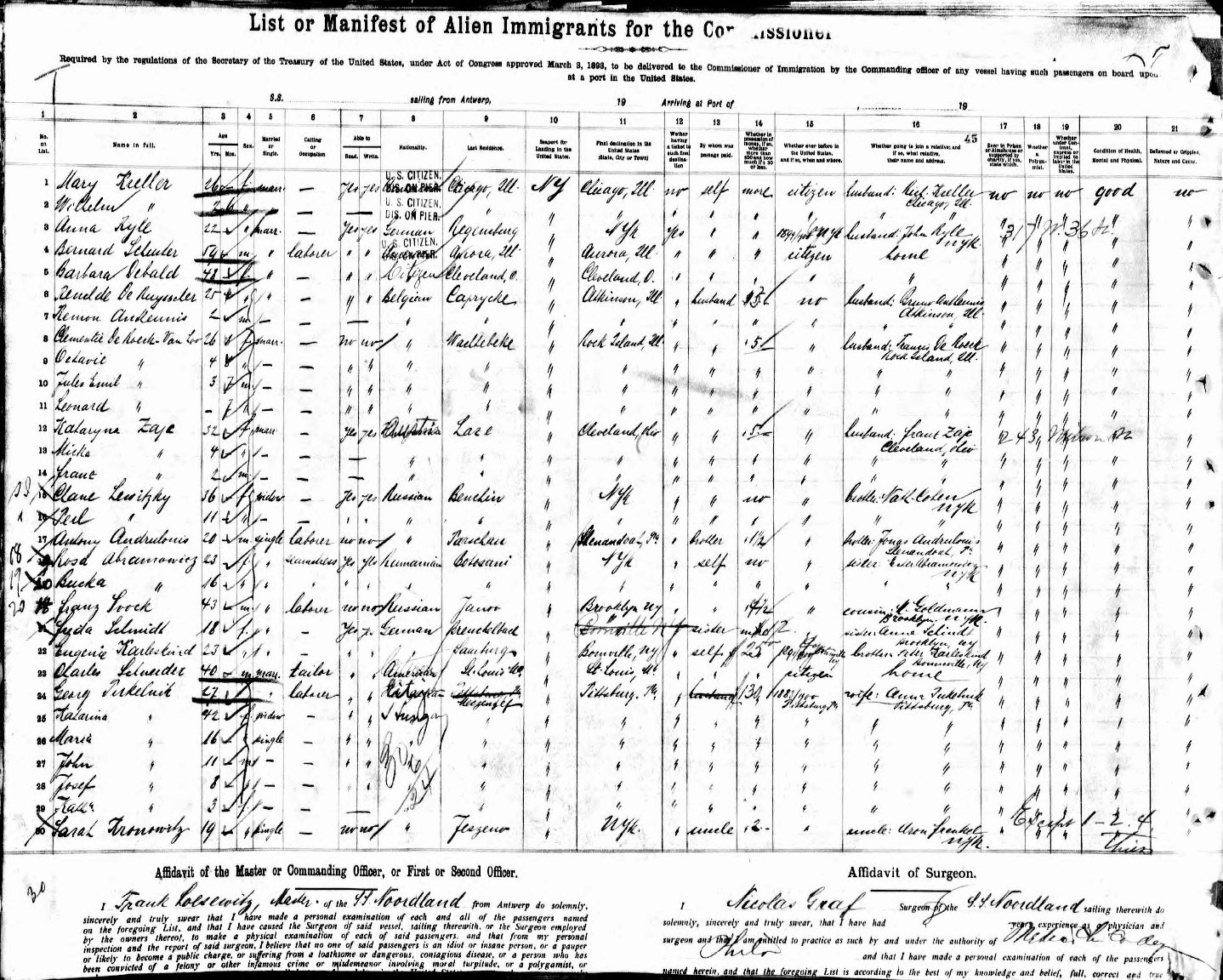
My Schneider ancestors immigrated in 1892, but I do not know if they came through Ellis Island. However, my 2nd-great-grandfather Carl Joseph Schneider arrived at the port when he returned from a visit to Germany. He sailed on the Noordland and arrived on 16 August 1900. By then, he had become an American citizen. He was listed on the manifest as Charles Schneider.

Manifest SS Noordland, arrival in New York, NY, 16 August 1900. Ancestry.com. New York, Passenger Lists, 1820-1957 [database on-line]. Provo, UT, USA: Ancestry.com Operations, Inc., 2010. Original data: Passenger and Crew Lists of Vessels Arriving at New York, New York, 1897-1957. Microfilm Publication T715. Records of the Immigration and Naturalization Service; National Archives at Washington, D.C.

My 2nd-great-grandfather Andrew T. Anderson (formerly Andreas Troedsson) also arrived at Ellis Island after a visit to his homeland. He traveled to Sweden in 1912, and returned on the Caronia on 28 July 1912.

Manifest SS Caronia, arrival in New York, NY, 28 July 1912. Ancestry.com. New York, Passenger Lists, 1820-1957 [database on-line]. Provo, UT, USA: Ancestry.com Operations, Inc., 2010. Original data: Passenger and Crew Lists of Vessels Arriving at New York, New York, 1897-1957. Microfilm Publication T715. Records of the Immigration and Naturalization Service; National Archives at Washington, D.C.

References
Ellis Island
Ellis Island History
9 Things You May Not Know About Ellis Island

Monday, December 28, 2015

Maritime Monday: The Pursuit, Glasgow to New York, 1849

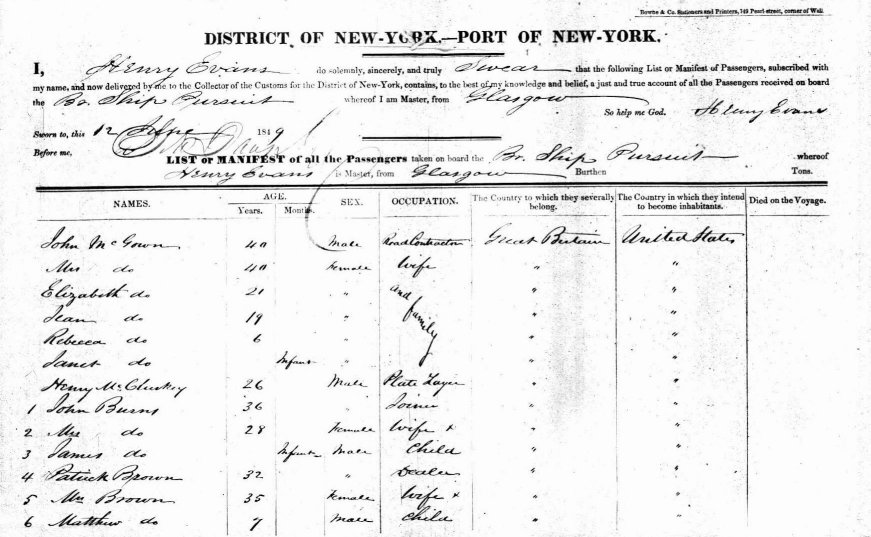
My 4th-great-grandfather Hugh Winters and most of his children (including his son John, my 3rd-great-grandfather) sailed from Glasgow, Scotland to New York, New York on the Pursuit in 1849. (His wife Mary Bennet and their daughter Margaret apparently traveled separately.)

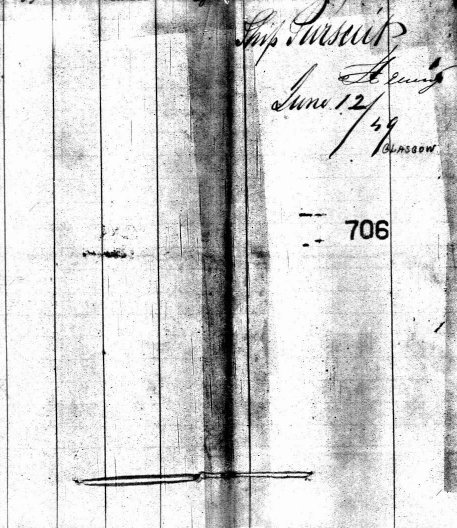
The manifest, filled out by the ship's master Henry Evans, was dated 12 June 1849.

Passenger Lists of Vessels Arriving at New York, New York, 1820-1897. Microfilm Publication M237, 675 rolls. Records of the U.S. Customs Service, Record Group 36. National Archives at Washington, D.C. Year: 1849; Arrival: New York, New York; Microfilm Serial: M237, 1820-1897; Microfilm Roll: Roll 080; List Number: 706. Ancestry.com. New York, Passenger Lists, 1820-1957 [database on-line]. Provo, UT, USA: Ancestry.com Operations, Inc., 2010.

Passenger Lists of Vessels Arriving at New York, New York, 1820-1897. Microfilm Publication M237, 675 rolls. Records of the U.S. Customs Service, Record Group 36. National Archives at Washington, D.C. Year: 1849; Arrival: New York, New York; Microfilm Serial: M237, 1820-1897; Microfilm Roll: Roll 080; List Number: 706. Ancestry.com. New York, Passenger Lists, 1820-1957 [database on-line]. Provo, UT, USA: Ancestry.com Operations, Inc., 2010.

Passenger Lists of Vessels Arriving at New York, New York, 1820-1897. Microfilm Publication M237, 675 rolls. Records of the U.S. Customs Service, Record Group 36. National Archives at Washington, D.C. Year: 1849; Arrival: New York, New York; Microfilm Serial: M237, 1820-1897; Microfilm Roll: Roll 080; List Number: 706. Ancestry.com. New York, Passenger Lists, 1820-1957 [database on-line]. Provo, UT, USA: Ancestry.com Operations, Inc., 2010.

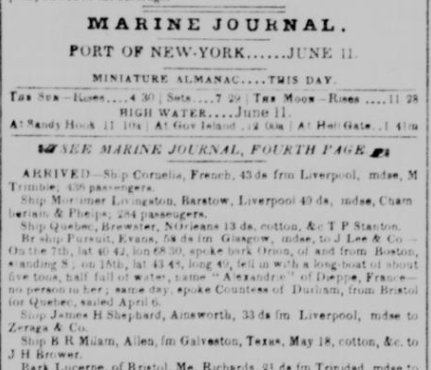
The 11 June 1849 issue of the New York Daily Tribune reported that the Pursuit had arrived from Glasgow. 

New York Daily Tribune, 11 June 1849, page 3. Available from Chronicling America

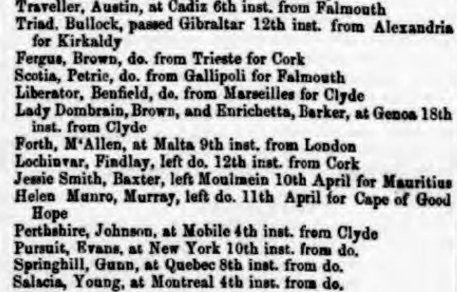
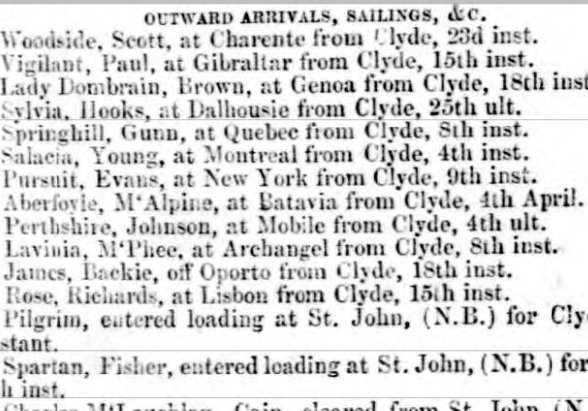
Several British newspapers also reported the ship's arrival.

Caledonia Mercury, 28 June 1849, page 4. Available from British Newspaper Archive. Image © THE BRITISH LIBRARY BOARD. ALL RIGHTS RESERVED.

Greenock Advertiser, 29 June 1849, page 3. Available from British Newspaper Archive. Image © THE BRITISH LIBRARY BOARD. ALL RIGHTS RESERVED.

Liverpool Mail, 30 June 1849, page 7. Available from British Newspaper Archive. Image © THE BRITISH LIBRARY BOARD. ALL RIGHTS RESERVED.

Two of the newspapers reported that the Pursuit had sailed from Clyde. They must have been referring to the River Clyde.

Monday, December 21, 2015

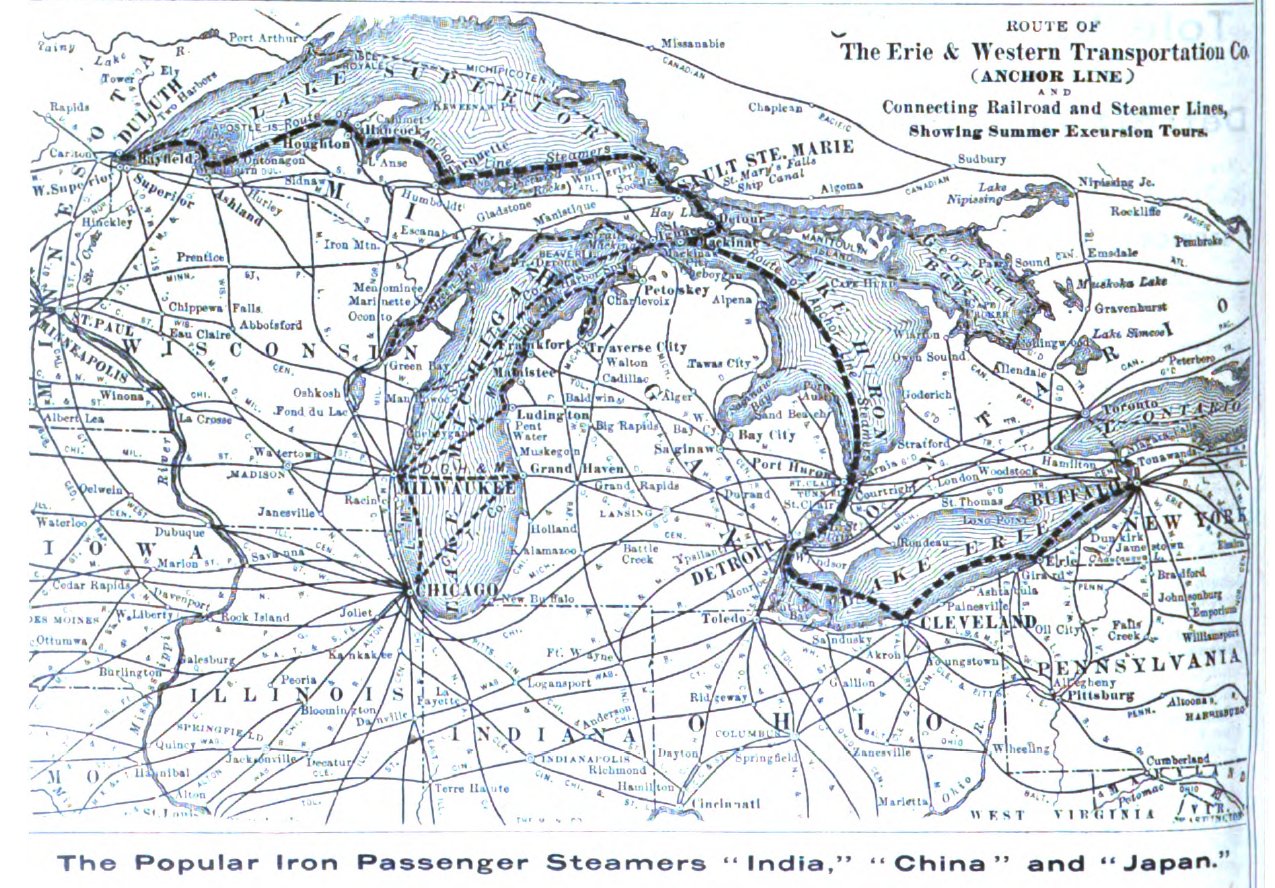
Mappy Monday: Route of the Erie & Western Transportation Co. (Anchor Line)

Route of the Erie & Western Transportation Co. (Anchor Line) and connecting railroad and steamer lines, showing summer excursion tours. Traveler's Official Guide of the Railway and Steam Navigation Lines in the United States, Canada, and Mexico. New York: National Railway Publication Co. 32nd year, no. 10. March 1900. Page 462. Available from Google Books.

This map shows the route of the Erie & Western Transportation Co. (Anchor Line), as well as connecting lines (both railroad and steamer). Passengers could travel from Buffalo, New York; Erie, Pennsylvania; Cleveland, Ohio; and Detroit, Michigan to the summer resorts. They could connect at Mackinac Island and then take steamer lines.

I found this map interesting because it gave me an idea of how my ancestors John and Ann (Walker) Winters and their daughter Elizabeth may have traveled from Tonawanda, New York to Chicago, Illinois.

Tuesday, September 29, 2015

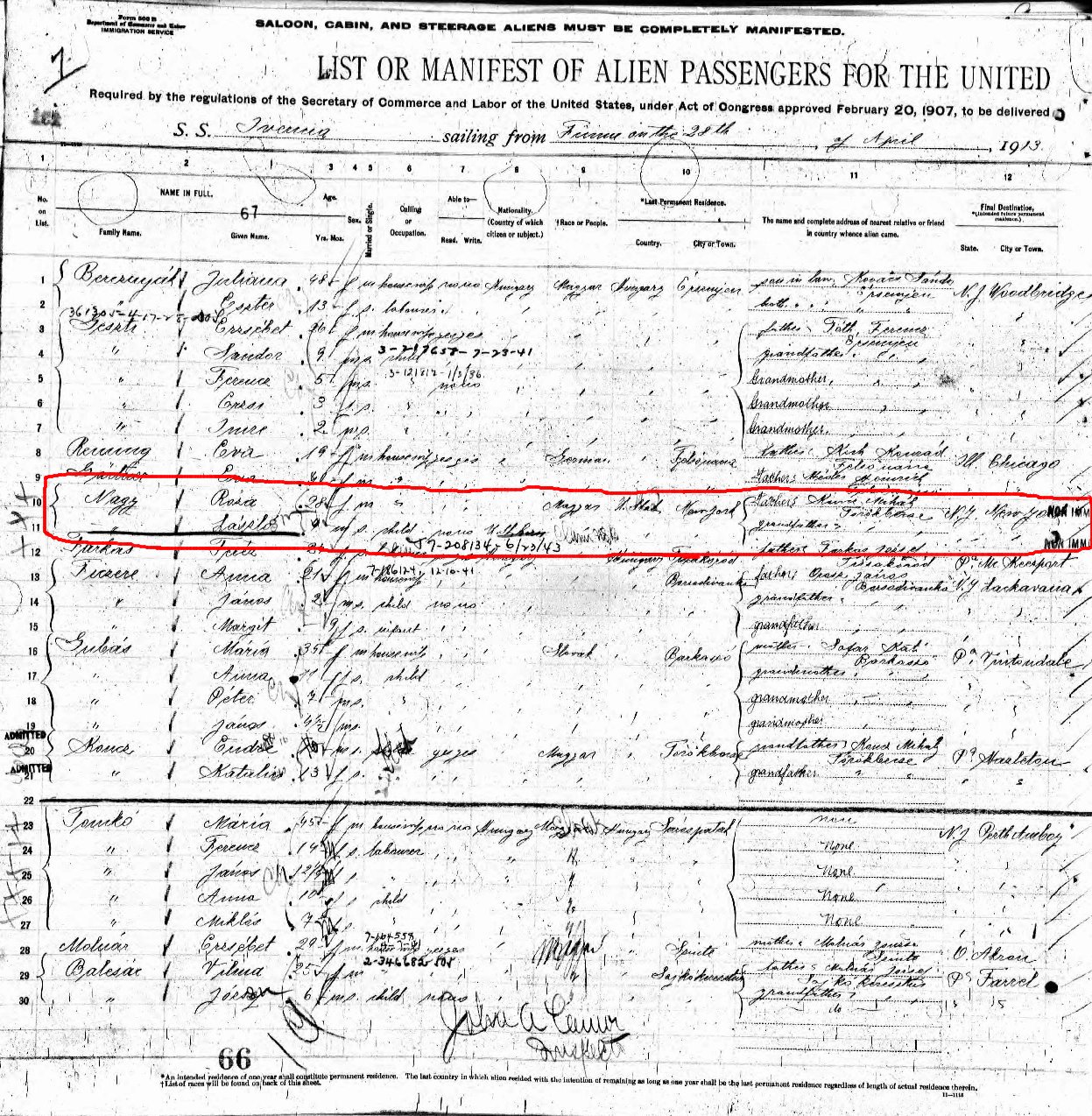
Travel Tuesday: Laszlo and Rosa Nagy's Trip to the Kingdom of Hungary

When he was a young child, my maternal grandmother's sister's husband Laszlo James Nagy and his mother Rosa (Koncz) Nagy traveled to the Kingdom of Hungary to visit family. Laszlo's grandfather (and Rosa's father) was listed as the nearest relative on the passenger manifest for their trip back home to New York. He lived in Törökbecse, Torontál County, Kingdom of Hungary (now Novi Bečej, Central Banat District, Vojvodina, Serbia). They sailed home from Fiume (now Rijeka, Croatia) on the Ivernia and arrived in New York City on 17 May 1913. Laszlo was only four years old.

Ancestry.com. New York, Passenger Lists, 1820-1957 [database on-line]. Provo, UT, USA: Ancestry.com Operations, Inc., 2010.Year: 1913; Arrival, New York, New York; Microfilm Serial: T715, 1897-1957; Microfilm Roll: Roll 2080; Line: 11; Page Number: 132.

Saturday, August 15, 2015

52 Ancestors: Week 33 "Defective, Dependent, and Delinquent": Hugh Winters

My 4th-great-grandfather Hugh Winters was enumerated (as "Winter, Huge") on the list of blind inhabitants in the 1880 United States Census Defective, Dependent and Delinquent schedule.
1880 United States Census, Brooklyn,  Kings County, New York, Defective, Dependent, and Delinquent Classes schedule, Blind Inhabitants, page 586. Ancestry.com. U.S. Federal Census - 1880 Schedules of Defective, Dependent, and Delinquent Classes [database on-line]. Provo, UT, USA: Ancestry.com Operations, Inc., 2010. 
 
Although many additional questions are asked on this schedule, the only ones that were answered were the number and line taken from the population schedule, name, and residence. Based on what I know about Hugh Winters, I will consider what the answers may have been to the unanswered questions.

Is he (or she) self-supporting or partly so?

In the 1880 United States Census, Hugh Winters was enumerated in the household of James and Mary Feenan (son and mother). His occupation was "Laboring." He appears to have been at least partly self-supporting.

1880 United States Census, Brooklyn, Kings County, New York, population schedule, enumeration district 4, page 61C. Ancestry.com. 1880 United States Federal Census [database on-line]. Provo, UT, USA: Ancestry.com Operations Inc, 2010.

Age at which blindness occurred

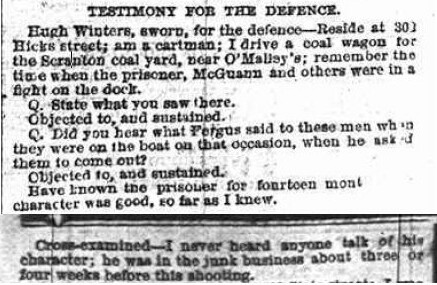
In 1866, Hugh stated that he drove a coal wagon for the Scranton Coal Co. His blindness must have occurred after he made this statement, since no one would hire a blind person to drive a coal wagon.

Brooklyn Daily Eagle, 23 November 1866

Form of blindness
Supposed cause of blindness

There are many reasons that Hugh could have been blind. Some possible explanations are:

Accident - Perhaps Hugh lost his sight in an accident.

Cataracts - According to "Leading Causes of Blindness" (NIH MedlinePlus, Summer 2008) and "Causes of Blindness and Visual Impairment" (World Health Organization), cataracts are the leading cause of visual impairment in the world. Hugh was born about 1810, so he would have been about 70 years old in 1880. At his age, he may have had cataracts.

Diabetic retinopathy - According to "Facts About Diabetic Eye Disease" (National Eye Institute), diabetic retinopathy is one of the leading causes of blindness in adults, and is the most common diabetic eye disease. "Leading Causes of Blindness" states that it is the most common cause of blindness in adults in the United States. Perhaps Hugh was diabetic and the blood vessels in his retina were damaged.

Glaucoma - According to "Glaucoma Facts and Stats" (Glaucoma Research Foundation), older people have a higher risk of glaucoma, and glaucoma can also cause blindness.

Macular degeneration - According to the American Optometric Association, age-related macular degeneration is the leading cause of vision loss in adults over 50 years of age. Hugh may have experienced macular degeneration. If he did, he may not have been able to see objects clearly, and may have experienced partial blindness,

Trachoma - Hugh may have contracted trachoma, a bacterial infection caused by Chlamydia trachomatis. Trachoma is more likely to spread in areas with poor sanitation ("Hygiene-Related Diseases: Trachoma," Centers for Disease Control and Prevention.) "The Condition of Brooklyn's Streets and Houses" (Brooklyn Daily Eagle, 9 May 1885) reports on the poor sanitary conditions in Brooklyn in the 1880s.

Without more information, it is unclear which of these, if any, was the cause of Hugh's blindness.

Is the person totally blind?
Is the person semi-blind?

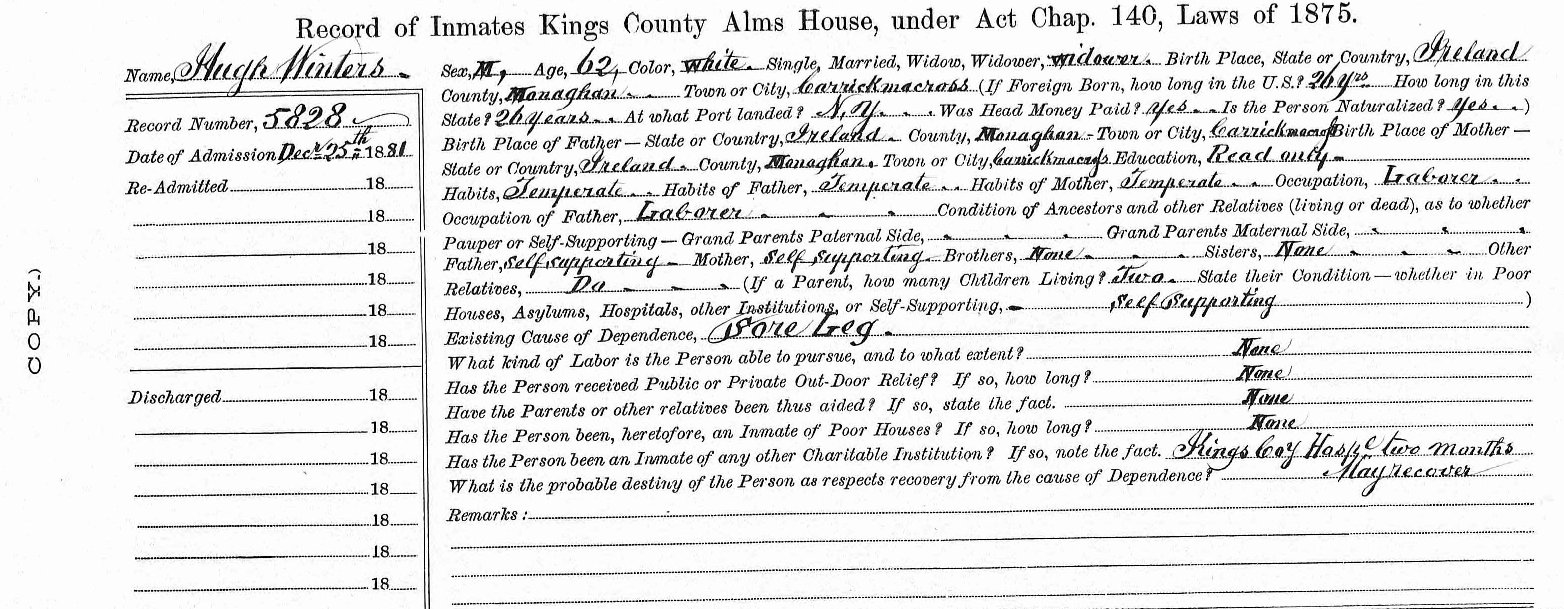
On 25 December 1881, Hugh was admitted to the Kings County Alms House. His admission record indicated that he could read, but not could write. His 1880 U.S. census enumeration had indicated that he could not read or write. No mention of blindness was made on the admission record; his cause of admission was a sore leg. He seems to have been able to work in 1880 in spite of being blind. Perhaps he was semi-blind and could read a little. However, if he could see enough to read, he was not supposed to have been listed on the Defective, Dependent and Delinquent schedule. Perhaps he had been able to read before going blind, so he said he could read. Or perhaps his blindness had been temporary, not permanent.

Admission record, Hugh Winters, Kings County Alms House, 25 December 1881. New York State Archives, Albany, New York. New York State Archives; Albany, New York; Census of Inmates in Almshouses and Poorhouses, 1875-1921; Series: A1978; Reel: A1978:46; Record Number: 5828. Available from Ancestry.com. New York, Census of Inmates in Almshouses and Poorhouses, 1830-1920 [database on-line]. Provo, UT, USA: Ancestry.com Operations, Inc., 2011.

Has this person ever been an inmate of an institution for the blind? If yes, give name of such institution.

On the above admission record, when asked if he had been an inmate of any other charitable institution, Hugh stated that he had been in the Kings County Hospital for two months. He did not mention any institutions for the blind, so the answer to this question appears to have been "No."

Date of his or her discharge

Not applicable.

Is this person also insane?
Is he (or she) also idiotic?
Is he (or she) also a deaf-mute?

Hugh did not appear on the list of Deaf-Mutes, Insane, or Idiots, so the answer to these questions appears to have been "No."