Since today is Tax Day, it seemed an appropriate time to share some tax lists that are freely available.
New River Notes provides information about the Upper New River Valley of Virginia and North Carolina. It includes a 1787 Wilkes County, North Carolina tax list. My 6th-great-grandfather Francis Hardgrave is listed in Captain A. Trible's District, along with his Greer brothers-in-law. There is also a 1797 tax list for Wilkes County, North Carolina. By then, Francis Hardgrave had left Wilkes County. Other tax lists on the site are the 1774 list of tithables for Surry County, North Carolina; 1790 Surry County, North Carolina tax list; 1782 Montgomery County, Virginia land and personal property tax lists; 1802 Tazewell County, Virginia personal property tax list; 1806 Giles County, Virginia personal property tax list; 1810 Patrick County, Virginia personal property tax list; 1815 Ashe County, North Carolina tax list; 1831 Floyd County, Virginia personal property tax list; 1838 Smyth County, Virginia personal property tax lists (there is a separate list for free persons of color); and 1842 Carroll County, Virginia personal property tax list. There are numerous tax lists for Grayson County, Virginia and Washington County, Virginia.
Cape Fear Clans has the following tax lists: 1763 Bladen County, North Carolina tax list; 1755 Cumberland County, North Carolina tax list; 1801 list of taxable property for Captain Watson's district, Robeson County, North Carolina; and the 1825 tax list for Rockfish district, Cumberland County, North Carolina.
The Russell County, Virginia GenWeb has tax lists for Russell, County Virginia.
Images and partial transcriptions of the 1837 and 1838 Smith County, Tennessee tax lists and images of early Upcountry South Carolina tax lists are available at kenshelton.com.
The Sumner County, Tennessee Archives has Sumner County tax lists, 1795-1801. John Mills, the future husband of Francis Hardgrave's daughter Nancy (they married in 1820), was taxed in 1799 and 1800.
These are just a few examples. It's worthwhile to search and see if there are any free tax lists for your areas of interest. Although no one likes paying taxes, the taxpayers left us something useful: records of their residence in a particular place at a particular time, and possibly additional information.

Showing posts with label Greer. Show all posts
Showing posts with label Greer. Show all posts
Friday, April 15, 2016

Tuesday, April 5, 2016
Travel Tuesday: The Wilderness Road and the Cumberland Gap
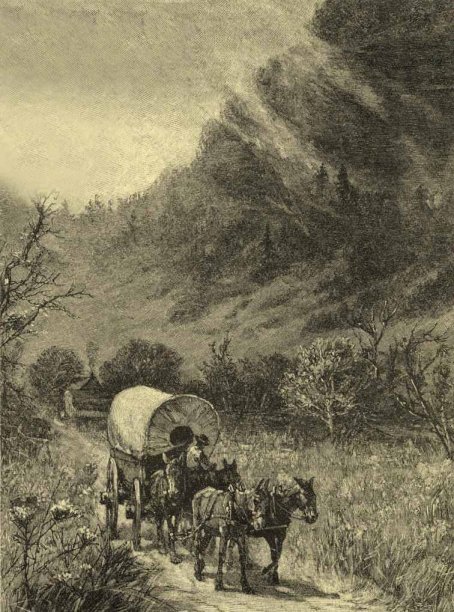
Wilderness Road. Library of Congress. Public domain. Available from Wikimedia Commons.
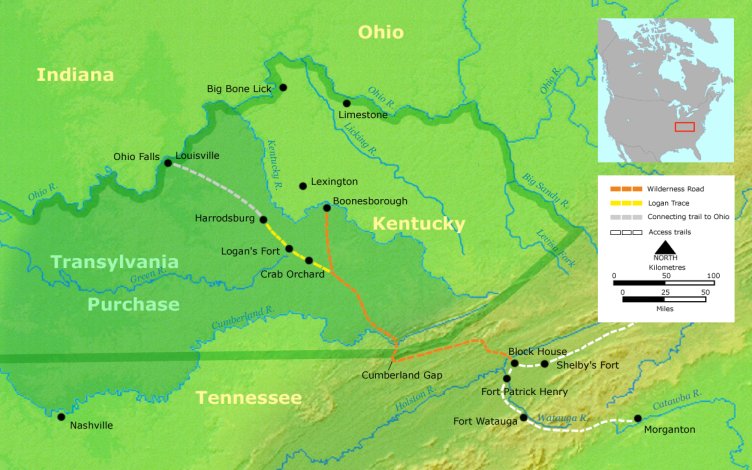
For more than fifty years, people traveled to Kentucky via the Wilderness Road. The road began in Virginia, looped south into Tennessee, and then veered north into Kentucky. The route was 200 miles long.
In 1775, Daniel Boone was hired by the Transylvania Company to widen the path through the Cumberland Gap. In less than a month, he and his company of men cut a trail from Long Island, Tennessee (now Kingsport) to Kentucky.
Travel on the road was dangerous, and most people were armed so that they could protect themselves. Native Americans sometimes attacked travelers. In 1784, more than 100 people were killed on the Kentucky side of the Cumberland Gap.
More than 200,000 settlers passed through the Cumberland Gap. For the first twenty years, the gap was too narrow for wagons to cross. Travelers had to cross by foot or on horses. In 1796, the road was widened by James Knox and Joseph Crockett. Conestoga wagons were then able to cross the Cumberland Gap. The route became officially known as the Wilderness Road. Around that time, my 6th-great-grandparents Francis Hardgrave and Sarah (Greer) Hardgrave and their family (including my 5th-great-grandmother Hannah Hardgrave) traveled from Wilkes County, North Carolina to Lincoln County, Kentucky.
References
Cumberland Gap
Daniel Boone, 30 Woodsmen Blazed Famed 200-Mile Wilderness Road in Spring, 1775
Longfellow, Rickie. Back in Time: The Cumberland Gap
Whitaker, Beverly (2006). The Wilderness Road
Wilderness Road
Thursday, February 4, 2016
Those Places Thursday: Gunpowder River
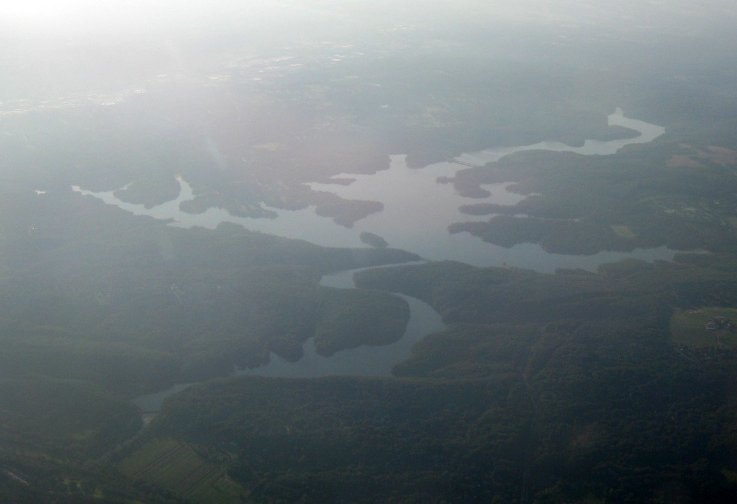
The Gunpowder River is a tidal inlet on the western side of Chesapeake Bay. It is formed by the joining of the Gunpowder Falls (also known as Big Gunpowder Falls) and the Little Gunpowder Falls. It is 6.8 miles long. The Gunpowder River and the Little Gunpowder Falls form the boundary between Baltimore and Harford Counties, Maryland.
My 8th-great-grandparents John Greer and Sarah Day lived by the Great Falls of the Gunpowder River. Their land was surveyed in 1718.
The town of Joppa was located on the Gunpowder River and was an important colonial seaport. Tobacco was the main export.
In 1959, the Gunpowder Falls State Park was established to protect the Gunpowder River and the Big and Little Gunpowder valleys. The park includes trails, a beach, a marina, and areas for fishing, canoeing, and kayaking.
References
Gunpowder Falls State Park
Gunpowder River
Joppatowne, Maryland
Tuesday, August 25, 2015
Founders' Day, the Birthday of the National Park Service
On 25 August 1916, President Woodrow Wilson signed the act that established the National Park Service. Every year on August 25, the National Park Service celebrates Founders Day.
My parents have visited some of the national parks, including Yellowstone National Park and Yosemite National Park.
I took this picture at one of the newest national parks, the Paterson Great Falls National Historical Park.

Some places where my ancestors spent time are now national historical parks. My 5th-great-grandfather Stephen Mayo and his brother Benjamin camped at Valley Forge during the revolutionary War. My 5th-great-grandmother Hannah Hardgrave and her parents, my 6th-great-grandparents Francis Hardgrave and Sarah Greer, passed through the Cumberland Gap when they traveled from Wilkes County, North Carolina to Kentucky.


My parents have visited some of the national parks, including Yellowstone National Park and Yosemite National Park.
I took this picture at one of the newest national parks, the Paterson Great Falls National Historical Park.
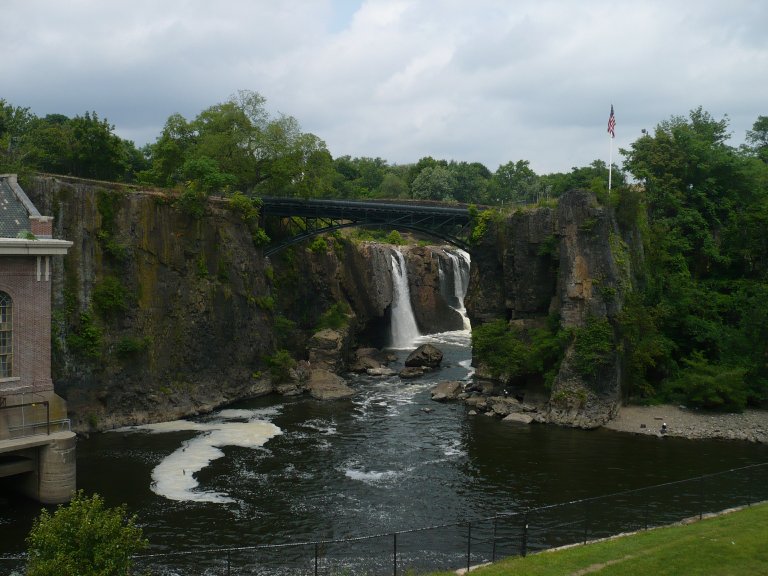
Paterson Great Falls National Historical Park
Some places where my ancestors spent time are now national historical parks. My 5th-great-grandfather Stephen Mayo and his brother Benjamin camped at Valley Forge during the revolutionary War. My 5th-great-grandmother Hannah Hardgrave and her parents, my 6th-great-grandparents Francis Hardgrave and Sarah Greer, passed through the Cumberland Gap when they traveled from Wilkes County, North Carolina to Kentucky.
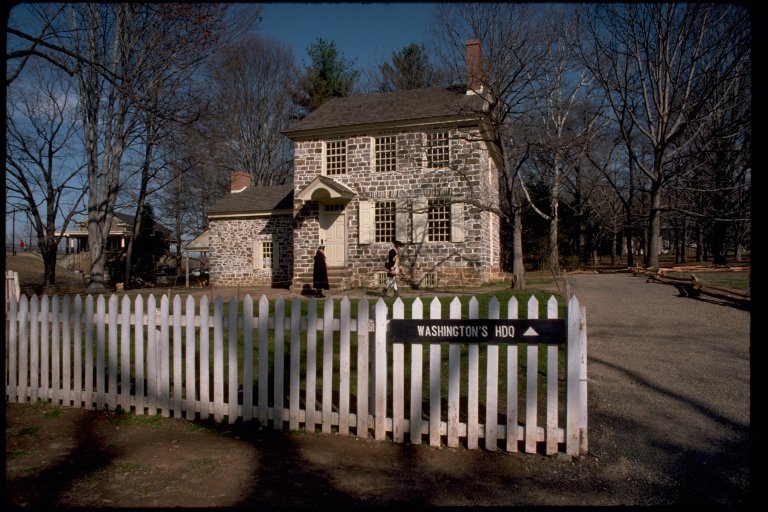
Valley Forge National Historical Park. Photo from the National Park Service.

Cumberland Gap National Historical Park. Photo from the National Park Service.

Chellberg Farm is now part of the Indiana Dunes National Lakeshore. My 2nd-great-grandmother's brother Alfred Borg married Emily Kjellberg, and they lived at Chellberg Farm.
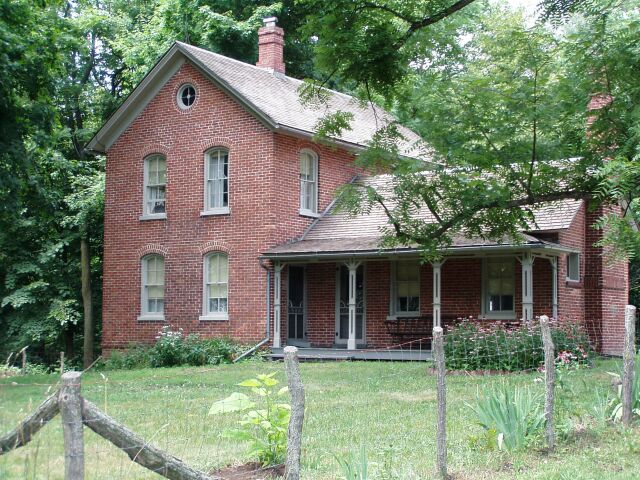
1885 brick house on Chellberg Farm. Photo by Chris Light at en.wikipedia [CC BY-SA 3.0 (http://creativecommons.org/licenses/by-sa/3.0) or GFDL (http://www.gnu.org/copyleft/fdl.html)]. Available from Wikimedia Commons.

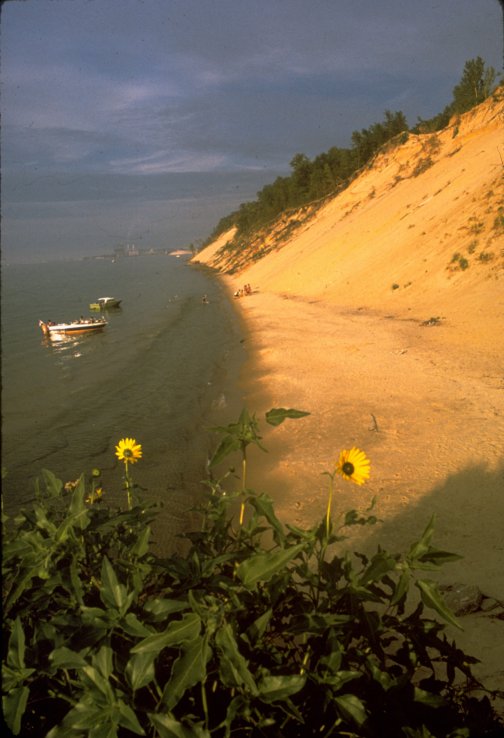
Indiana Dunes National Lakeshore. Photo from the National Park Service.
Wednesday, March 25, 2015
Maryland Day
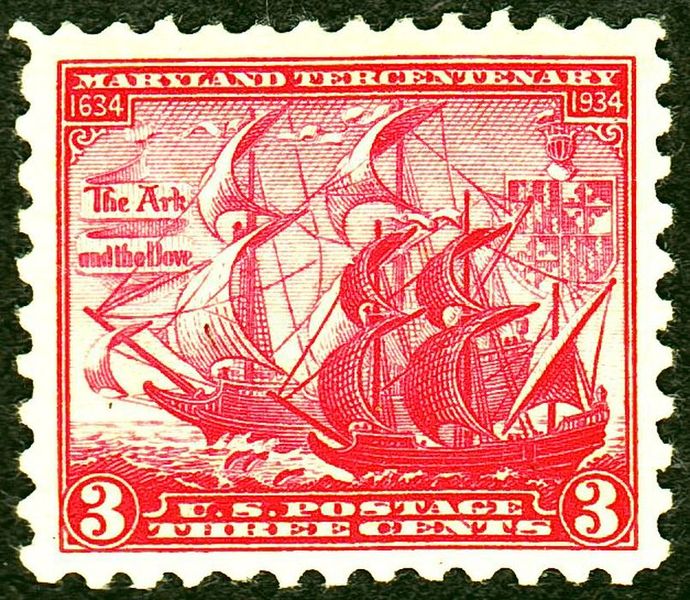
March 25 is Maryland Day. The day commemorates the arrival of the first settlers in Maryland. On 22 March 1634, two ships, the Ark and the Dove, landed at St. Clemens Island (now St. Mary's County).
Maryland Day was first observed in 1903, after the State Board of Education chose March 25 as a day to honor local history. In 1916, the Maryland General Assembly authorized Maryland Day as a legal holiday.
My 9th-great-grandfathers James Greer and Nicholas Day lived in Maryland, in the Gunpowder River area. James Greer's son John (born about 1688) married Nicholas Day's daughter Sarah. They were my 8th-great-grandparents.
References
Maryland at a Glance: Maryland Day - March 25
Maryland Day
Friday, March 13, 2015
Friend of Friends Friday: John Greer's Bequests to His Daughters Ann Mitchell and Hannah Demoss
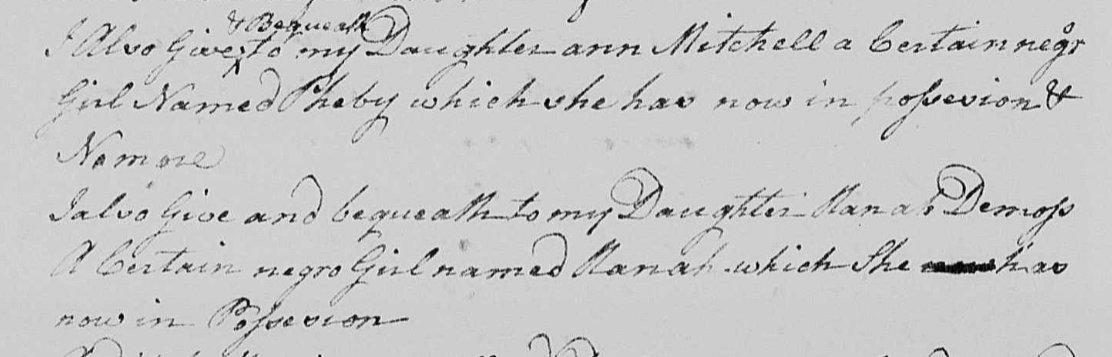
In his will, dated 2 April 1782, my 7th-great-grandfather John Greer included the following bequests to his daughters Ann Mitchell and Hannah Demoss:
I also give & bequeath to my daughter Ann Mitchell a certain negro girl named Pheby which she has now in possession & no more
I also give and bequeath to my daughter Hanah Demoss a certain negro girl named Hanah which she has now in possession
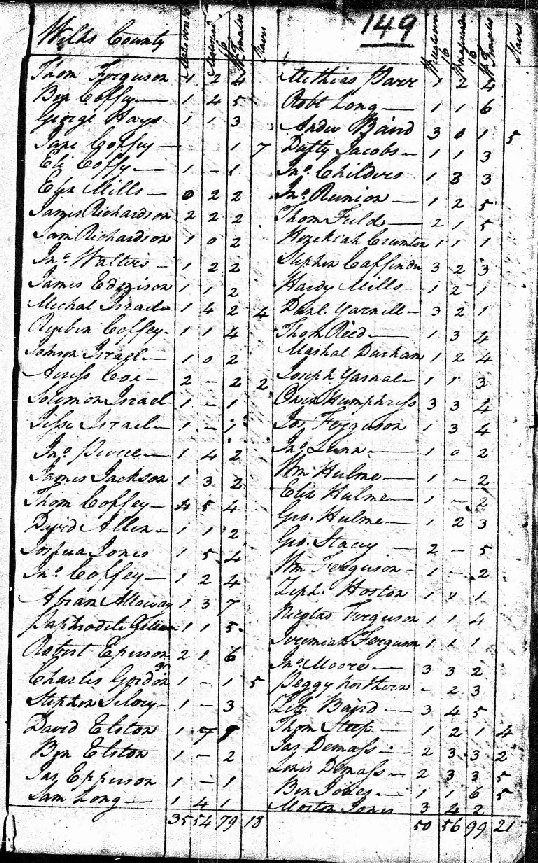
John Greer's daughter Hannah was the wife of Abraham Louis (or Lewis) Demoss (or DeMoss). The 1790 United States census enumeration for Wilkes County, North Carolina shows that the household of Louis Demoss included 5 slaves.
Saturday, November 8, 2014
52 Ancestors: #45 Francis Hardgrave, Revolutionary War Captain and Major
My 6th-great-grandfather Francis Hardgrave was born on 5 March 1745 in Augusta County, Virginia. He was the son of James Hardgrave and Elizabeth Cawley. Francis married Sarah Greer, and the couple moved to Surry County, North Carolina about 1770. They lived near Sarah's father John Greer and other members of the Greer family. Francis was tax assessor for his local tax district in 1777. The area became part of Wilkes County after the county was founded in 1778.
Francis and Sarah had nine children: James (born 12 December 1772), Sarah (born 31 December 1776), Robert (born 17 October 1778), Nancy (born 6 August 1780), my 5th-great-grandmother Hannah (born 22 February 1782), Micajah Lewis (born 1 November 1783), Seeley (born 27 April 1786, died 23 April 1791), John (born 29 October 1787), and Skelton (born 7 May 1792).
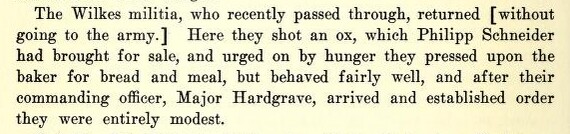
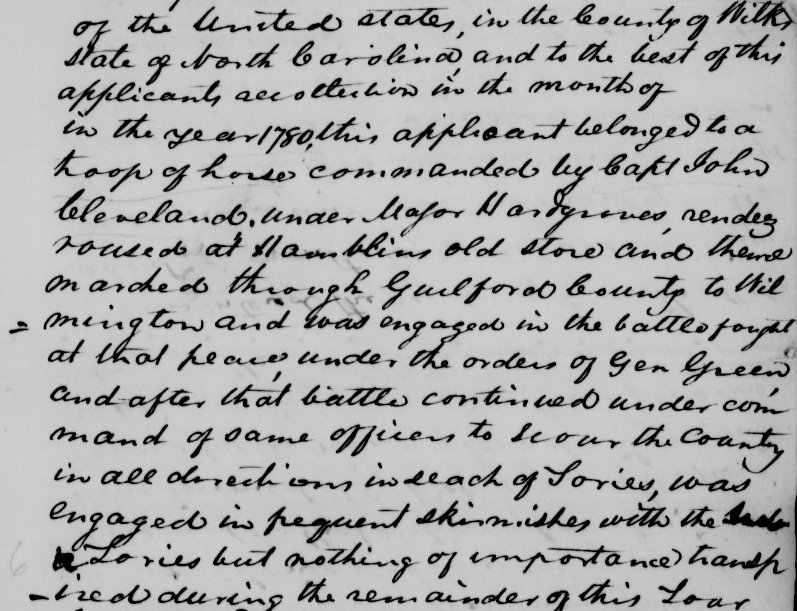
During the American Revolution, Francis was a captain in the Surry County Regiment of Militia in 1776-1777, and was a captain in the Wilkes County Regiment of Militia in 1778-1780. In 1780-1781, he was a major in the Wilkes County Militia, under Col. Benjamin Cleveland. He is known to have participated in the Cherokee Expedition (1 August 1776-1 November 1776) and in the Battle of Hanging Rock (6 August 1780).
Around 1795, Francis and his family moved Lincoln County, Kentucky. In 1799, he moved to Davidson County, Tennessee. His son James and his family also moved to Tennessee and settled in nearby Williamson County. His three daughters remained in Kentucky. His daughter Sarah had married Isaac Lowe in Wilkes County, North Carolina in 1790; they lived in Barren County, Kentucky. Nancy married Archibald Mills in Lincoln County, Kentucky in 1797, and Hannah married Andrew Russell in 1799. Both couples lived in Pulaski County, Kentucky; Nancy and Archibald then moved to Wayne County, Kentucky.
Francis was a member of the Providence Baptist Church in Davidson County, Tennessee. Although he was in his sixties, Francis served in the War of 1812.
Francis' daughters Nancy and Hannah and their families eventually came to Tennessee as well. Nancy, by then a widow, married her husband's brother John Mills in Davidson County, Tennessee in 1820, and they settled in nearby Sumner County, Tennessee. Hannah, who was head of household by 1820, lived near her parents on land that Francis owned.
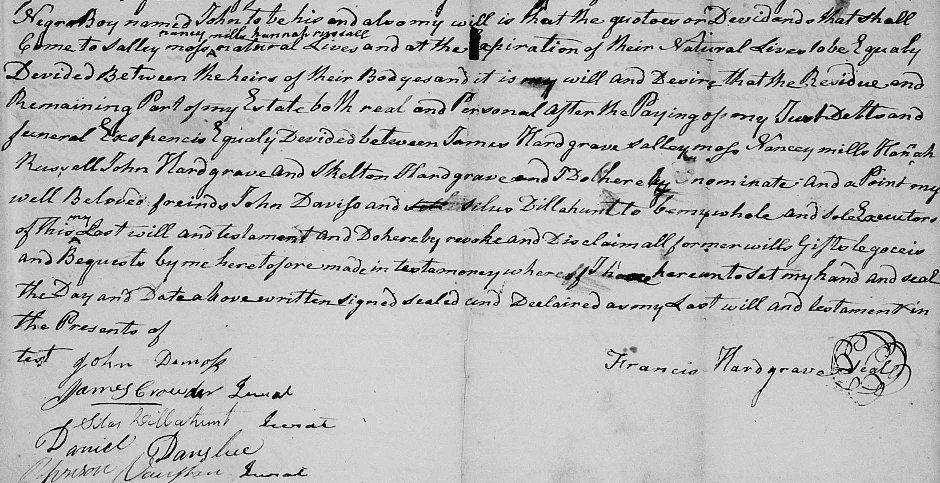
Francis died on 7 August 1828 in Davidson County, Tennessee. He is buried in the Hardgrave Family Cemetery in Williamson County, Tennessee. In his will, he left his daughter Hannah, my 5th-great-grandmother, the land that she was living on, and he stated that after she died, it was to go to her son James Russell. James Russell was Hannah's youngest son, and possibly her youngest child. Hannah appears to have been widowed by 1820, when James was only about three years old. Francis made sure that his young grandson would be provided for. He also specified that after his three daughters died, their shares of the inheritance were to be divided among the heirs of their bodies. He wanted to be sure that the inheritance passed to his daughters' descendants.
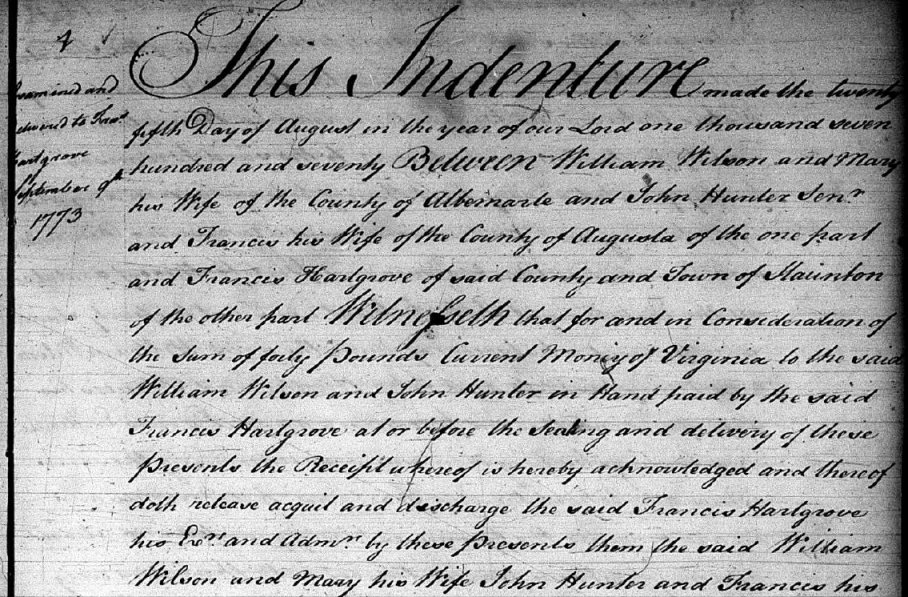
 Deed, 25 August 1770. Augusta County Deed Book 17, 1770-1771. Library of Virginia, microfilm reel 9. Francis Hardgrave sold his land in Staunton, Augusta County, Virginia.
 Fries, Adelaide L., ed. Records of the Moravians in North Carolina. Volume IV: 1780-1783. Raleigh, NC: Edwards & Broughton, 1930. Available from Internet Archive.
 Bennet Tilley pension application file. Case Files of Pension and Bounty-Land Warrant Applications Based on Revolutionary War Service. NARA microfilm publication M804. The National Archives at Washington, D.C. Available from Fold3.
 Will of Francis Hardgrave, Davidson County, Tennessee, Will Book No. 9. Available from FamilySearch.

Francis and Sarah had nine children: James (born 12 December 1772), Sarah (born 31 December 1776), Robert (born 17 October 1778), Nancy (born 6 August 1780), my 5th-great-grandmother Hannah (born 22 February 1782), Micajah Lewis (born 1 November 1783), Seeley (born 27 April 1786, died 23 April 1791), John (born 29 October 1787), and Skelton (born 7 May 1792).
During the American Revolution, Francis was a captain in the Surry County Regiment of Militia in 1776-1777, and was a captain in the Wilkes County Regiment of Militia in 1778-1780. In 1780-1781, he was a major in the Wilkes County Militia, under Col. Benjamin Cleveland. He is known to have participated in the Cherokee Expedition (1 August 1776-1 November 1776) and in the Battle of Hanging Rock (6 August 1780).
Around 1795, Francis and his family moved Lincoln County, Kentucky. In 1799, he moved to Davidson County, Tennessee. His son James and his family also moved to Tennessee and settled in nearby Williamson County. His three daughters remained in Kentucky. His daughter Sarah had married Isaac Lowe in Wilkes County, North Carolina in 1790; they lived in Barren County, Kentucky. Nancy married Archibald Mills in Lincoln County, Kentucky in 1797, and Hannah married Andrew Russell in 1799. Both couples lived in Pulaski County, Kentucky; Nancy and Archibald then moved to Wayne County, Kentucky.
Francis was a member of the Providence Baptist Church in Davidson County, Tennessee. Although he was in his sixties, Francis served in the War of 1812.
Francis' daughters Nancy and Hannah and their families eventually came to Tennessee as well. Nancy, by then a widow, married her husband's brother John Mills in Davidson County, Tennessee in 1820, and they settled in nearby Sumner County, Tennessee. Hannah, who was head of household by 1820, lived near her parents on land that Francis owned.
Francis died on 7 August 1828 in Davidson County, Tennessee. He is buried in the Hardgrave Family Cemetery in Williamson County, Tennessee. In his will, he left his daughter Hannah, my 5th-great-grandmother, the land that she was living on, and he stated that after she died, it was to go to her son James Russell. James Russell was Hannah's youngest son, and possibly her youngest child. Hannah appears to have been widowed by 1820, when James was only about three years old. Francis made sure that his young grandson would be provided for. He also specified that after his three daughters died, their shares of the inheritance were to be divided among the heirs of their bodies. He wanted to be sure that the inheritance passed to his daughters' descendants.
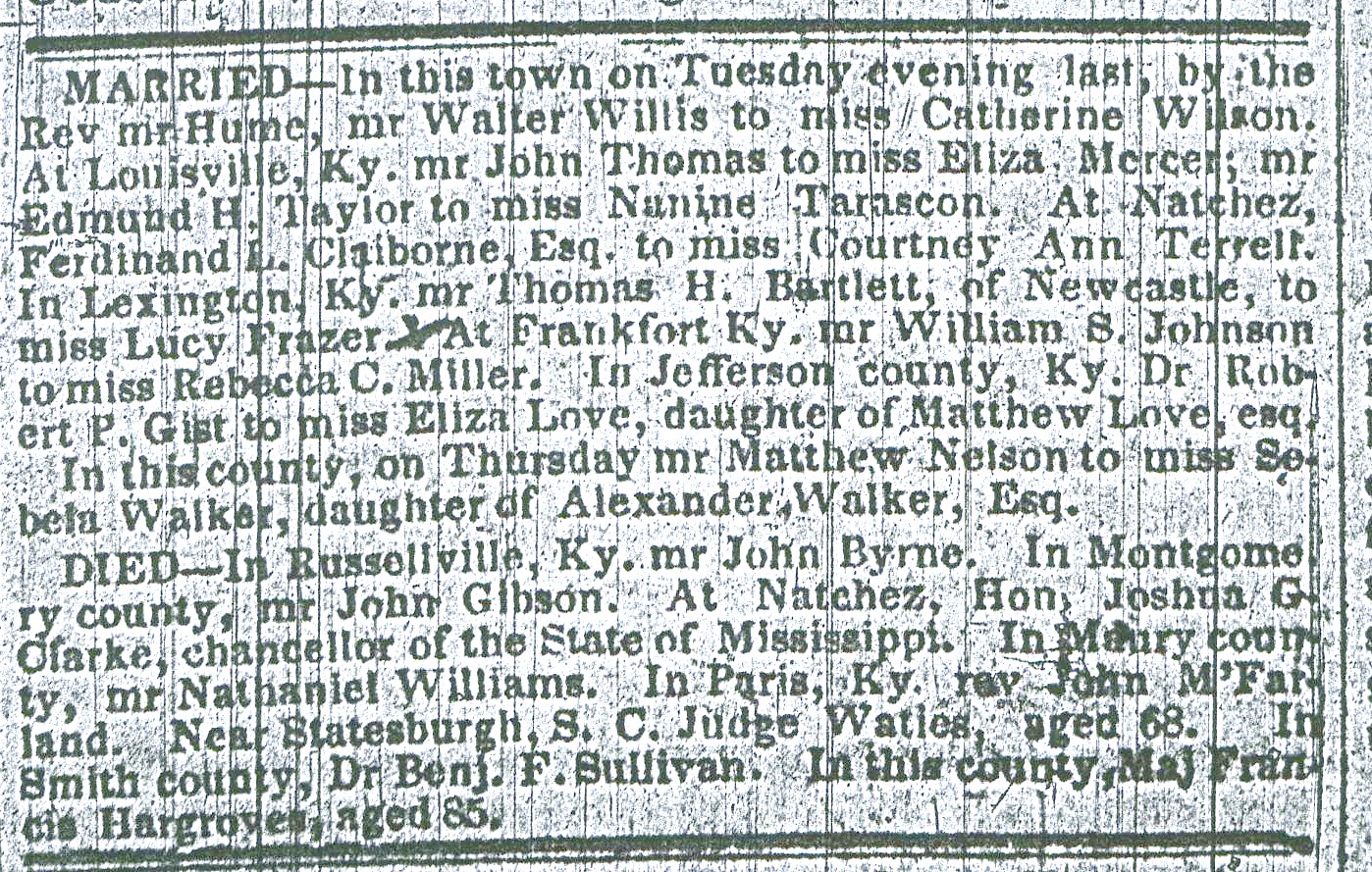
Nashville Banner and Nashville Whig, 9 August 1828
Sunday, August 17, 2014
52 Ancestors: #33 Sarah Greer
Sarah, wife of Francis Hardgrave, was born on 7 February 1751, according to family Bible records. Edythe Rucker Whitley identified her as Sarah Skelton, and the book The History of the Hardgrave Family also states that Francis Hardgrave's wife was Sarah Skelton. Numerous online family trees also refer to Francis Hardgrave's wife as Sarah Skelton. However, she was actually Sarah Greer, daughter of John Greer.
Around 1770, Francis and Sarah Hardgrave moved from Virginia to Surry County, North Carolina; in 1778, the area became part of Wilkes County. They lived near John Greer and other members of the Greer family. John Greer's will mentions Sarah Hardgrave; she was one of the heirs of his estate. She must have been his daughter, since she inherited a portion of his estate along with his other children.
According to the family Bible, Francis and Sarah had the following children: James (born 12 December 1772), Sarah (born 31 December 1776), Robert (born 17 August 1778), Nancy (born 6 August 1780), Hannah (born 22 February 1782), Micajah Lewis (born 1 November 1783), Seeley (born 27 April 1786, died 1791), John (born 29 October 1787), and Skelton (born 7 May 1792).
Skelton is an unusual given name; Edythe Rucker Whitley may have assumed that Skelton Hardgrave was given his mother's maiden name. But he was not the only child in the family who was named Skelton. Hannah Greer, John Greer's daughter and Sarah's sister, named a son Skelton Taylor DeMoss. Sarah's grandson James Russell named a son Skelton. At first I thought that James named his son after his uncle, but then I found out that James' wife Miriam Hill had a brother named Skelton. The name may have come from a family surname, but if so, it must have come from an earlier generation. There is no other evidence that suggests that Sarah's surname was Skelton.
The Hardgrave family moved to Kentucky about 1795, and then to Davidson County, Tennessee around 1799.
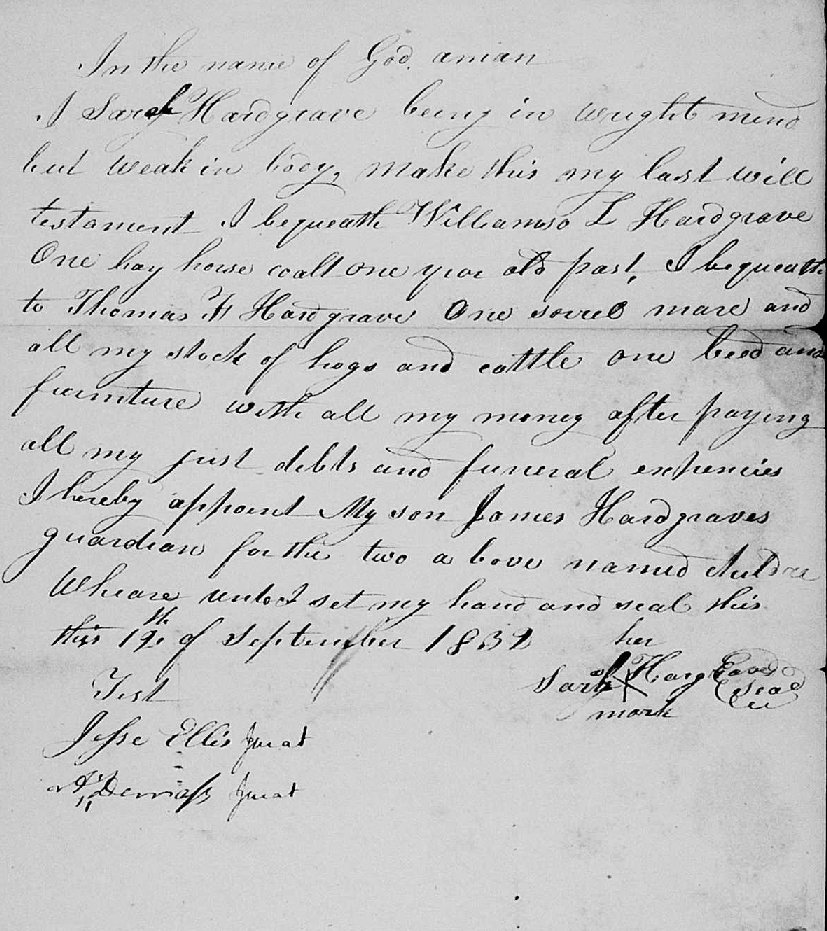
Francis Hardgrave died in 1828, and Sarah was listed as head of household in the 1830 United States census. Sarah died on 30 November 1832.
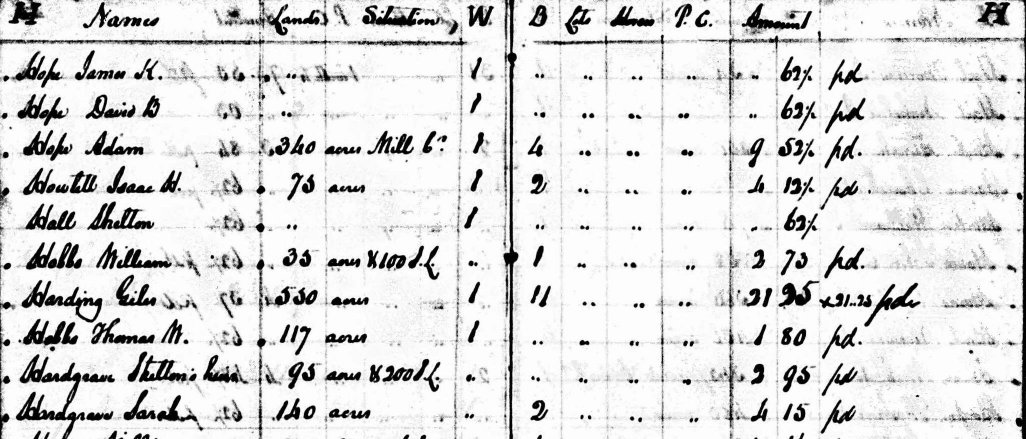
 Davidson County Tennessee tax list, 1929. Tennessee, Early Tax List Records, 1783-1895. Ancestry.com. Original data: Early Tax Lists of Tennessee. Microfilm, 12 rolls. The Tennessee State Library and Archives, Nashville, Tennessee.
 Sarah Hardgrave will. Davidson County, Tennessee. Available from Tennessee, Probate Court Files, 1795-1927 on FamilySearch.
Around 1770, Francis and Sarah Hardgrave moved from Virginia to Surry County, North Carolina; in 1778, the area became part of Wilkes County. They lived near John Greer and other members of the Greer family. John Greer's will mentions Sarah Hardgrave; she was one of the heirs of his estate. She must have been his daughter, since she inherited a portion of his estate along with his other children.
According to the family Bible, Francis and Sarah had the following children: James (born 12 December 1772), Sarah (born 31 December 1776), Robert (born 17 August 1778), Nancy (born 6 August 1780), Hannah (born 22 February 1782), Micajah Lewis (born 1 November 1783), Seeley (born 27 April 1786, died 1791), John (born 29 October 1787), and Skelton (born 7 May 1792).
Skelton is an unusual given name; Edythe Rucker Whitley may have assumed that Skelton Hardgrave was given his mother's maiden name. But he was not the only child in the family who was named Skelton. Hannah Greer, John Greer's daughter and Sarah's sister, named a son Skelton Taylor DeMoss. Sarah's grandson James Russell named a son Skelton. At first I thought that James named his son after his uncle, but then I found out that James' wife Miriam Hill had a brother named Skelton. The name may have come from a family surname, but if so, it must have come from an earlier generation. There is no other evidence that suggests that Sarah's surname was Skelton.
The Hardgrave family moved to Kentucky about 1795, and then to Davidson County, Tennessee around 1799.
Francis Hardgrave died in 1828, and Sarah was listed as head of household in the 1830 United States census. Sarah died on 30 November 1832.
Friday, May 9, 2014
NGS 2014: Day 3
I started off Day 3 of NGS with Craig Roberts Scott's 8:00 session on the Virginia militia. I had not realized that by law, every able-bodied man had to be in the Virginia militia (although some people, such as those who did not believe in fighting, might choose not to show up). At 9:30 I heard A. B. Pruitt speak about land grants in Tennessee. I have many Tennessee ancestors, so this session was very relevant to my research. Ernest Thode's 11:00 session on online historic German newspapers was very relevant for me as well, because I am 1/4 German. Until I learned about this session, I had not realized that these newspapers were available online. It was very exciting news for me! I then attended the International Society for British Genealogy and Family History luncheon, where Michael Leclerc spoke about researching Benjamin Franklin's family. At 2:30 I attended Elizabeth Shown Mills' session "Problem Solving in the Problem-Riddled Carolina Backcountry". She demonstrated how contextual knowledge can help us to analyze the information in documents, and talked about research principles. At 4:00, I attended Patricia O'Brien Shawker's session "Marylanders Migrating South." My Greer ancestors migrated from Maryland to Virginia and then to North Carolina. In the evening, I went to the NGS banquet. It was another long day, but very educational!
Monday, April 7, 2014
Military Monday: 10th Regiment, Tennessee Cavalry, Company D (DeMoss')
Several members of my family were in the Confederate Army's 10th Regiment, Tennessee Cavalry, Company D (DeMoss'). My 3rd-great-grandfather Joseph Tarkington was a private in Company D, but by May-June 1863 he was home on sick leave due to asthma and pneumonia. My 3rd-great-grandfather's brother John G. Gatlin was also a private in Company D; he was captured in December 1863 and was held prisoner at Rock Island Barracks in Rock Island, Illinois. One of the regiment's colonels, William E. DeMoss, was my second cousin 6 times removed. His father, Abraham Louis DeMoss, was the son of Abraham Louis DeMoss and Hannah Greer. Hannah's sister Sarah was my 6th-great-grandmother.
The 10th Regiment, Tennessee Cavalry was organized in February 1863, by consolidating Cox's and Napier's Battalions. The men in Company D were from Davidson County, Tennessee. Some of the regiment participated in the battles of Battle of Thompson's Station, Brentwood, Chickamauga, the Atlanta Campaign, the Battle of Franklin, and the Battle of Nashville. In February 1865, the regiment was consolidated with the 11th Regiment, Tennessee Cavalry. In May 1865, they surrendered in Alabama.
References
Confederate Tennessee Troops. 10th Regiment, Tennessee Cavalry (DeMoss'). http://www.nps.gov/civilwar/search-regiments-detail.htm?regiment_id=CTN0010RC01
Tennesseeans in the Civil War, Confederate Cavalry Units: 10th Tennessee Cavalry Regiment. http://www.tngenweb.org/civilwar/csacav/csa10cav.html
The 10th Regiment, Tennessee Cavalry was organized in February 1863, by consolidating Cox's and Napier's Battalions. The men in Company D were from Davidson County, Tennessee. Some of the regiment participated in the battles of Battle of Thompson's Station, Brentwood, Chickamauga, the Atlanta Campaign, the Battle of Franklin, and the Battle of Nashville. In February 1865, the regiment was consolidated with the 11th Regiment, Tennessee Cavalry. In May 1865, they surrendered in Alabama.
References
Confederate Tennessee Troops. 10th Regiment, Tennessee Cavalry (DeMoss'). http://www.nps.gov/civilwar/search-regiments-detail.htm?regiment_id=CTN0010RC01
Tennesseeans in the Civil War, Confederate Cavalry Units: 10th Tennessee Cavalry Regiment. http://www.tngenweb.org/civilwar/csacav/csa10cav.html
Saturday, March 8, 2014
52 Ancestors: #8 Hannah Hardgrave, A Woman of Strength
March is Women's History Month, so it is a good time for me to write about my female ancestors. My 5th-great-grandmother Hannah Hardgrave seems to have been a strong woman. She was born on 22 February 1782 in Wilkes County, North Carolina, and was the daughter of Francis Hardgrave (a captain and major in the Revolutionary War) and Sarah Greer. Around 1796, the Hardgrave family moved from Wilkes County, North Carolina to Lincoln County, Kentucky. In 1799, Hannah's parents and brothers moved to Tennessee. Hannah and her two sisters remained in Kentucky. Her sister Sarah, who had married Isaac Lowe in Wilkes County, North Carolina on 8 September 1790, was living in Barren County, Kentucky in 1810. Her sister Nancy married Archibald Mills in Lincoln County, Kentucky on 29 January 1797. Hannah married Andrew Russell in Lincoln County, Kentucky on 28 June 1799, and they settled in Pulaski County, Kentucky, which had been created from Green and Lincoln Counties in December 1798. The family appears there in the 1810 United States census, living in the town of Somerset. By 1820 Hannah and her family were living in Davidson County, Tennessee, near her parents Francis and Sarah Hardgrave. She was listed as head of household in the 1820 United States census; she was the head of a large family. Her husband Andrew Russell had probably died. On 7 August 1828, her father Francis Hardgrave died. He left Hannah the land that she was living on, and specified that after her death, it was to go to her son James Russell (her youngest son). Hannah's mother Sarah died on 30 November 1832. By 1840, Hannah was the only one of the children of Francis and Sarah still remaining in Tennessee, and may have been the only one of them that was still living. Her two oldest sons had moved to Kentucky. She was listed as head of household in the 1840 United State census. Again, she headed a large family, which probably consisted of her widowed daughter Malvira Carrington, Malvira's children, her daughter Sobrina (my 4th-great-grandmother), and Sobrina's apparently illegitimate daughter Amanda (my 3rd-great-grandmother). Her youngest son James lived nearby. Hannah could not read and write, and yet she managed, in a male-dominated society, to successfully raise three sons and five or six daughters, and to help raise her grandchildren, including one who appears to have been illegitimate. Sobrina lived with Hannah until Hannah's death; Hannah seems to have been a very supportive mother to her. Although Hannah had help from her father Francis Hardgrave until he died, and her son James Russell probably helped the family too, Hannah still strikes me as a remarkably strong woman for her time.
Hannah died in Davidson County, Tennessee about 1853. Below is her estate inventory.

 Davidson County, Tennessee Will Books Microfilm Reel #433 Volume 16,
Page 332, Hannah Russell Estate Inventory Sale, Tennessee State Library
and Archives.
Davidson County, Tennessee Will Books Microfilm Reel #433 Volume 16,
Page 332, Hannah Russell Estate Inventory Sale, Tennessee State Library
and Archives.
 Davidson County, Tennessee Will Books Microfilm Reel #433 Volume 16,
Page 333, Hannah Russell Estate Inventory Sale, Tennessee State Library
and Archives.
Davidson County, Tennessee Will Books Microfilm Reel #433 Volume 16,
Page 333, Hannah Russell Estate Inventory Sale, Tennessee State Library
and Archives.
Hannah died in Davidson County, Tennessee about 1853. Below is her estate inventory.
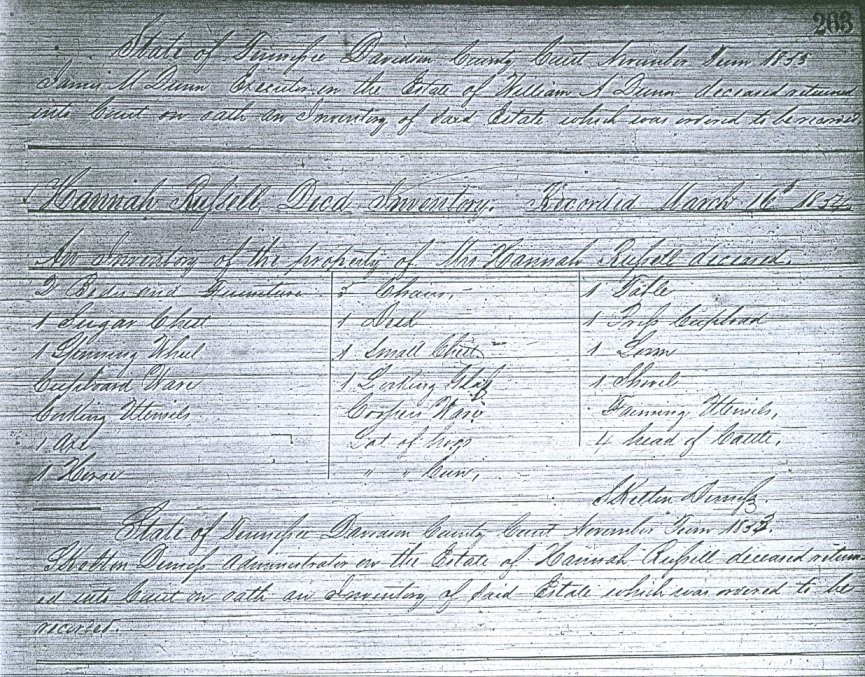
Davidson County, Tennessee Will Books Microfilm Reel #433 Volume 16,
Page 263, Hannah Russell Estate Inventory Dated 16 March 1854,
Tennessee State Library and Archives.
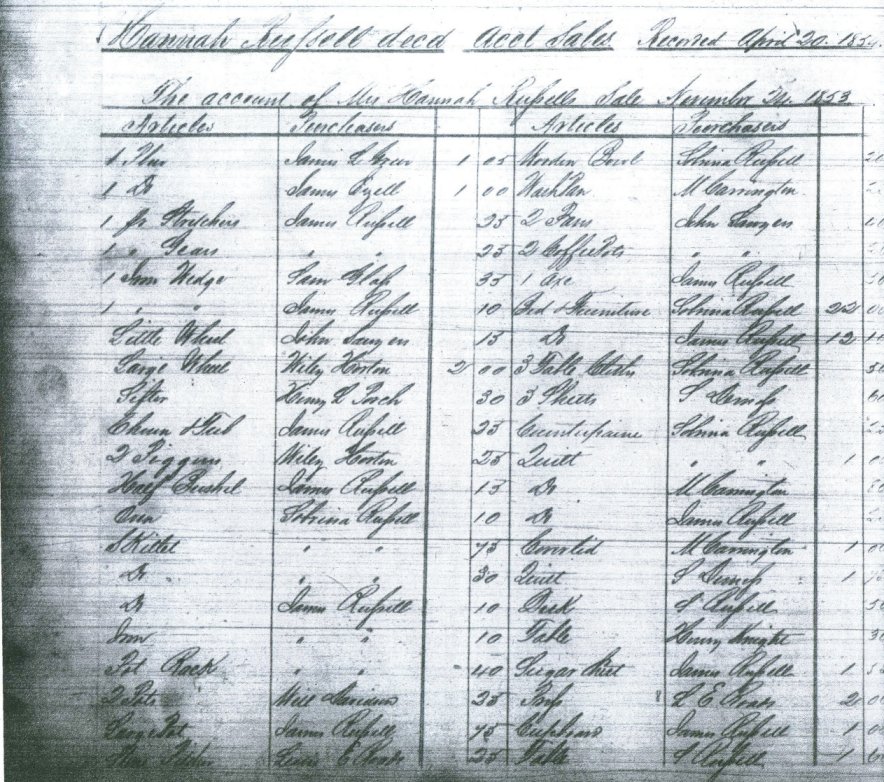
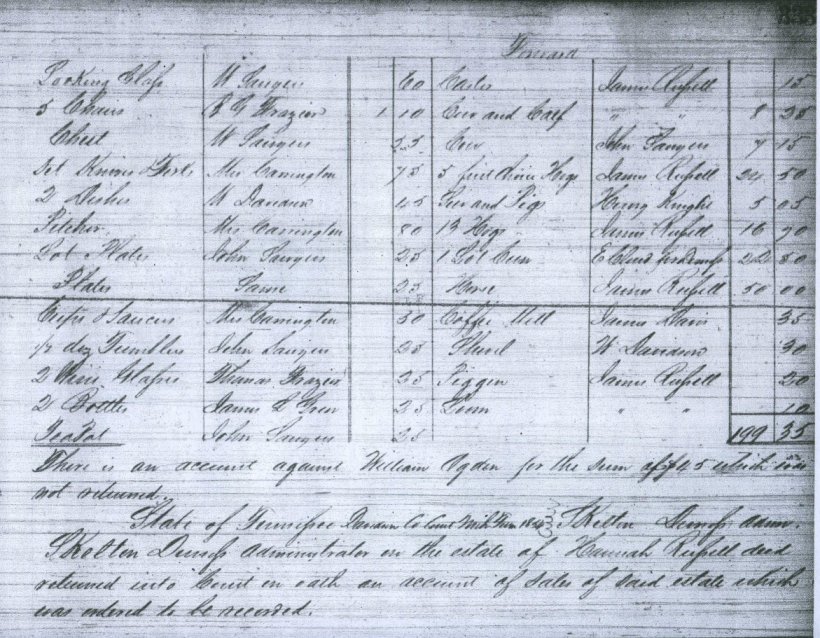
Subscribe to:
Posts (Atom)