Hector's last visit to his family before his duel with Achilles:
Astyanax, on Andromache's knees, stretches to touch his father's helmet.
Apulian red-figure column-crater, ca. 370–360 BC. From Ruvo. Stored in
the Museo Nazionale of the Palazzo Jatta in Ruvo di Puglia (Bari). Jastrow, 2006. Public domain. Wikimedia Commons.
One of the unusual names I have come across in my family tree is Astyanax. In Greek mythology, Astyanax was the son of the Trojan prince Hector and his wife Andromache.
The first Astyanax I have come across is Astyanax Mills, the son of Archibald Ewing Mills and Nancy Hardgrave (sister of my 5th-great-grandmother Hannah Hardgrave.) He was born in Kentucky and was a child when his father died around 1814. He may have died young. However, the name continued in the family.
Astyanax Mills Douglass (10 September 1838 - 1 March 1908) was the son of James S. Douglass and Caroline Mills (half-sister/half-first cousin of Astyanax Mills; daughter of Nancy Hardgrave and her second husband John F. Mills, the half-brother of Archibald Ewing Mills.) He was a physician, Confederate officer, and Texas state representative. He was born and raised in Sumner County, Tennessee. He studied medicine in Nashville and earned his medical degree in 1861. He served in Company I of the Sixth Mississippi Infantry Regiment and was promoted to 2nd Lieutenant after the Battle of Shiloh. After he was wounded in 1862, he went to Bowling Green, Kentucky and served as assistant surgeon. He returned to the Sixth Mississippi Infantry Regiment in 1863. After the war, he returned to Sumner County, Tennessee and practiced medicine, then moved to Covington, Hill County, Texas. He served in the Texas State Legislature from 13 January 1874-18 April 1876; 18 April 1876-14 January 1879; and 14 January 1879-11 January 1881, and served in the Texas State Senate from 10 January 1893-10 January 1895 and 13 January 1903-10 January 1905. He was chairman of the Texas State Board of Health and president of the Medical and Surgical Association of Hill County, the Medical Examining Board of the Eighteenth Judicial District, and the Confederate Veterans and Old Settlers Association of Hill County. He was profiled on the blog The Strangest Names in American Political History.
Astyanax Mills Douglass had a son, Astyanax Saunders Douglass (24 September 1871-27 April 1897), who had a son also named Astyanax Saunders Douglass (19 September 1897-26 January 1975.) This Astyanax was a Major League Baseball catcher. He played for the Cincinnati Reds in 1921 and 1925. He was a veteran of World War I. He was a coach at Amarillo High School in Amarillo, Texas, and named the team the Golden Sandstorms. He later founded Furniture Warehouse Stores of El Paso, Texas.
Elizabeth L. Mills, daughter of John F. Mills and his first wife Frances Thurmond, and stepsister/half-first cousin of Astyanax Mills, had a son named Astyanax Mills Duncan (6 February 1833-5 September 1921). He lived in and near Sumner County, Tennessee.
The name Astyanax was also used as a middle name in the family. Ann Hardgrave Mills, the daughter of Nancy Hardgrave and John F. Mills, had a son named Dero Astyanax Saunders (13 June 1858-28 June 1913). He lived in Mississippi. He had a son who was also named Dero Astyanax Saunders (9 March 1900-15 October 1961), who fathered a third Dero Astyanax Saunders (13 September 1931-15 March 1969.)
References
Bork, June, comp. Wayne County, Kentucky Deed Book B (1811-1818). San Diego, CA: June Bork, 1993. Deed abstracts: Joel Coffey & Patsy his wife to the heirs of Arch. E. Mills, dec'd, 24 Nov 1814; Joshua Jones Sr. & Hannah his wife to Nancy Mills, widow of Archibald Mills, et al., 9 Mar 1816.
Miller, Aragorn Storm. Douglass, Astyanax M. Handbook of Texas Online. Texas State Historical Association.
A. M. Douglass. Texas Legislators: Past and Present. Legislative Reference Library of Texas.
Find A Grave, Astyanax S Douglass
Astyanax Douglass - Wikipedia
Astyanax Douglass. Baseball Reference.
Astyanax Douglass - "A Horned Frog Makes Good"
Death notice, A. S. Douglass. El Paso Herald-Post, 27 Jan 1975, p. C-7.
"Concerning Names." El Paso Herald-Post, 1 Feb 1975, p. B-1.
Find A Grave, Astynas Mills Duncan
Find A Grave, Dero Astyanax Saunders
Find A Grave, Dero Astanyax Saunders
Find A Grave, Dero Astyanax Saunders, Jr.
Covering genealogy, family history, historical events and places, and anything else related!
Showing posts with label Kentucky. Show all posts
Tuesday, January 22, 2019
Friday, December 2, 2016
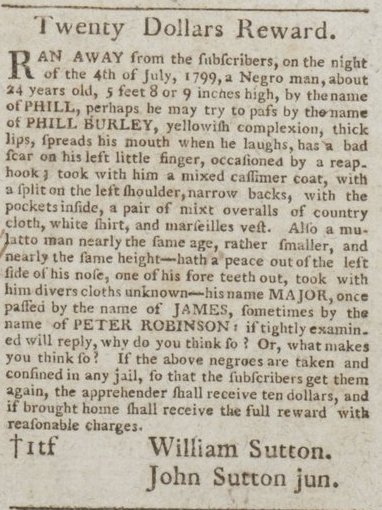
Friend of Friends Friday: Runaway Slaves of William and John Sutton
Kentucky Gazette, 1 August 1799, page 6. Kentucky Digital Library.
Twenty Dollars Reward.
RAN AWAY from the subscribers, on the night of the 4th of July, 1799, a Negro man, about 24 years old, 5 feet 8 or 9 inches high, by the name of PHILL, perhaps he may try to pass by the name of PHILL BURLEY, yellowish complexion, thick lips, spreads his mouth when he laughs, has a bad scar on his left little finger, occasioned by a reap-hook ; took with him a mixed cassimer coat, with a split on the left shoulder, narrow backs, with the pockets inside, a pair of mixt overalls of country cloth, white shirt, and marseilles vest. Also a mulatto man nearly the same age, rather smaller, and nearly the same height––hath a peace out of the left side of his nose, one of his fore teeth out, took with him divers cloths unknown––his name MAJOR, once passed by the name of JAMES, sometimes by the name of PETER ROBINSON : if tightly examined will reply, why do you think so ? Or, what makes you think so? If the above negroes are taken and confined in any jail, so that the subscribers get them again, the apprehender shall receive ten dollars, and if brought home shall receive the full reward with reasonable charges.William Sutton
John Sutton jr.
Monday, October 17, 2016
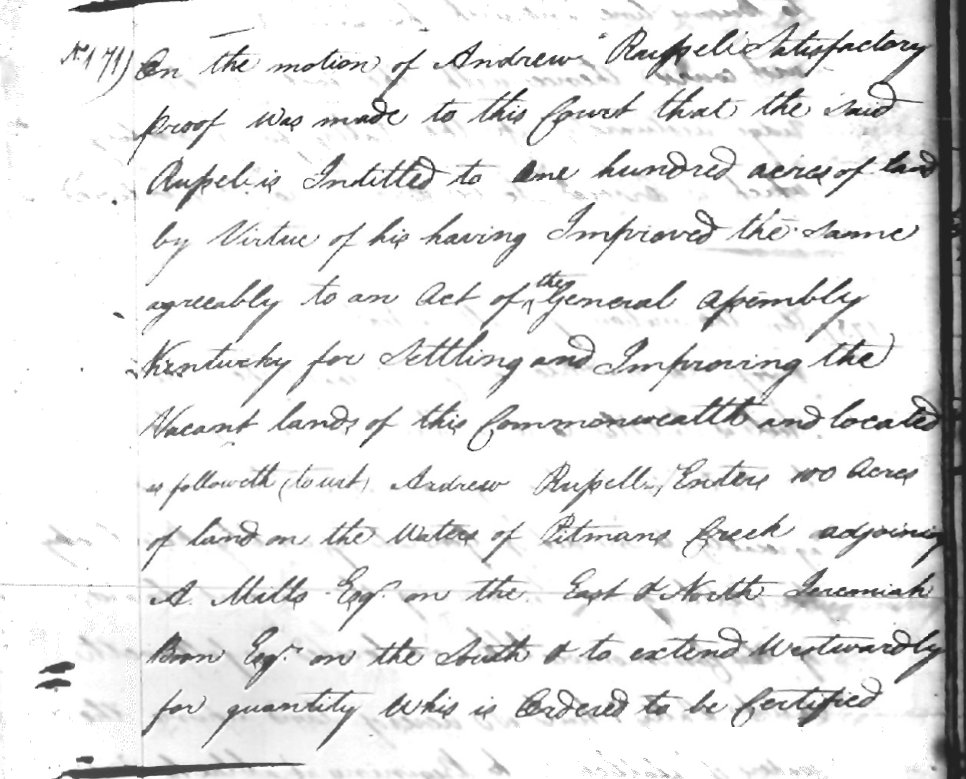
Amanuensis Monday: Andrew Russell Enters 100 Acres of Land on Pitmans Creek, Pulaski County, Kentucky
Pulaski County, Kentucky. Court Orders, Vol. 1, 1799-1803. No. 171, Andrew Russell, 24 June 1801. Salt Lake City, Utah: Filmed by the Genealogical Society of Utah, 1969. Microfilm 804646.
N. 171) On the motion of Andrew Russell Satisfactory proof was made to this Court that the said Russell is Intitled to one hundred acres of land by Virtue of his having Improved the same agreeably to an act of the General assembly Kentucky for Settling and Improving the Vacant lands of this Commonwealth and located as followeth (to wit) Andrew Russell, Enters 100 acres of land on the waters of Pitmans Creek adjoining A Mills Esq on the East & North Jeremiah Boon Esq on the South & to extend westwardly for quantity whis is Ordered to be Certified
Saturday, September 10, 2016
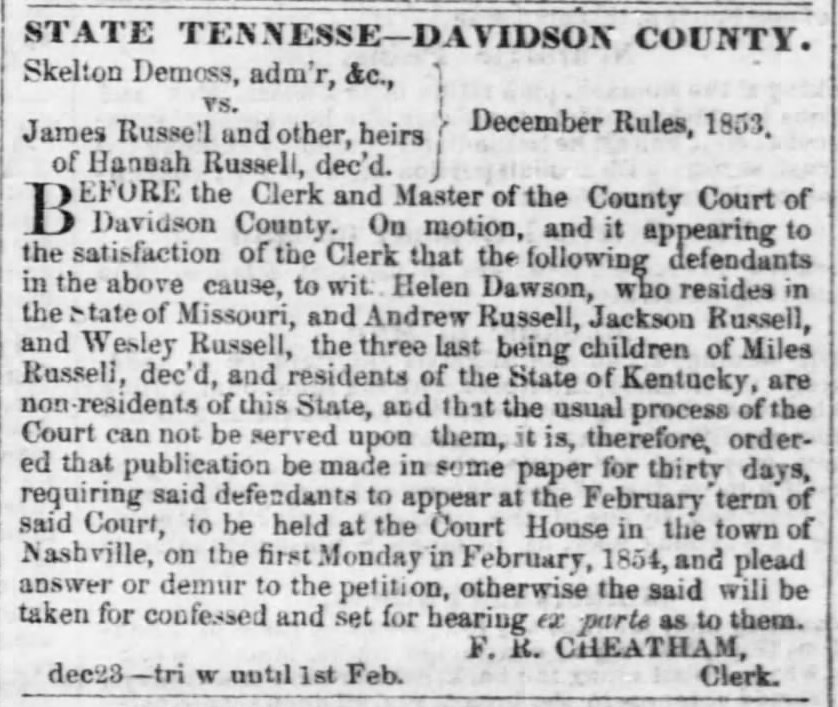
Sympathy Saturday: Non-Resident Heirs of Hannah (Hardgrave) Russell
Nashville Union and American, 22 December 1853, page 2
My 5th-great-grandmother Hannah (Hardgrave) Russell died in 1853. Skelton Demoss was the administrator of her estate. Some of her heirs were not residents of Tennessee, so they could not be served by the County Court of Davidson County, Tennessee. Her daughter Helen (Russell) Dawson was living in Missouri. Her son Mills Russell (incorrectly listed as Miles in the notice) had died in 1852, but he had three sons in Livingston County, Kentucky: Andrew Russell, John D. Russell, and Wesley Russell.
A notice was published in the Nashville Union and American, beginning on 22 December 1853 (the beginning date given at the bottom of the notice is December 23, but the newspaper issue that the notice appears in is dated December 22). The last notice was published on 9 February 1854. Mills Russell's sons and Helen Dawson were asked to appear at the courthouse in Nashville on the first Monday in February 1854 (6 February 1854).
Tuesday, August 30, 2016
Travel Tuesday: Wilderness Road Completed
Kentucky Gazette, 29 October 1796, page 5. Kentucky Digital Library.
In 1796, the Kentucky Gazette published a notice that the Wilderness Road had been completed:
THE WILDERNESS ROAD From the Cumberland Gap to the settlements in Kentucky, is now compleated. Waggons loaded with a ton weight, may pass with ease, with four good horses. –– Travellers will find no difficulty in procuring such necessaries as they may stand in need of on the road ; and the abundant crop now growing in Kentucky, will afford the emigrants a certainty of being supplied with every necessary of life on the most reasonable terms.
Joseph Crockett, } Commissioners
James Knox }
The Printers in the different States are requested to re-publish this notice.
Monday, August 29, 2016
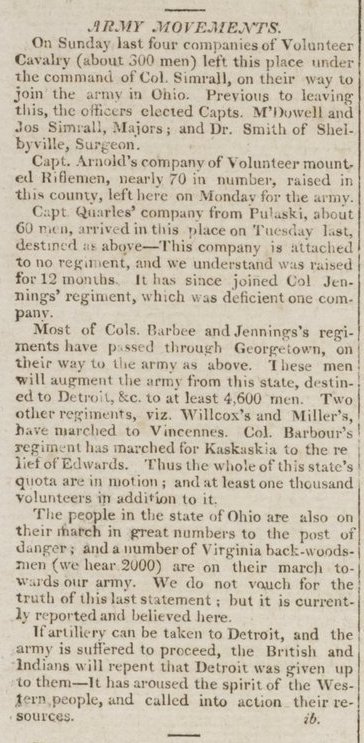
Military Monday: Kentucky in the War of 1812
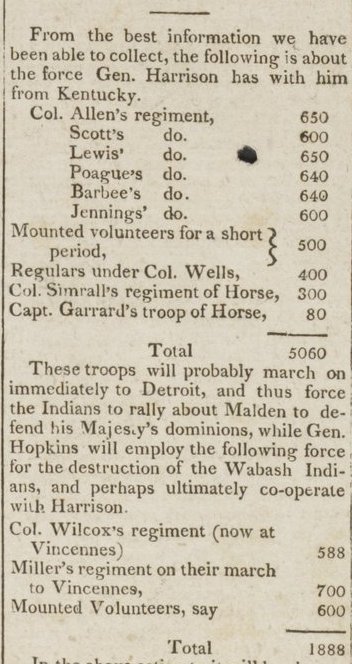
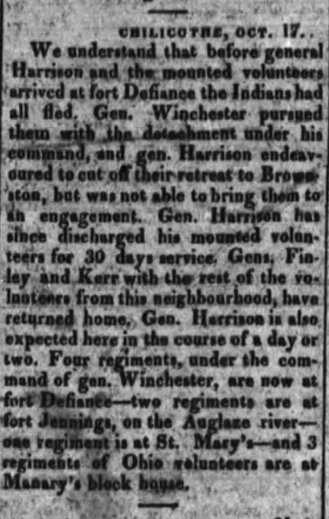
During the War of 1812, my 5th-great-grandfather Andrew Russell was a private in Tunstall Quarles' Company of Infantry, 2nd Regiment Kentucky Volunteer Militia. Although he is not mentioned by name in the clippings below, they provide more information about his experiences.
Captain Quarles' regiment is specifically mentioned in this report of army movements.
Andrew was one of the 600 men in Col. Jennings' regiment.
Andrew's regiment built Fort Jennings.
Kentucky Gazette, 8 September 1812, page 3. Kentucky Digital Library.
Captain Quarles' regiment is specifically mentioned in this report of army movements.
Kentucky Gazette, 15 September 1812, page 13. Kentucky Digital Library.
Andrew was one of the 600 men in Col. Jennings' regiment.
Hornets' Nest (Murfreesboro, NC), 5 November 1812, page 2
Andrew's regiment built Fort Jennings.
Friday, August 5, 2016
Friend of Friends Friday: Aron, Slave of Herbert G. Waggener
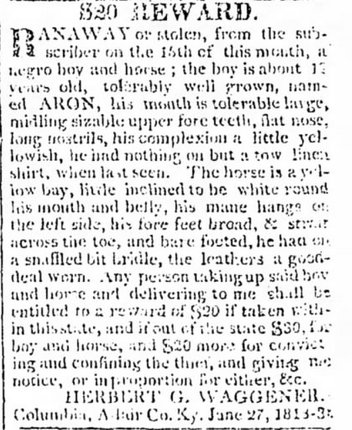
Nashville Whig, 4 July 1818, page 4
$20 REWARD.
RANAWAY or stolen, from the subscriber on the 15th of this month, a negro boy and horse ; the boy is about 17 years old, tolerably well grown, named ARON, his mouth is tolerable large, midling sizeable upper fore teeth, flat nose, long nostrils, his complexion a little yellowish, he had nothing on but a tow linen shirt, when last seen. The horse is a yellow bay, little inclined to be white round his mouth and belly, his mane hangs on the left side, his fore feet broad, & s[?] across the toe, and bare footed, he had on a snaffled bit bridle, the leathers a good deal worn. Any person taking up said boy and horse and delivering tho me shall be entitled to a reward of $20 if taken within this state, and if out of the state $30, for boy and horse, and $20 more for convicting and confining the thief, and giving me notice, or in proportion for either, &c.HERBERT G. WAGGENER
Columbia, Adair Co., Ky. June 27, 1818-3t
Herbert G. Waggener was a Baptist preacher. The Herbert Green Waggener Timeline provides more information on him and his slaves.
Tuesday, August 2, 2016
Travel Tuesday: Annie Gatlin and Ida (Gatlin) Andrews' Trip to Bowling Green, Kentucky
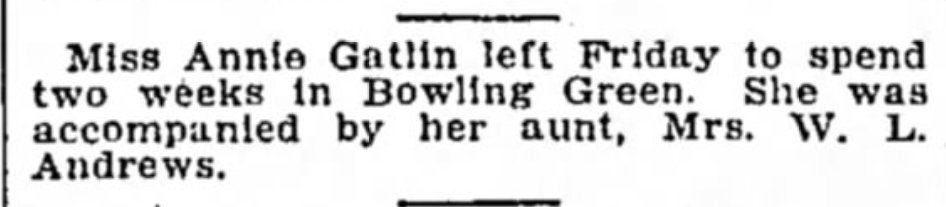
Nashville American, 22 August 1909, page 14
On 20 August 1909, my first cousin three times removed Annie Lee Gatlin and her aunt, my 2nd-great-grandfather's sister Ida Lee (Gatlin) Andrews, left Nashville and went to Bowling Green, Kentucky. They spent two weeks there. They were probably visiting my 2nd-great-grandfather's sister Lillie May (Gatlin) Bailey and her daughter Mary Elizabeth Bailey. Although Lillie and Mary were living in Nashville in 1910, they had lived in Bowling Green at least from 1899-1903, and they had returned to Bowling Green by 1912.
Tuesday, April 5, 2016
Travel Tuesday: The Wilderness Road and the Cumberland Gap
Wilderness Road. Library of Congress. Public domain. Available from Wikimedia Commons.
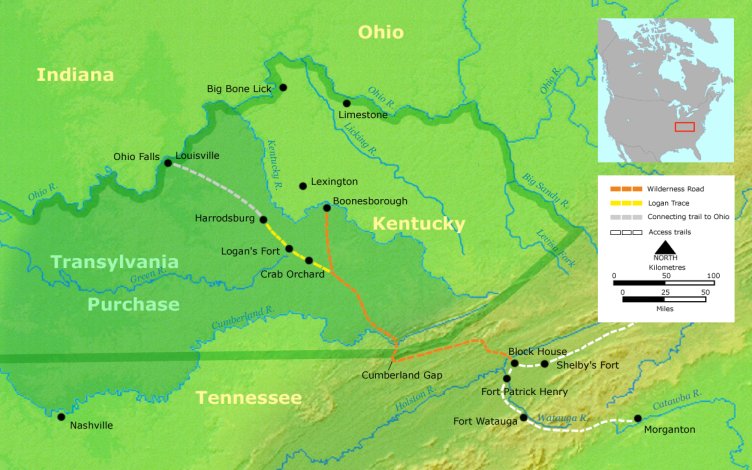
For more than fifty years, people traveled to Kentucky via the Wilderness Road. The road began in Virginia, looped south into Tennessee, and then veered north into Kentucky. The route was 200 miles long.
In 1775, Daniel Boone was hired by the Transylvania Company to widen the path through the Cumberland Gap. In less than a month, he and his company of men cut a trail from Long Island, Tennessee (now Kingsport) to Kentucky.
Travel on the road was dangerous, and most people were armed so that they could protect themselves. Native Americans sometimes attacked travelers. In 1784, more than 100 people were killed on the Kentucky side of the Cumberland Gap.
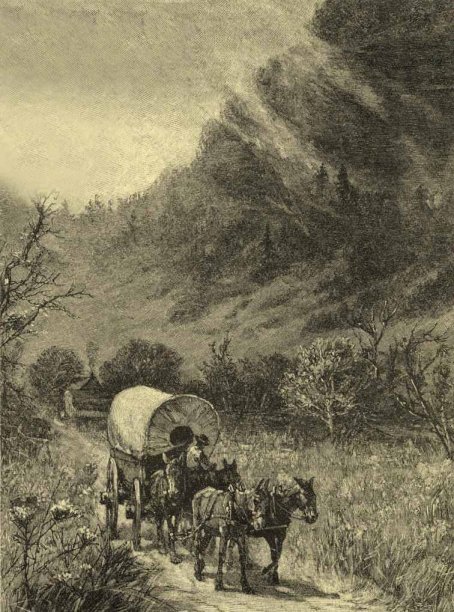
More than 200,000 settlers passed through the Cumberland Gap. For the first twenty years, the gap was too narrow for wagons to cross. Travelers had to cross by foot or on horses. In 1796, the road was widened by James Knox and Joseph Crockett. Conestoga wagons were then able to cross the Cumberland Gap. The route became officially known as the Wilderness Road. Around that time, my 6th-great-grandparents Francis Hardgrave and Sarah (Greer) Hardgrave and their family (including my 5th-great-grandmother Hannah Hardgrave) traveled from Wilkes County, North Carolina to Lincoln County, Kentucky.
Course of the Wilderness Road. Nikater. Background map by Demis. Public domain. Available from Wikimedia Commons.
References
Cumberland Gap
Daniel Boone, 30 Woodsmen Blazed Famed 200-Mile Wilderness Road in Spring, 1775
Longfellow, Rickie. Back in Time: The Cumberland Gap
Whitaker, Beverly (2006). The Wilderness Road
Wilderness Road
Wednesday, February 3, 2016
Wednesday's Child: Travis Russell
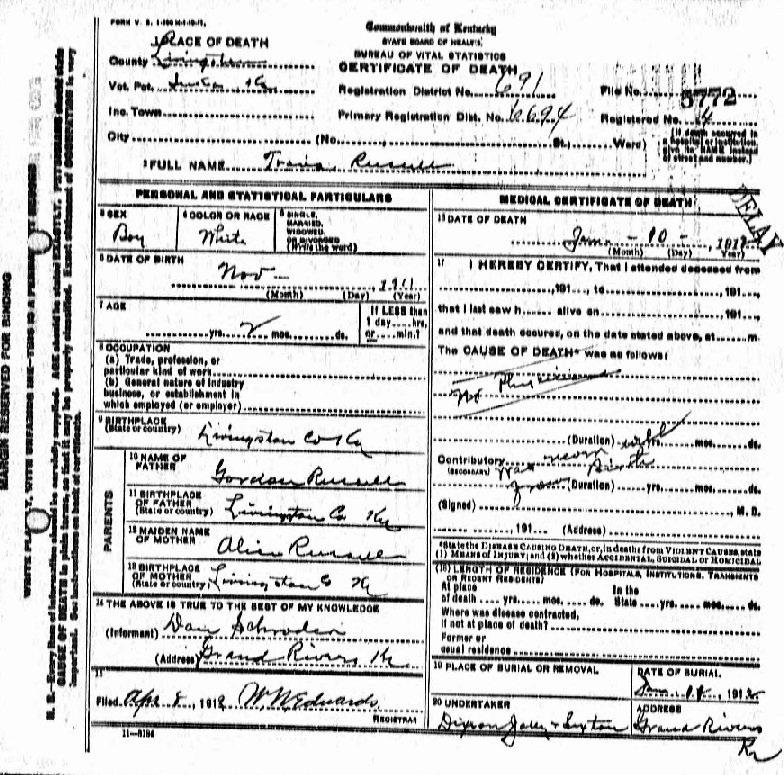
Commonwealth of Kentucky, Bureau of Vital Statistics. Certificate of death, Travis Russell. Ancestry.com. Kentucky, Death Records, 1852-1963 [database on-line]. Provo, UT, USA: Ancestry.com Operations Inc, 2007.Original data: Kentucky. Vital Statistics Original Death Certificates – Microfilm (1911-1955). Microfilm rolls #7016130-7041803. Kentucky Department for Libraries and Archives, Frankfort, Kentucky.
Travis Russell was born in November 1911 in Livingston County, Kentucky. He was the son of John Gordon Russell and Alice Isabel Schroder. He died on 10 January 1912 in Livingston County, Kentucky.
Travis was my second cousin four times removed. His father John Gordon Russell was the son of John D. Russell and Elizabeth Wilson. John was the son of Archibald Mills Russell and Margaret Harding. Mills was the son of my 5th-great-grandparents Andrew Russell and Hannah Hardgrave.
Travis Russell was born in November 1911 in Livingston County, Kentucky. He was the son of John Gordon Russell and Alice Isabel Schroder. He died on 10 January 1912 in Livingston County, Kentucky.
Travis was my second cousin four times removed. His father John Gordon Russell was the son of John D. Russell and Elizabeth Wilson. John was the son of Archibald Mills Russell and Margaret Harding. Mills was the son of my 5th-great-grandparents Andrew Russell and Hannah Hardgrave.
Tuesday, December 29, 2015
52 Ancestors: Week 52 "Resolution": Andrew Russell
My 5th-great-grandfather Andrew Russell is one of my brick walls. I do not know when or where he was born, or who his parents were. Some online family trees state that he was born in 1778 in North Carolina, but I have never seen a source for this information. There were men named Andrew Russell in Augusta County, Virginia, where my Andrew Russell's wife's parents were from; I suspect that he may be related to them.
Andrew Russell married Hannah Hardgrave on 28 June 1799 in Lincoln County, Kentucky. In 1800, he lived in Pulaski County, Kentucky, which had been created from parts of Lincoln and Green Counties in December 1798.
He was one of the commissioners that helped to plan the town of Somerset (the county seat of Pulaski County) and arrange the location of public buildings such as the courthouse, jail, and stocks. (Pulaski County Fact Book II: Chapter 2: The Founding and Growth of Somerset.)
He was enumerated in Somerset in the 1810 United States census. This is the only census record that I have for him. His household consisted of 1 free white male age 26-44, 2 free white males under age 10, and 1 free white female age 26-44, 1 free white female age 10-15, and 3 free white females under age 10.
1810 United States census, Somerset, Pulaski County, Kentucky, roll 8, page 143, image 00135. Ancestry.com. 1810 United States Federal Census [database on-line]. Provo, UT, USA: Ancestry.com Operations, Inc., 2010.
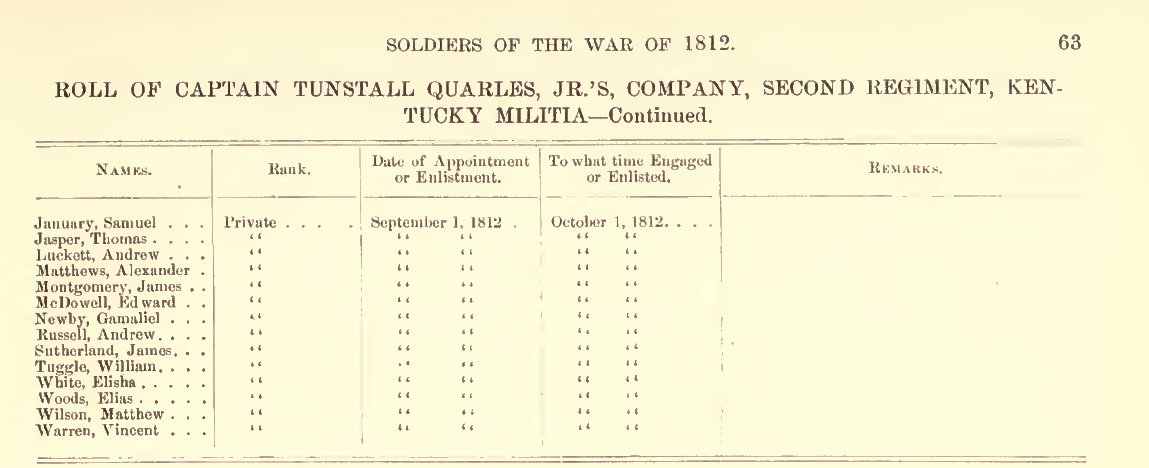
Andrew was a private in Tunstall Quarles' Company of Infantry, 2nd Regiment Kentucky Volunteer Militia during the War of 1812. His regiment constructed Fort Jennings in Ohio and remained there on garrison duty. They later headed north up to Put-in-Bay, Ohio. They were sent back to Cincinnati and discharged in 1813. The 2nd Regiment Kentucky Volunteer Militia Reenactment Group's unit history provides more information on the regiment's activities.
Report of the Adjutant General of the State of Kentucky. Soldiers of the War of 1812. Printed by authority of the legislature of Kentucky. Frankfort, KY: E. Polk Johnson, 1891. Available from Internet Archive.
Compiled service record, Andrew Russell, Pvt., Tunstall Quarles' Company of Infantry, 2nd Regiment Kentucky Volunteer Militia, War of 1812. Record Group 94. National Archives, Washington, DC.
In the 1820 United States census, Andrew's wife Hannah was enumerated as head of household in Davidson County, Tennessee. Andrew may have died by 1820. I have found no further record of him.
This year I kept my resolution to obtain Andrew Russell's military records from the National Archives and Records Administration. In the coming year, I resolve to obtain land records. According to a Rootsweb family tree page for James Matthews (who rented land from Andrew Russell), Andrew Russell received two certificates for 100 and 300 acres of land on Pitman's Creek in June 1801. According to note 10, this information came from Pulaski County Order Books 1 and 2.
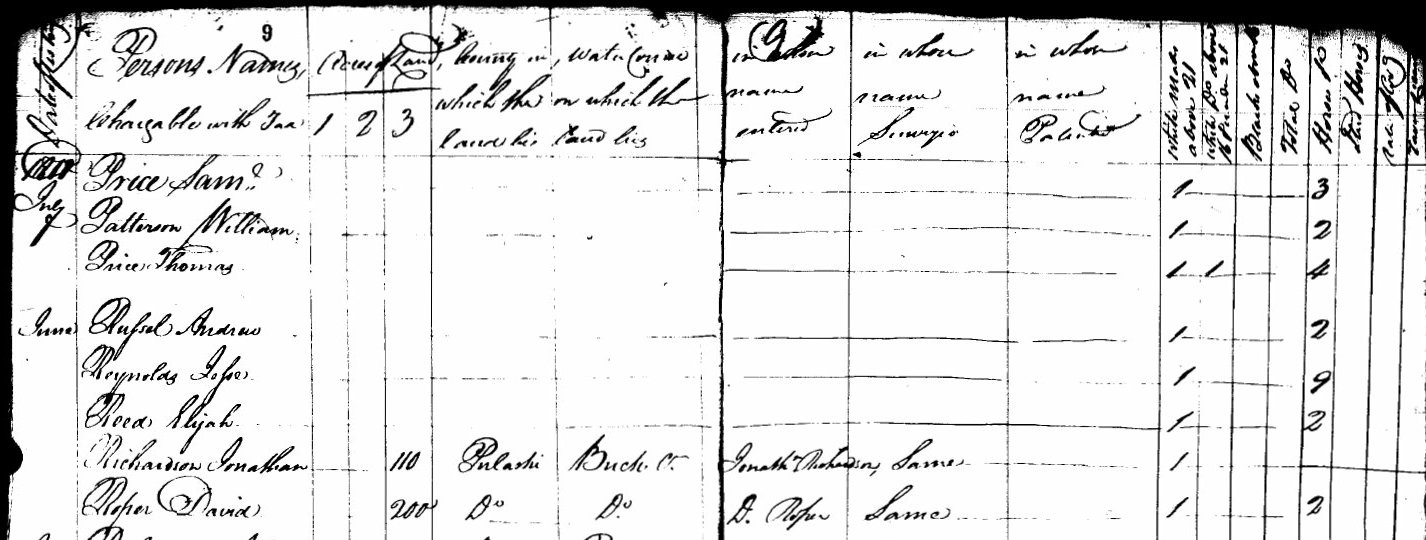
I will also take another look at the microfilmed Pulaski County, Kentucky tax lists at my local Family History Center. I made digital copies of the relevant pages, but some of the microfilm was very hard to read. Some of the copies are difficult to read; those pages might be a little easier to read if I go back to the microfilm. Fortunately some images, like the one below, are legible.
1800 Tax List, Pulaski County, Kentucky. Pulaski County (Kentucky). Tax Assessor. Tax books 1799-1822. Frankfort, Kentucky: Kentucky State Historical Society, 1952-1953. Family History Library microfilm 8209.
Andrew Russell married Hannah Hardgrave on 28 June 1799 in Lincoln County, Kentucky. In 1800, he lived in Pulaski County, Kentucky, which had been created from parts of Lincoln and Green Counties in December 1798.
He was one of the commissioners that helped to plan the town of Somerset (the county seat of Pulaski County) and arrange the location of public buildings such as the courthouse, jail, and stocks. (Pulaski County Fact Book II: Chapter 2: The Founding and Growth of Somerset.)
He was enumerated in Somerset in the 1810 United States census. This is the only census record that I have for him. His household consisted of 1 free white male age 26-44, 2 free white males under age 10, and 1 free white female age 26-44, 1 free white female age 10-15, and 3 free white females under age 10.
1810 United States census, Somerset, Pulaski County, Kentucky, roll 8, page 143, image 00135. Ancestry.com. 1810 United States Federal Census [database on-line]. Provo, UT, USA: Ancestry.com Operations, Inc., 2010.
Andrew was a private in Tunstall Quarles' Company of Infantry, 2nd Regiment Kentucky Volunteer Militia during the War of 1812. His regiment constructed Fort Jennings in Ohio and remained there on garrison duty. They later headed north up to Put-in-Bay, Ohio. They were sent back to Cincinnati and discharged in 1813. The 2nd Regiment Kentucky Volunteer Militia Reenactment Group's unit history provides more information on the regiment's activities.
Report of the Adjutant General of the State of Kentucky. Soldiers of the War of 1812. Printed by authority of the legislature of Kentucky. Frankfort, KY: E. Polk Johnson, 1891. Available from Internet Archive.
Compiled service record, Andrew Russell, Pvt., Tunstall Quarles' Company of Infantry, 2nd Regiment Kentucky Volunteer Militia, War of 1812. Record Group 94. National Archives, Washington, DC.
In the 1820 United States census, Andrew's wife Hannah was enumerated as head of household in Davidson County, Tennessee. Andrew may have died by 1820. I have found no further record of him.
This year I kept my resolution to obtain Andrew Russell's military records from the National Archives and Records Administration. In the coming year, I resolve to obtain land records. According to a Rootsweb family tree page for James Matthews (who rented land from Andrew Russell), Andrew Russell received two certificates for 100 and 300 acres of land on Pitman's Creek in June 1801. According to note 10, this information came from Pulaski County Order Books 1 and 2.
I will also take another look at the microfilmed Pulaski County, Kentucky tax lists at my local Family History Center. I made digital copies of the relevant pages, but some of the microfilm was very hard to read. Some of the copies are difficult to read; those pages might be a little easier to read if I go back to the microfilm. Fortunately some images, like the one below, are legible.
1800 Tax List, Pulaski County, Kentucky. Pulaski County (Kentucky). Tax Assessor. Tax books 1799-1822. Frankfort, Kentucky: Kentucky State Historical Society, 1952-1953. Family History Library microfilm 8209.
Labels:
52 Ancestors,
Hardgrave,
Kentucky,
Ohio,
Russell,
War of 1812
Wednesday, December 16, 2015
52 Ancestors: Week 50 "Naughty": Michael J. Dyer
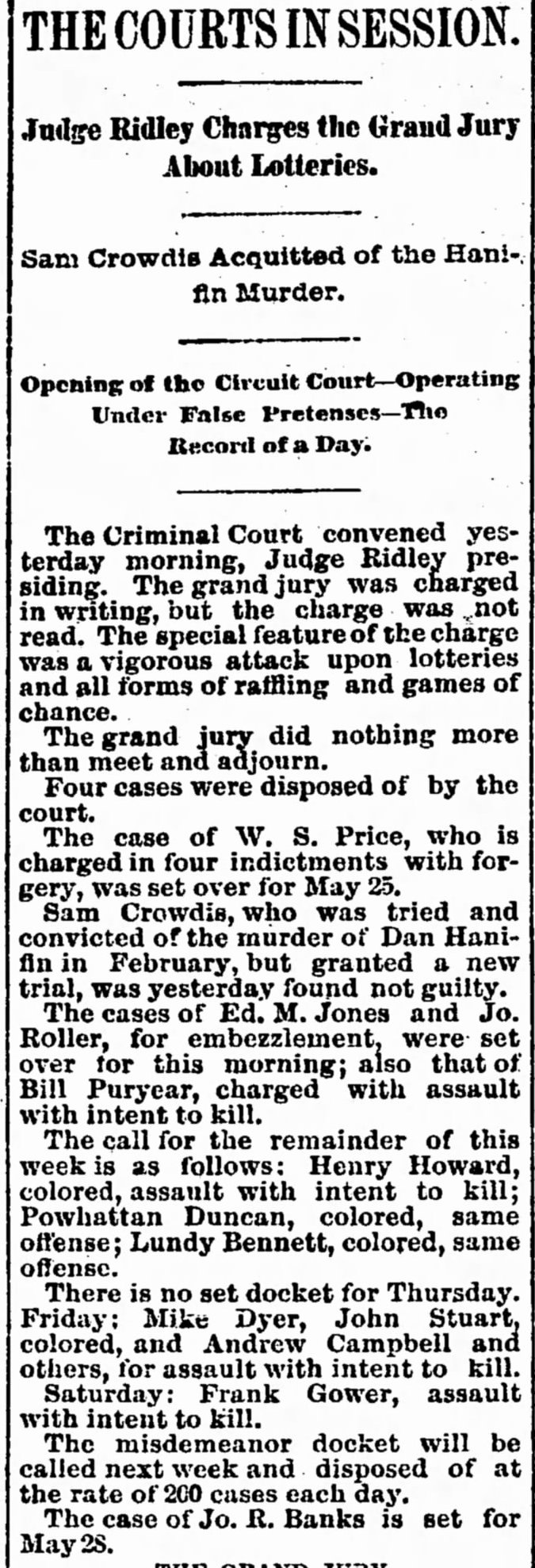
Many members of my family would be good choices for this week's 52 Ancestors theme, "Naughty." I have written about many of them already. I keep finding more and more "black sheep." This week I will focus on my 2nd-great-grandmother's brother Michael J. "Mike" Dyer, who only recently was added to the "naughty list" of relatives after I did more research in newspapers.
Mike was born about 1868 in Tennessee, probably Nashville (his family's place of residence). He was the son of Irish immigrants Mary and Michael Dyer. In 1870, Mike's father committed suicide. His mother remarried John Cox in 1871, but was widowed in 1878.
In 1884, Mike and his friends Patrick Kane and David Hanley (or Harley) ran away from home. Mike stole $40 from his mother's grocery store and got on a train in Nashville. They stopped at Louisville, Kentucky to buy revolvers, and then got off the train in Cincinnati, Ohio. They wanted to go West. They had been reading about Jesse James and Buffalo Bill, and wanted to scalp Indians and experience the Wild West. But they were hungry and broke, so they tried to sell their guns, and were arrested. Telegraphs were sent to their families.
The "Bound for the Plains" article, which was published in the 17 April 1884 issue of the Cincinnati Enquirer,was reprinted in the Nashville newspaper Daily American, 18 April 1884.
In May 1888, Mike was charged with assault with intent to kill.
In February 1892, Mike shot at William Dunn, who was engaged in a fight with Dave Farrell, and one of the bullets hit Dunn's thigh. Mike's half-brother Tom Cox then whipped out a knife and cut Dunn's neck.
Shortly afterward, Mike appeared in City Court on the charges of assault with and carrying a pistol and shooting in corporate limits.
In 1893, Mike was charged with carrying weapons.
In September 1894, Mike was arrested for gaming and was fined $10.
On December 12, 1895, Mike and Charles Neyman got into a fight. Charles, who claimed that Mike started the fight, hit Mike on the head with a hammer. Mike's skull was fractured, and several pieces of bone had to be removed. It was reported that he would recover.
However, on 24 December 1895, Mike died at his mother's home.
Two days after Mike's death notice was published, an item appeared in the newspaper which provided more information. Mike died of "congestion of brain." He must have died as a result of the blow on his head. I wonder if Charles Neylan was charged with murder. He should have been.
Mike's half-brother William Cox died on 2 March 1896. When William was buried, Mike's body was removed from a vault and buried at the same time.
Mike was born about 1868 in Tennessee, probably Nashville (his family's place of residence). He was the son of Irish immigrants Mary and Michael Dyer. In 1870, Mike's father committed suicide. His mother remarried John Cox in 1871, but was widowed in 1878.
In 1884, Mike and his friends Patrick Kane and David Hanley (or Harley) ran away from home. Mike stole $40 from his mother's grocery store and got on a train in Nashville. They stopped at Louisville, Kentucky to buy revolvers, and then got off the train in Cincinnati, Ohio. They wanted to go West. They had been reading about Jesse James and Buffalo Bill, and wanted to scalp Indians and experience the Wild West. But they were hungry and broke, so they tried to sell their guns, and were arrested. Telegraphs were sent to their families.
Daily American (Nashville, TN), 17 April 1884, page 4
The "Bound for the Plains" article, which was published in the 17 April 1884 issue of the Cincinnati Enquirer,was reprinted in the Nashville newspaper Daily American, 18 April 1884.
Cincinnati Enquirer, 17 April 1884, page 4
In May 1888, Mike was charged with assault with intent to kill.
Daily American (Nashville, TN), 8 May 1888, page 4
In February 1892, Mike shot at William Dunn, who was engaged in a fight with Dave Farrell, and one of the bullets hit Dunn's thigh. Mike's half-brother Tom Cox then whipped out a knife and cut Dunn's neck.
Daily American (Nashville. TN), 27 February 1892, page 3
Shortly afterward, Mike appeared in City Court on the charges of assault with and carrying a pistol and shooting in corporate limits.
Daily American (Nashville, TN), 1 March 1892, page 3
In 1893, Mike was charged with carrying weapons.
Daily American (Nashville, TN), 6 September 1893, page 4
In September 1894, Mike was arrested for gaming and was fined $10.
Nashville Daily American, 11 September 1894, page 6
On December 12, 1895, Mike and Charles Neyman got into a fight. Charles, who claimed that Mike started the fight, hit Mike on the head with a hammer. Mike's skull was fractured, and several pieces of bone had to be removed. It was reported that he would recover.
Nashville American, 14 December 1895, page 6
However, on 24 December 1895, Mike died at his mother's home.
Nashville American, 25 December 1895, page 5
Two days after Mike's death notice was published, an item appeared in the newspaper which provided more information. Mike died of "congestion of brain." He must have died as a result of the blow on his head. I wonder if Charles Neylan was charged with murder. He should have been.
Nashville American, 27 December 1895, page 5
Mike's half-brother William Cox died on 2 March 1896. When William was buried, Mike's body was removed from a vault and buried at the same time.
Nashville American, 3 March 1896, page 4
Labels:
52 Ancestors,
Black sheep,
Cox,
Dyer,
Kentucky,
Nashville,
Ohio,
Tennessee
Saturday, November 14, 2015
Sympathy Saturday: Card of Thanks, Family of George Hanley Fant
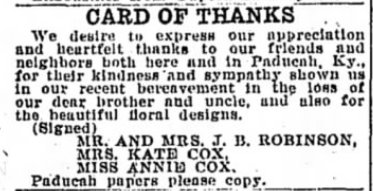
Nashville Tennesseean, 28 November 1913, page 13
George Hanley Fant, the former brother-in-law of my 2nd-great-grandmother's half-brother Tom Cox, died on 22 November 1918 in Nashville, Tennessee. His World War I draft registration card shows that he was a resident of Paducah, McCracken County, Kentucky on 22 September 1918.
A card of thanks was published in the Nashville Tennessean by his family: his brother-in-law and sister John B. and Laura (Fant) Robinson, his sister Kate (Fant) Cox (Tom Cox's ex-wife), and his niece Annie Cox (Kate and Tom Cox's daughter).
Wednesday, October 21, 2015
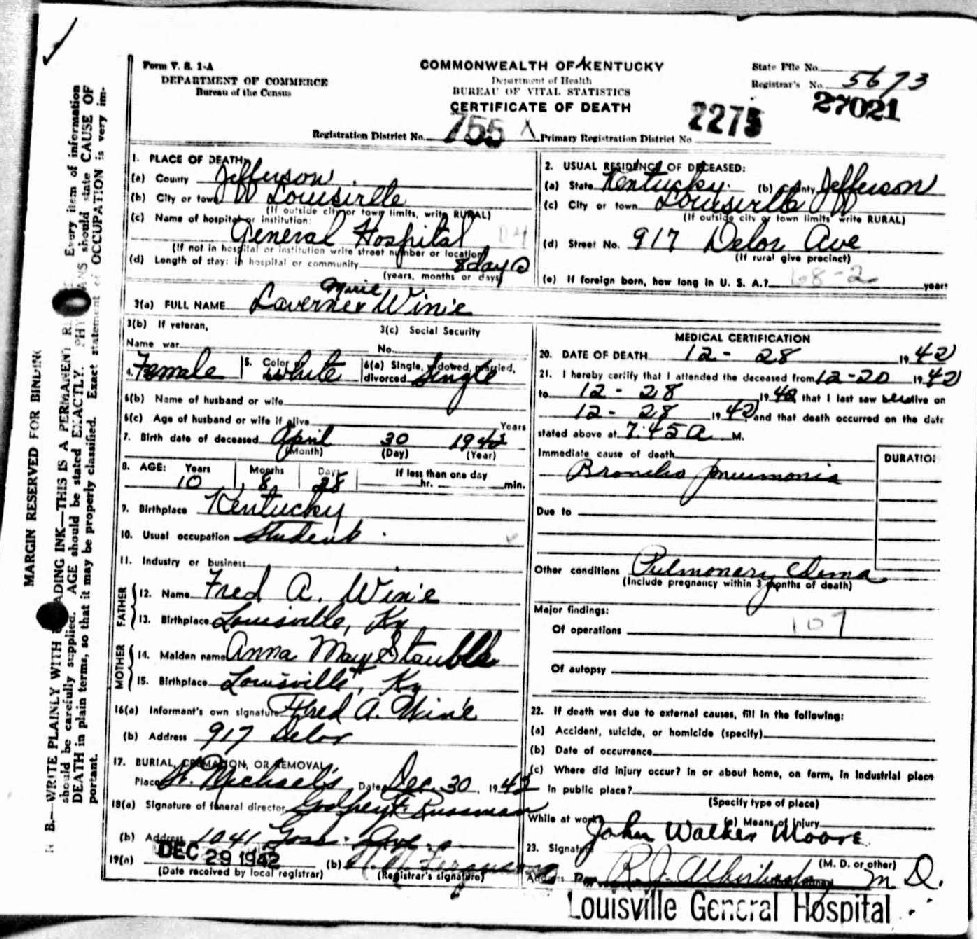
Wednesday's Child: Laverne Marie Win'e
Commonwealth of Kentucky, Bureau of Vital Statistics. Certificate of death, Laverne Marie Win'e. Ancestry.com. Kentucky, Death Records, 1852-1963 [database on-line]. Provo, UT, USA: Ancestry.com Operations Inc, 2007.
Original data: Kentucky. Vital Statistics Original Death Certificates – Microfilm (1911-1955). Microfilm rolls #7016130-7041803. Kentucky Department for Libraries and Archives, Frankfort, Kentucky.
Laverne Marie Win'e was born on 30 April 1942 in Jefferson County, Kentucky. She was the daughter of Frederick Anthony Win'e and Anna Mary Stauble. She died of bronchopneumonia on 28 December 1942 in Louisville General Hospital, Louisville, Jefferson County, Kentucky, and was buried in St. Michael Cemetery in Louisville on 30 December 1942.
Laverne was my fourth cousin twice removed. She and her mother were descendants of my 5th-great-grandparents Anton Stäuble and Maria Elisabeth Gaßmann (or, written without using the eszett, Gassmann).
Laverne Marie Win'e was born on 30 April 1942 in Jefferson County, Kentucky. She was the daughter of Frederick Anthony Win'e and Anna Mary Stauble. She died of bronchopneumonia on 28 December 1942 in Louisville General Hospital, Louisville, Jefferson County, Kentucky, and was buried in St. Michael Cemetery in Louisville on 30 December 1942.
Laverne was my fourth cousin twice removed. She and her mother were descendants of my 5th-great-grandparents Anton Stäuble and Maria Elisabeth Gaßmann (or, written without using the eszett, Gassmann).
Monday, October 12, 2015
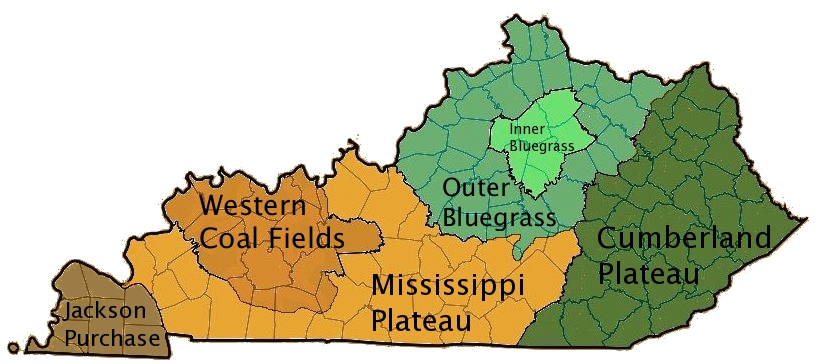
Mappy Monday: Kentucky Physiography
Kentucky physiography map. Created by Lamontacranston [Public domain]. Available from Wikimedia Commons.
This map shows the different physical geographic regions of Kentucky:
Cumberland Plateau: includes the Eastern Kentucky Coal Fields; the eastern portion consists of escarpment formed from sandstone and other sedimentary rocks, and the interior has forested hills and valleys
Mississippi Plateau or Pennyroyal Region: a limestone plain with sink holes, sinking streams, springs, valleys, and caverns
Outer Bluegrass: deep valleys, very little flat land
Inner Bluegrass: fertile soil and rolling hills with sink holes, sinking streams, springs, and caves
Western Coal Fields: part of the Illinois Basin (also called Eastern Interior Basin); escarpment formed from sandstone and other sedimentary rocks
Jackson Purchase or Mississippi Embayment: flat land with lakes, ponds, and swamps
This map shows the different physical geographic regions of Kentucky:
Cumberland Plateau: includes the Eastern Kentucky Coal Fields; the eastern portion consists of escarpment formed from sandstone and other sedimentary rocks, and the interior has forested hills and valleys
Mississippi Plateau or Pennyroyal Region: a limestone plain with sink holes, sinking streams, springs, valleys, and caverns
Outer Bluegrass: deep valleys, very little flat land
Inner Bluegrass: fertile soil and rolling hills with sink holes, sinking streams, springs, and caves
Western Coal Fields: part of the Illinois Basin (also called Eastern Interior Basin); escarpment formed from sandstone and other sedimentary rocks
Jackson Purchase or Mississippi Embayment: flat land with lakes, ponds, and swamps
Sunday, October 11, 2015
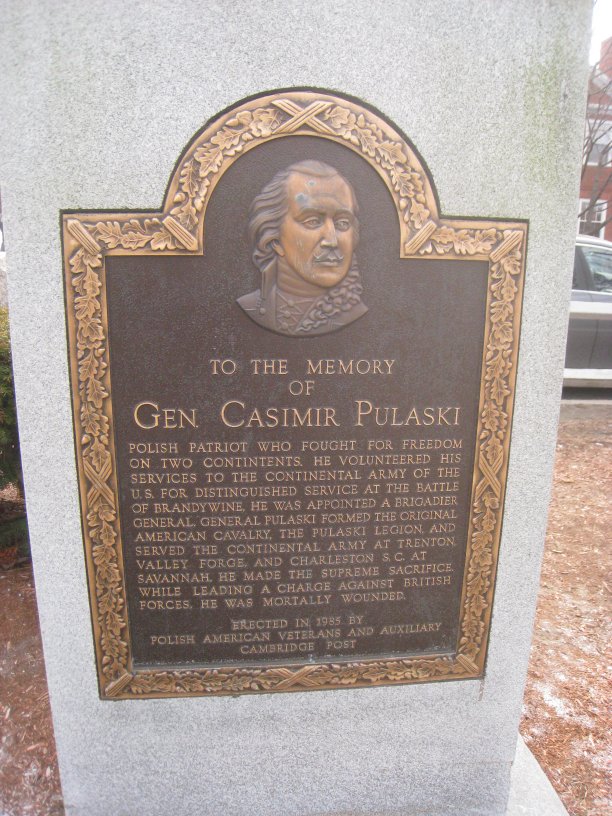
General Pulaski Memorial Day
General Casimir Pulaski plaque, Cambridge Commons, Cambridge, Massachusetts. Photo by Daderot (Own work) [Public domain], 14 February 2010. Available from Wikimedia Commons.
October 11 is General Pulaski Memorial Day, in honor of Casimir (Kazimierz) Pulaski. In 1929, Congress passed a resolution designating October 11 as General Pulaski Memorial Day. Since 1931, a presidential proclamation has been issued for the holiday every year.
Kazimierz Michał Władysław Wiktor Pułaski was born on 6 March 1745 in Warsaw, Poland. He and his father Józef Pulaski were among the founders of the Bar Confederation, an association formed to defend Poland against Russia and King Stanisław August Poniatowski. Pulaski became the commander after his father died in 1769. One of his military accomplishments was taking control of the Jasna Góra Monastery in September 1770. In 1771 members of the Bar Confederation attempted to kidnap King Stanisław August Poniatowski, and Pulaski was implicated. He went to Silesia, Prussia in 1772 and met with Franciszka Corvin-Krasińska, the wife of Charles of Saxony, Duke of Courland. He went to France in 1773, and attempted to join the French Army, but was unsuccessful. He spent some time in a debtors' prison in 1775. He met Benjamin Franklin in 1777. Franklin and the Marquis de Lafayette recruited him for service in the Continental Army.
On 23 July 1777, Pulaski arrived in Marblehead, Massachusetts. He traveled to Pennsylvania in August, and met George Washington. His first battle in North America was the Battle of Brandywine on 11 September 1777. Pulaski gathered troops together and charged in order to prevent the British from retreating. On 15 September 1777, Washington made Pulaski a brigadier general in the Continental Army cavalry.
Pulaski participated in the Battle of Germantown, and spent the winter of 1777-1778 at Valley Forge. He assisted General Anthony Wayne in February 1778, but returned to Valley Forge in March.
Pulaski created a new cavalry regiment, Pulaski's Legion. Its headquarters were in Baltimore, Maryland, and most of the men were recruited there.They participated in the Little Egg Harbor Massacre on 15 October 1778.
On 8 May 1779, Pulaski arrived in Charleston, South Carolina.In September, he headed to Georgia. Pulaski's regiment served as advance guard for Admiral Charles Hector, comte d'Estaing's troops. Pulaski commanded both the French and American cavalry on 9 October 1779 at the Siege of Savannah. He was wounded by grapeshot and carried off the battlefield. He died on 11 or 15 October 1779.
My 5th-great-grandfather Stephen Mayo also participated in the battles of Brandywine and Germantown. He and his brother Benjamin were at Valley Forge together.
Pulaski County, Kentucky is named for Casimir Pulaski. My 5th-great-grandparents Andrew and Hannah (Hardgrave) Russell lived in Pulaski County, Kentucky, and my 4th-great-grandmother Sobrina Russell was probably born there.
References
Bar Confederation
Casimir Pulaski
Casimir Pulaski, Father of the U.S. Cavalry
A Chronology of Casimir Pulaski's Life 1745-1779
General Casimir Pulaski (1745-1779)
General Pulaski Memorial Day
October 11 is General Pulaski Memorial Day, in honor of Casimir (Kazimierz) Pulaski. In 1929, Congress passed a resolution designating October 11 as General Pulaski Memorial Day. Since 1931, a presidential proclamation has been issued for the holiday every year.
Kazimierz Michał Władysław Wiktor Pułaski was born on 6 March 1745 in Warsaw, Poland. He and his father Józef Pulaski were among the founders of the Bar Confederation, an association formed to defend Poland against Russia and King Stanisław August Poniatowski. Pulaski became the commander after his father died in 1769. One of his military accomplishments was taking control of the Jasna Góra Monastery in September 1770. In 1771 members of the Bar Confederation attempted to kidnap King Stanisław August Poniatowski, and Pulaski was implicated. He went to Silesia, Prussia in 1772 and met with Franciszka Corvin-Krasińska, the wife of Charles of Saxony, Duke of Courland. He went to France in 1773, and attempted to join the French Army, but was unsuccessful. He spent some time in a debtors' prison in 1775. He met Benjamin Franklin in 1777. Franklin and the Marquis de Lafayette recruited him for service in the Continental Army.
On 23 July 1777, Pulaski arrived in Marblehead, Massachusetts. He traveled to Pennsylvania in August, and met George Washington. His first battle in North America was the Battle of Brandywine on 11 September 1777. Pulaski gathered troops together and charged in order to prevent the British from retreating. On 15 September 1777, Washington made Pulaski a brigadier general in the Continental Army cavalry.
Pulaski participated in the Battle of Germantown, and spent the winter of 1777-1778 at Valley Forge. He assisted General Anthony Wayne in February 1778, but returned to Valley Forge in March.
Pulaski created a new cavalry regiment, Pulaski's Legion. Its headquarters were in Baltimore, Maryland, and most of the men were recruited there.They participated in the Little Egg Harbor Massacre on 15 October 1778.
On 8 May 1779, Pulaski arrived in Charleston, South Carolina.In September, he headed to Georgia. Pulaski's regiment served as advance guard for Admiral Charles Hector, comte d'Estaing's troops. Pulaski commanded both the French and American cavalry on 9 October 1779 at the Siege of Savannah. He was wounded by grapeshot and carried off the battlefield. He died on 11 or 15 October 1779.
My 5th-great-grandfather Stephen Mayo also participated in the battles of Brandywine and Germantown. He and his brother Benjamin were at Valley Forge together.
Pulaski County, Kentucky is named for Casimir Pulaski. My 5th-great-grandparents Andrew and Hannah (Hardgrave) Russell lived in Pulaski County, Kentucky, and my 4th-great-grandmother Sobrina Russell was probably born there.
References
Bar Confederation
Casimir Pulaski
Casimir Pulaski, Father of the U.S. Cavalry
A Chronology of Casimir Pulaski's Life 1745-1779
General Casimir Pulaski (1745-1779)
General Pulaski Memorial Day
Wednesday, October 7, 2015
Wednesday's Child: Marcella Staeuble
Mortuary record for April 1910, Louisville, Kentucky. Ancestry.com. Kentucky, Death Records, 1852-1963 [database on-line]. Provo, UT, USA: Ancestry.com Operations Inc, 2007.
Marcella Staeuble (or Stauble) was born on 5 July 1908 in Louisville, Jefferson County, Kentucky. She was the daughter of John A. Staeuble (or Stauble) and Mary K. Casabella. She died of diptheria on 18 April 1910.
The 1910 United States Federal Census enumeration responses reflected the composition of the household as of 15 April 1910. Marcella's family was enumerated on 22 or 23 April 1910. Although she was deceased at that time, she was enumerated with her family because she was still alive on April 15.
Marcella was my third cousin three times removed. She and her father were descendants of my 5th-great-grandparents Anton Stäuble and Maria Elisabeth Gaßmann (or, written without using the eszett, Gassmann).
Marcella Staeuble (or Stauble) was born on 5 July 1908 in Louisville, Jefferson County, Kentucky. She was the daughter of John A. Staeuble (or Stauble) and Mary K. Casabella. She died of diptheria on 18 April 1910.
The 1910 United States Federal Census enumeration responses reflected the composition of the household as of 15 April 1910. Marcella's family was enumerated on 22 or 23 April 1910. Although she was deceased at that time, she was enumerated with her family because she was still alive on April 15.
Marcella was my third cousin three times removed. She and her father were descendants of my 5th-great-grandparents Anton Stäuble and Maria Elisabeth Gaßmann (or, written without using the eszett, Gassmann).
Monday, September 28, 2015
Military Monday: More Information on Andrew Russell, Private in 2nd Regiment Kentucky Volunteer Militia, War of 1812
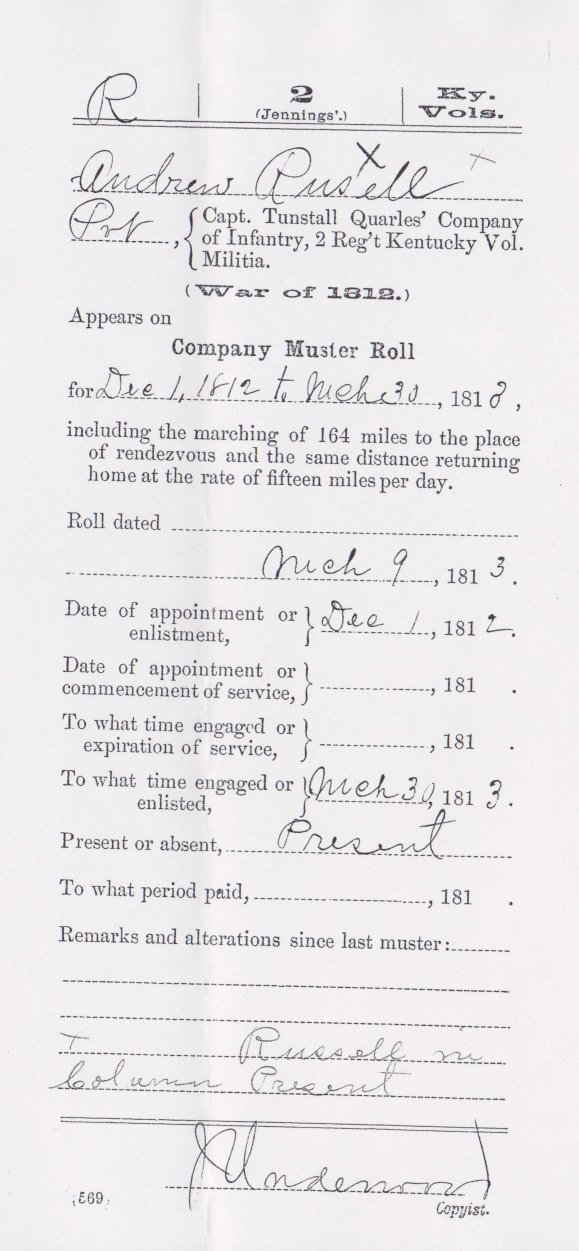
My 5th-great-grandfather Andrew Russell was a private in Tunstall Quarles' Company of Infantry, 2nd Regiment Kentucky Volunteer Militia during the War of 1812. According to the book Soldiers of the War of 1812, the men in the company were enlisted from 1 September 1812 to 1 October 1812. I recently received Andrew Russell's compiled service record from the National Archives and Records Administration, and found out that he served with the company for a longer period of time. He was enlisted from 1 September 1812 to 30 March 1813.
The 2nd Regiment Kentucky Volunteer Militia Reenactment Group has a unit history on their Web site. By looking at the history and the compiled service record, I can see what Andrew was doing during the War of 1812.
The unit history states that the 2nd Regiment Kentucky Volunteer Militia was formed in Frankfort, Kentucky on 1 September 1812. The regiment marched to Lexington, Kentucky, and then went to Newport Barracks in Newport, Kentucky. The men received 2 months' advance pay at Newport.
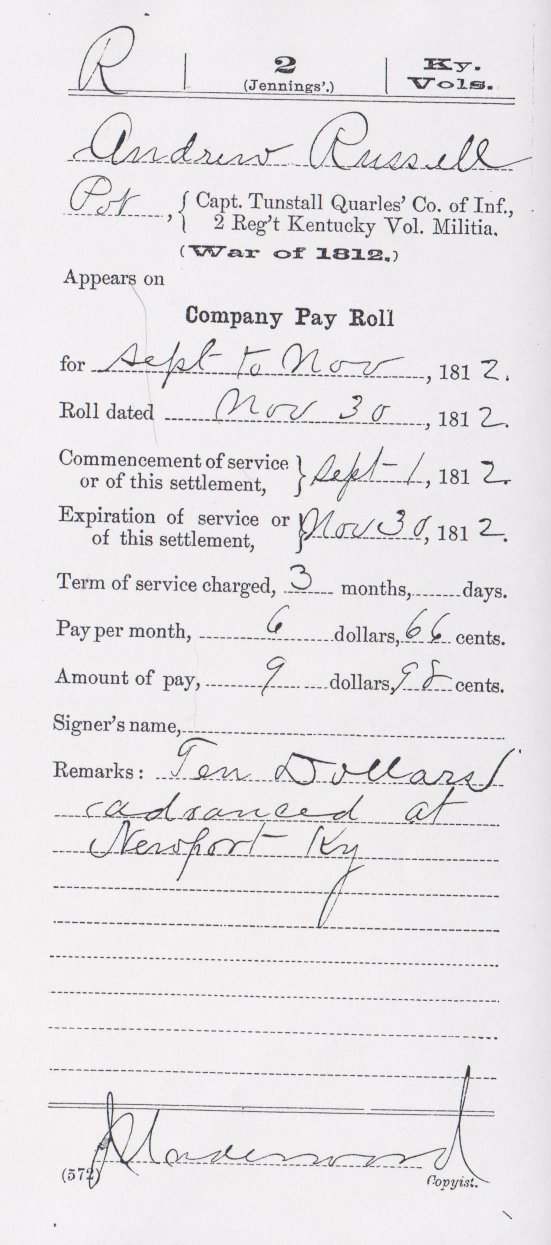
The company pay roll dated 30 November 1812 states that Andrew Russell was advanced ten dollars at Newport.
Compiled service record, Andrew Russell, Pvt., Tunstall Quarles' Company of Infantry, 2nd Regiment Kentucky Volunteer Militia, War of 1812. Record Group 94. National Archives, Washington, DC.
By mid-September, the men had arrived at General William Henry Harrison's headquarters in St. Marys, Ohio. They then headed north and constructed Fort Jennings. It was completed in October 1812. They remained at Fort Jennings on garrison duty.
Several months later, the men headed further north, and got as far as Put-in-Bay, Ohio. They were then sent back to Cincinnati, and were discharged in 1813.
According to the company muster roll dated 9 March 1813, the company marched 164 miles to the rendezvous, and 164 miles back. They marched about fifteen miles per day.
Compiled service record, Andrew Russell, Pvt., Tunstall Quarles' Company of Infantry, 2nd Regiment Kentucky Volunteer Militia, War of 1812. Record Group 94. National Archives, Washington, DC.
The 2nd Regiment Kentucky Volunteer Militia Reenactment Group has a unit history on their Web site. By looking at the history and the compiled service record, I can see what Andrew was doing during the War of 1812.
The unit history states that the 2nd Regiment Kentucky Volunteer Militia was formed in Frankfort, Kentucky on 1 September 1812. The regiment marched to Lexington, Kentucky, and then went to Newport Barracks in Newport, Kentucky. The men received 2 months' advance pay at Newport.
The company pay roll dated 30 November 1812 states that Andrew Russell was advanced ten dollars at Newport.
Compiled service record, Andrew Russell, Pvt., Tunstall Quarles' Company of Infantry, 2nd Regiment Kentucky Volunteer Militia, War of 1812. Record Group 94. National Archives, Washington, DC.
By mid-September, the men had arrived at General William Henry Harrison's headquarters in St. Marys, Ohio. They then headed north and constructed Fort Jennings. It was completed in October 1812. They remained at Fort Jennings on garrison duty.
Several months later, the men headed further north, and got as far as Put-in-Bay, Ohio. They were then sent back to Cincinnati, and were discharged in 1813.
According to the company muster roll dated 9 March 1813, the company marched 164 miles to the rendezvous, and 164 miles back. They marched about fifteen miles per day.
Compiled service record, Andrew Russell, Pvt., Tunstall Quarles' Company of Infantry, 2nd Regiment Kentucky Volunteer Militia, War of 1812. Record Group 94. National Archives, Washington, DC.
Saturday, May 2, 2015
Sports Center Saturday: Kentucky Derby
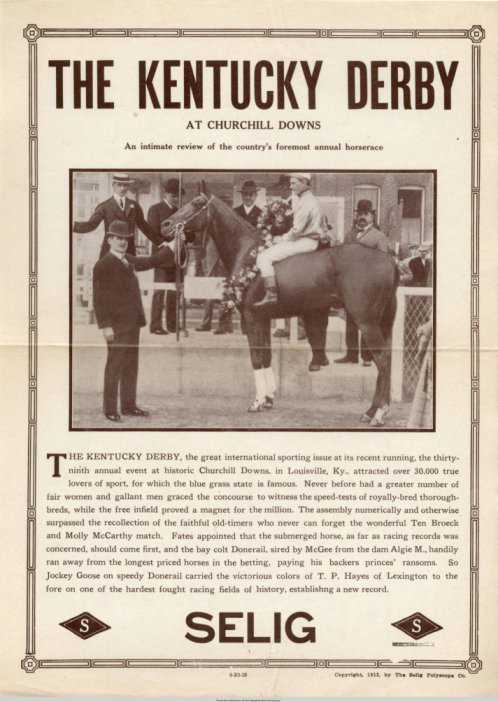
Release flyer for the Kentucky Derby, 1913. By Chicago : Selig Polyscope Co., Publisher [Public domain]. Available from Margaret Herrick Library Digital Collections and Wikimedia Commons.
Since 1875, the Kentucky Derby has been held annually at Churchill Downs in Louisville, Kentucky on the first Saturday in May. It is the first leg of the Triple Crown; it is followed by the Preakness Stakes and the Belmont Stakes. Twenty three-year-old horses compete in the Kentucky Derby.
The Kentucky Derby is also referred to as the "Run for the Roses" because a blanket of roses is draped over the winner. In 1896, Ben Brush became the first horse to receive flowers; he was given an arrangement of pink and white roses. the red rose became the official flower of the Kentucky Derby in 1904. The winning horse now receives a garland of more than 400 red roses which have been sewn into a backing of green satin. The winning jockey receives a bouquet of 60 long stemmed roses wrapped in ten yards of ribbon.
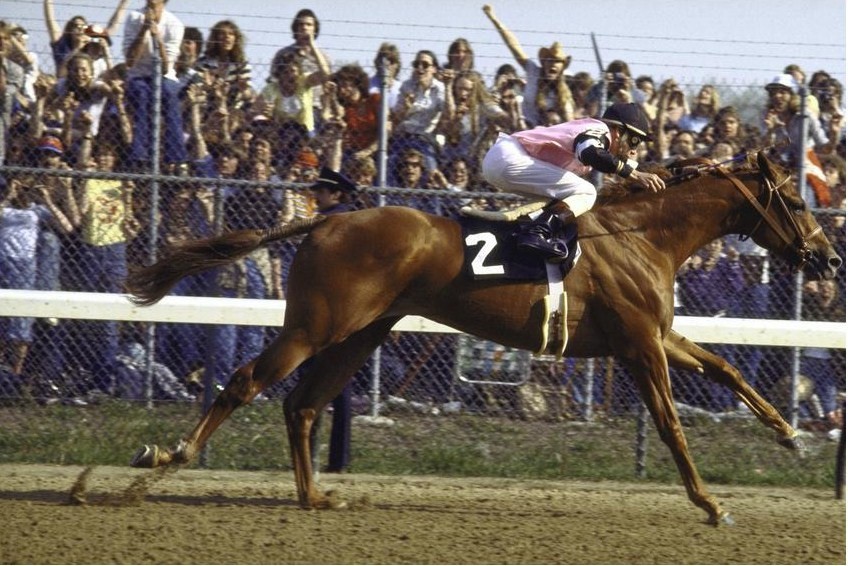
I remember watching the Kentucky Derby in 1978, as a child. I was drawn to the race horse Affirmed, and hoped that he would win the Kentucky Derby. I was very pleased that he won the race. I rooted for him in the Preakness and the Belmont, and watched him win those races too, beating his rival Alydar.
References
Kentucky Derby (official site)
Kentucky Derby (Wikipedia)
Since 1875, the Kentucky Derby has been held annually at Churchill Downs in Louisville, Kentucky on the first Saturday in May. It is the first leg of the Triple Crown; it is followed by the Preakness Stakes and the Belmont Stakes. Twenty three-year-old horses compete in the Kentucky Derby.
The Kentucky Derby is also referred to as the "Run for the Roses" because a blanket of roses is draped over the winner. In 1896, Ben Brush became the first horse to receive flowers; he was given an arrangement of pink and white roses. the red rose became the official flower of the Kentucky Derby in 1904. The winning horse now receives a garland of more than 400 red roses which have been sewn into a backing of green satin. The winning jockey receives a bouquet of 60 long stemmed roses wrapped in ten yards of ribbon.
I remember watching the Kentucky Derby in 1978, as a child. I was drawn to the race horse Affirmed, and hoped that he would win the Kentucky Derby. I was very pleased that he won the race. I rooted for him in the Preakness and the Belmont, and watched him win those races too, beating his rival Alydar.
Affirmed. Photo from Thoroughbred Racing Wiki.
References
Kentucky Derby (official site)
Kentucky Derby (Wikipedia)
Monday, April 20, 2015
Mappy Monday: Map of Kentucke, 1784
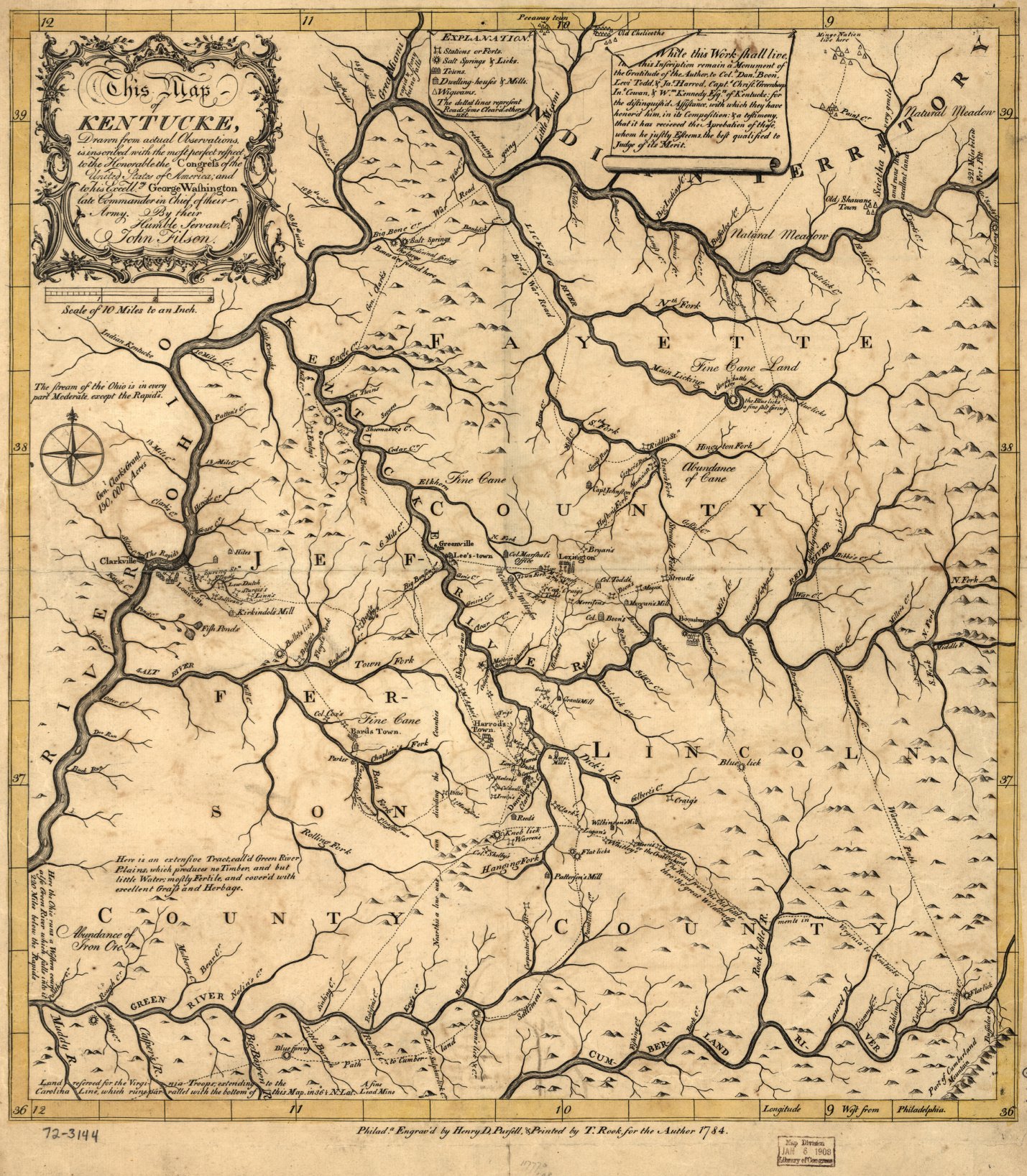
Map of Kentucke. From The Discovery, Settlement and Present State of Kentucke, by John Filson (1784). Public domain. Available from DigitalCommons@University of Nebraska-Lincoln and Wikimedia Commons.
This 1784 map by John Filson is the first known map of Kentucky. Filson dedicated the map to the United States Congress and to George Washington.
My Hardgrave ancestors came to Lincoln County, Kentucky around 1795. My 5th-great-grandparents Hannah Hardgrave and Andrew Russell married in Lincoln County in 1799, and afterward lived in Pulaski County, which was created out of Lincoln and Green Counties.
This 1784 map by John Filson is the first known map of Kentucky. Filson dedicated the map to the United States Congress and to George Washington.
My Hardgrave ancestors came to Lincoln County, Kentucky around 1795. My 5th-great-grandparents Hannah Hardgrave and Andrew Russell married in Lincoln County in 1799, and afterward lived in Pulaski County, which was created out of Lincoln and Green Counties.
Subscribe to:
Posts (Atom)