For years, I have been searching for my 2nd-great-grandmother Sarah Claire "Sadie" (Dyer) Gatlin's half-sister Nellie Cox. Nellie and her husband Owen McDonough were charged as accessories to murder after Tom Cox, Nellie's brother and Sadie's half-brother, shot and killed Ben Dowell, a police officer in 1903. A mistrial was declared. The 1906 Nashville city directory stated that Owen McDonough had moved to Birmingham, Alabama. I hadn't been able to locate Owen or Nellie since then.
Sadie died in Chicago, Illinois on 20 January 1945. Her death notice mentioned a surviving sister, Mrs. E. Goolsby. All of Sadie's other siblings were dead, so Mrs. E. Goolsby had to be Nellie.
A few months ago, I finally located Nellie's first husband, Owen McDonough. I found him listed in Lorain, Ohio city directories in the 1920s. His wife was named Jennie. Apparently Nellie's first marriage ended in divorce. I don't know when Owen and Nellie split up, but I wouldn't be surprised if it were when Owen left Nashville. Being charged as accessories to the murder that Nellie's brother committed probably put a strain on their marriage.
Since I had finally located Owen, I decided to try searching for Nellie again, although I had searched before without success. And much to my surprise, I immediately found her!
Nevada. Department of Health. Death certificate 65-1741 (1965), Nellie Dale Goolsby. Ancestry.com. Nevada, Death Certificates, 1911-1965 [database on-line]. Provo, UT, USA: Ancestry.com Operations, Inc., 2016.
Nellie died in Las Vegas, Nevada on 13 July 1965. I never expected to find her there! Her death certificate confirmed that her mother's maiden name was Mary Reynolds. My conclusion was correct. Her date of birth was consistent with the ages found in earlier census records. And I now had her second husband's name, Ezra A. Goolsby.
I still haven't located her in census records after 1900. Ezra Goolsby was enumerated in Memphis, Tennessee in 1940. He was a hotel proprietor. Nellie wasn't listed with him. It's possible that he just didn't mention her, though. Nellie and her first husband Owen McDonough both seem to have managed to avoid the census takers for decades. They may have been afraid that they would be tried as accessories to murder again.
Ezra Goolsby's mother, Salemma W. (Harris) Goolsby, died in Chicago, Illinois on 6 May 1926. His brother, Fleming Goolsby, lived in Chicago in 1930. Perhaps Nellie and Ezra met in Chicago. Sadie and her husband and children lived there; she was Nellie's only living sibling.
Nellie and Ezra (who died in 1979) are buried in Woodlawn Cemetery in Las Vegas.
Covering genealogy, family history, historical events and places, and anything else related!
Showing posts with label Black sheep. Show all posts
Sunday, February 17, 2019
Sunday, October 16, 2016
Black Sheep Sunday: Keeping a Disorderly House
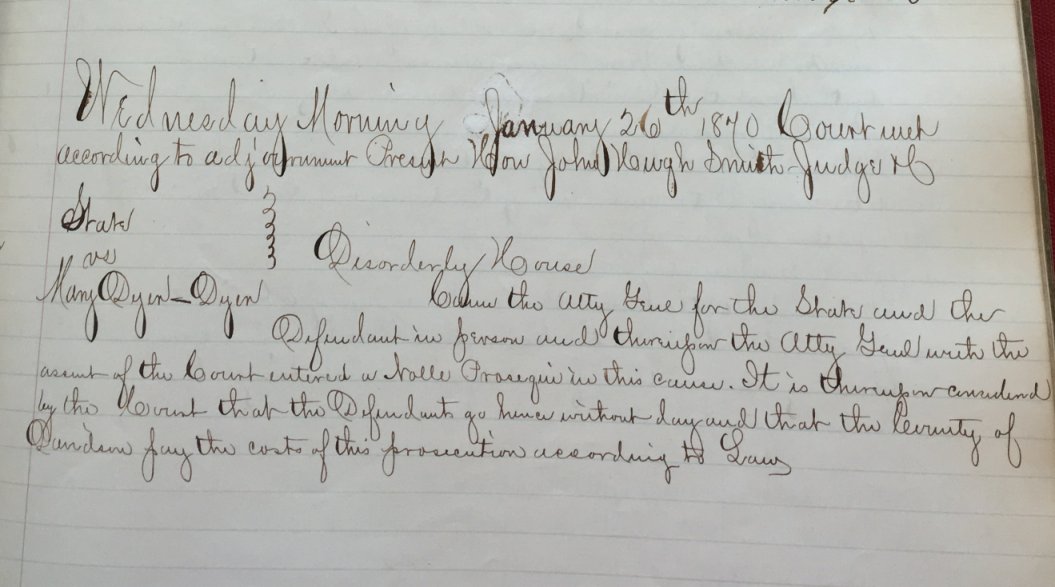
In August 1869, my 3rd-great-grandmother Mary Dyer was charged with keeping a disorderly house.
Davidson County, Tennessee. Criminal Court minutes, 1869, p. 501. Metropolitan Government Archives, Nashville Public Library, Nashville, Tennessee.
A "disorderly house" typically meant a brothel. On the same page of the Davidson County, Tennessee criminal court minutes, others will charged with "keeping house of ill fame." I am not sure what the difference was. Maybe a "house of ill fame" had a larger number of prostitutes. Or perhaps in this case, "disorderly house" meant something else. According to Duhaime's Law Dictionary, a disorderly house could also mean a gambling house. However, no one was charged with gaming at the same time that Mary was charged.
"Dyer," who was also charged, must have been her husband Michael Dyer. Since his first name is not given, perhaps he was not present when Mary was charged, but was also charged because the house was his residence.
On 26 January 1870, the Attorney General for the State of Tennessee entered a Nolle prosequi ("be unwilling to pursue"/"do not prosecute"). Davidson County, Tennessee paid the costs of the prosecution.
Davidson County, Tennessee. Criminal Court minutes, 1870, p. 45. Metropolitan Government Archives, Nashville Public Library, Nashville, Tennessee.
Davidson County, Tennessee. Criminal Court minutes, 1869, p. 501. Metropolitan Government Archives, Nashville Public Library, Nashville, Tennessee.
A "disorderly house" typically meant a brothel. On the same page of the Davidson County, Tennessee criminal court minutes, others will charged with "keeping house of ill fame." I am not sure what the difference was. Maybe a "house of ill fame" had a larger number of prostitutes. Or perhaps in this case, "disorderly house" meant something else. According to Duhaime's Law Dictionary, a disorderly house could also mean a gambling house. However, no one was charged with gaming at the same time that Mary was charged.
"Dyer," who was also charged, must have been her husband Michael Dyer. Since his first name is not given, perhaps he was not present when Mary was charged, but was also charged because the house was his residence.
On 26 January 1870, the Attorney General for the State of Tennessee entered a Nolle prosequi ("be unwilling to pursue"/"do not prosecute"). Davidson County, Tennessee paid the costs of the prosecution.
Davidson County, Tennessee. Criminal Court minutes, 1870, p. 45. Metropolitan Government Archives, Nashville Public Library, Nashville, Tennessee.
Thursday, June 16, 2016
Those Places Thursday: Illinois State Penitentiary
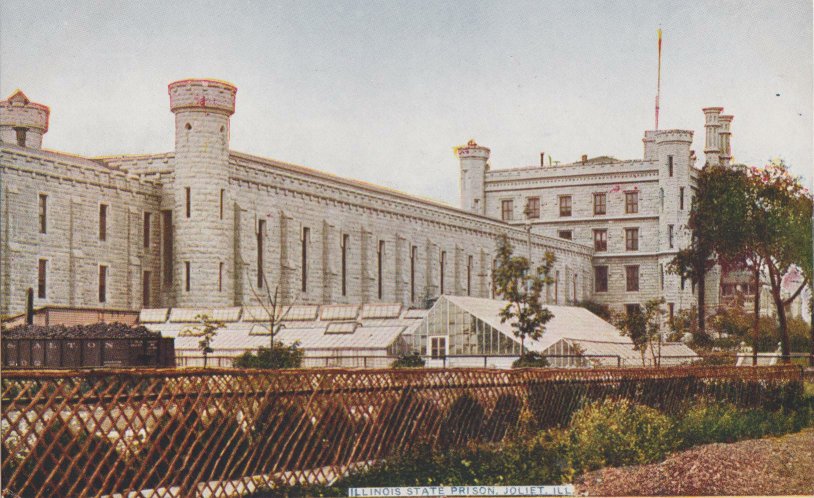
Illinois State Penitentiary was the original name for Joliet Correctional Center in Joliet, Will County, Illinois. It was in existence from 1858 to 2002.
The penitentiary was built with convict labor. In May 1858, thirty-three prisoners arrived from Alton to begin construction. Prison transfers were completed in July 1860.
From the 1870s onward, the penitentiary had work contracts with businesses in the area.
According to the Joliet Prison Post, vol. 1 no. 2 (1914), the inmates at the penitentiary were classified into three grades, which would determine the privileges that they were allowed. Prisoners in the first grade could write letters and have visitors once a week. Prisoners in the second grade were allowed to write and have visitors once every two weeks. Incoming prisoners were placed in the second grade upon arrival, and would be moved to the first grade after thirty days if their conduct was good. The third grade was for "willful offenders against the prison discipline" (p. 57). These prisoners could only write letters and have visitors once every four weeks, and could not go into the yard for recreation.
My great-grandfather's brother William D. Gatlin was sent to the Illinois State Penitentiary on 16 October 1917 to serve a sentence of one to fourteen years for robbery. He died there on 23 September 1919. He was shot by Henry Springer, a guard at the Illinois State Penitentiary, after refusing to obey orders. The incident occurred when William was being taken back to solitary confinement. William must have been in the third grade!
References
Joliet Correctional Center
Joliet Prison Post, Volume 1, Issue 2, 1914
Wednesday, December 30, 2015
Wedding Wednesday: Eventful Time for the Cox Family
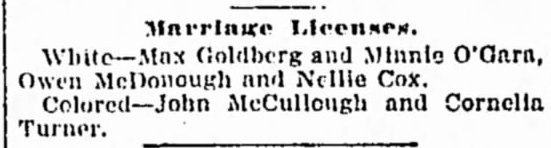
On 6 March 1899, my 2nd-great-grandmother's half-sister Nellie Cox married Owen McDonough in Davidson County, Tennessee. The March 7, 1899 issue of the Nashville American contains an announcement that the couple had obtained a marriage license.
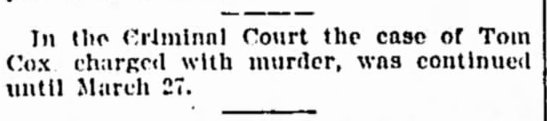
On the same page of the newspaper, there is more news about the Cox family. Nellie's brother Tom Cox was on trial for the murder of William Freeman. It was announced that his case was continued until March 27. (It ended in a mistrial.)
Nashville American, 7 March 1899, page 5
On the same page of the newspaper, there is more news about the Cox family. Nellie's brother Tom Cox was on trial for the murder of William Freeman. It was announced that his case was continued until March 27. (It ended in a mistrial.)
Nashville American, 7 March 1899, page 5
Sunday, December 27, 2015
Black Sheep Sunday: William D. Gatlin Robs His Own Family
Nashville Tennesseean and Nashville American, 22 September 1912
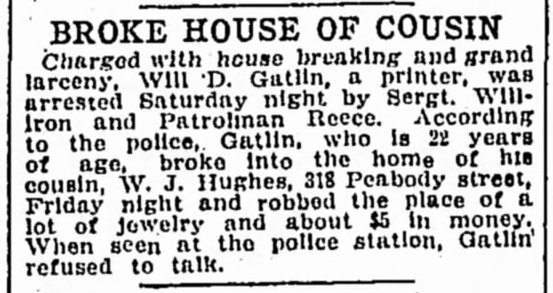
After my great-grandfather' brother William D. Gatlin escaped from jail in Bloomington, Indiana, he went to Nashville, Tennessee. He broken into the home of Walter J. Hughes and stole jewelry and $5. Although the above clipping states that W. J. Hughes was his cousin, he was actually William's uncle by marriage. Walter J. Hughes married Mary "Mollie" Dyer (William's mother's sister) on 11 February 1882.
Wednesday, December 16, 2015
52 Ancestors: Week 50 "Naughty": Michael J. Dyer
Many members of my family would be good choices for this week's 52 Ancestors theme, "Naughty." I have written about many of them already. I keep finding more and more "black sheep." This week I will focus on my 2nd-great-grandmother's brother Michael J. "Mike" Dyer, who only recently was added to the "naughty list" of relatives after I did more research in newspapers.
Mike was born about 1868 in Tennessee, probably Nashville (his family's place of residence). He was the son of Irish immigrants Mary and Michael Dyer. In 1870, Mike's father committed suicide. His mother remarried John Cox in 1871, but was widowed in 1878.
In 1884, Mike and his friends Patrick Kane and David Hanley (or Harley) ran away from home. Mike stole $40 from his mother's grocery store and got on a train in Nashville. They stopped at Louisville, Kentucky to buy revolvers, and then got off the train in Cincinnati, Ohio. They wanted to go West. They had been reading about Jesse James and Buffalo Bill, and wanted to scalp Indians and experience the Wild West. But they were hungry and broke, so they tried to sell their guns, and were arrested. Telegraphs were sent to their families.
The "Bound for the Plains" article, which was published in the 17 April 1884 issue of the Cincinnati Enquirer,was reprinted in the Nashville newspaper Daily American, 18 April 1884.
In May 1888, Mike was charged with assault with intent to kill.
In February 1892, Mike shot at William Dunn, who was engaged in a fight with Dave Farrell, and one of the bullets hit Dunn's thigh. Mike's half-brother Tom Cox then whipped out a knife and cut Dunn's neck.
Shortly afterward, Mike appeared in City Court on the charges of assault with and carrying a pistol and shooting in corporate limits.
In 1893, Mike was charged with carrying weapons.
In September 1894, Mike was arrested for gaming and was fined $10.
On December 12, 1895, Mike and Charles Neyman got into a fight. Charles, who claimed that Mike started the fight, hit Mike on the head with a hammer. Mike's skull was fractured, and several pieces of bone had to be removed. It was reported that he would recover.
However, on 24 December 1895, Mike died at his mother's home.
Two days after Mike's death notice was published, an item appeared in the newspaper which provided more information. Mike died of "congestion of brain." He must have died as a result of the blow on his head. I wonder if Charles Neylan was charged with murder. He should have been.
Mike's half-brother William Cox died on 2 March 1896. When William was buried, Mike's body was removed from a vault and buried at the same time.
Mike was born about 1868 in Tennessee, probably Nashville (his family's place of residence). He was the son of Irish immigrants Mary and Michael Dyer. In 1870, Mike's father committed suicide. His mother remarried John Cox in 1871, but was widowed in 1878.
In 1884, Mike and his friends Patrick Kane and David Hanley (or Harley) ran away from home. Mike stole $40 from his mother's grocery store and got on a train in Nashville. They stopped at Louisville, Kentucky to buy revolvers, and then got off the train in Cincinnati, Ohio. They wanted to go West. They had been reading about Jesse James and Buffalo Bill, and wanted to scalp Indians and experience the Wild West. But they were hungry and broke, so they tried to sell their guns, and were arrested. Telegraphs were sent to their families.
Daily American (Nashville, TN), 17 April 1884, page 4
The "Bound for the Plains" article, which was published in the 17 April 1884 issue of the Cincinnati Enquirer,was reprinted in the Nashville newspaper Daily American, 18 April 1884.
Cincinnati Enquirer, 17 April 1884, page 4
In May 1888, Mike was charged with assault with intent to kill.
Daily American (Nashville, TN), 8 May 1888, page 4
In February 1892, Mike shot at William Dunn, who was engaged in a fight with Dave Farrell, and one of the bullets hit Dunn's thigh. Mike's half-brother Tom Cox then whipped out a knife and cut Dunn's neck.
Daily American (Nashville. TN), 27 February 1892, page 3
Shortly afterward, Mike appeared in City Court on the charges of assault with and carrying a pistol and shooting in corporate limits.
Daily American (Nashville, TN), 1 March 1892, page 3
In 1893, Mike was charged with carrying weapons.
Daily American (Nashville, TN), 6 September 1893, page 4
In September 1894, Mike was arrested for gaming and was fined $10.
Nashville Daily American, 11 September 1894, page 6
On December 12, 1895, Mike and Charles Neyman got into a fight. Charles, who claimed that Mike started the fight, hit Mike on the head with a hammer. Mike's skull was fractured, and several pieces of bone had to be removed. It was reported that he would recover.
Nashville American, 14 December 1895, page 6
However, on 24 December 1895, Mike died at his mother's home.
Nashville American, 25 December 1895, page 5
Two days after Mike's death notice was published, an item appeared in the newspaper which provided more information. Mike died of "congestion of brain." He must have died as a result of the blow on his head. I wonder if Charles Neylan was charged with murder. He should have been.
Nashville American, 27 December 1895, page 5
Mike's half-brother William Cox died on 2 March 1896. When William was buried, Mike's body was removed from a vault and buried at the same time.
Nashville American, 3 March 1896, page 4
Labels:
52 Ancestors,
Black sheep,
Cox,
Dyer,
Kentucky,
Nashville,
Ohio,
Tennessee
Sunday, November 15, 2015
Black Sheep Sunday: Mike Dyer Arrested for Gambling
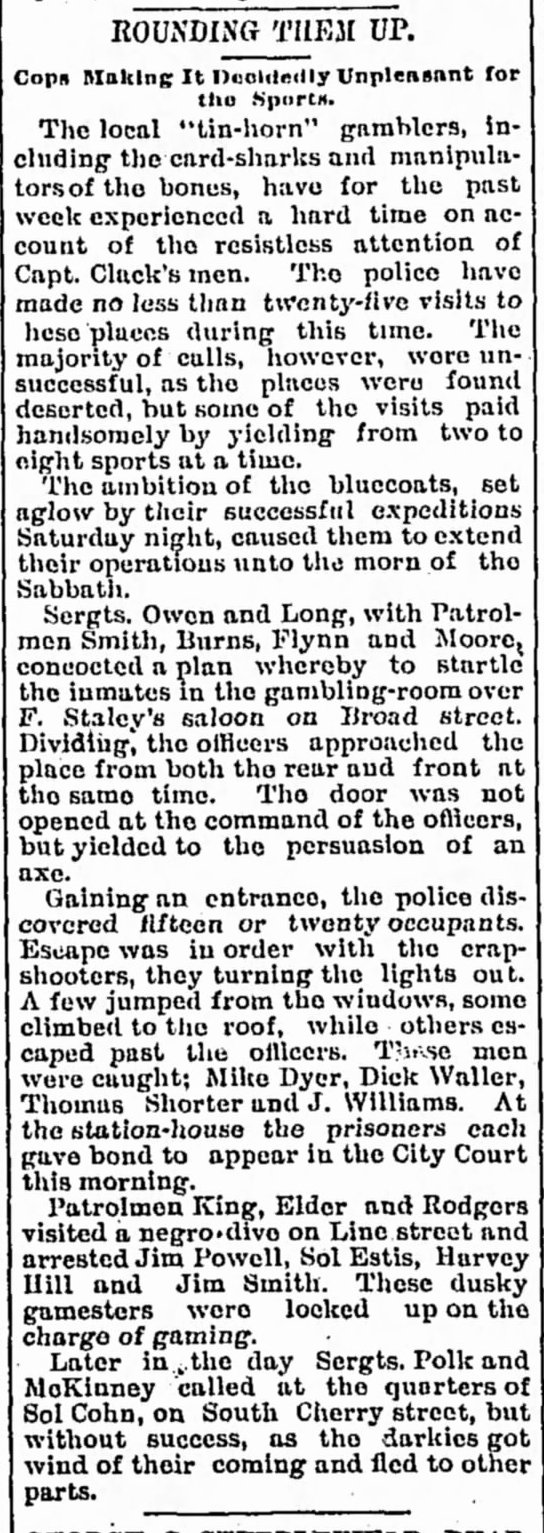
In early September 1894, the Nashville, Tennessee police officers visited gambling rooms at least twenty-five times within a week. They made some arrests, and one of the men arrested was my 2nd-great-grandmother's brother Mike Dyer.
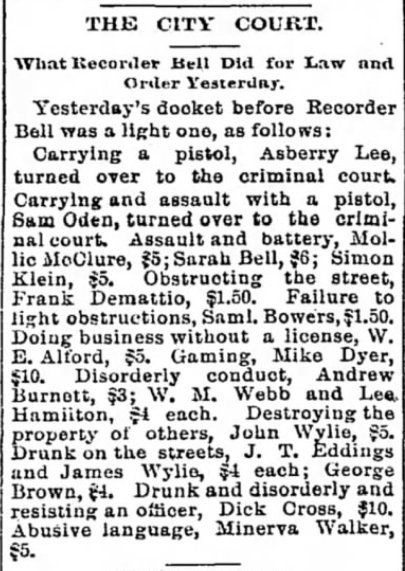
On 10 September 1894, Mike Dyer was fined $10.
This was not the first time that Mike Dyer had been arrested for gambling. On 28 August 1890, he was fined $10 for gaming.
Nashville Daily American, 10 September 1894, page 5
On 10 September 1894, Mike Dyer was fined $10.
Nashville Daily American, 11 September 1894, page 6
This was not the first time that Mike Dyer had been arrested for gambling. On 28 August 1890, he was fined $10 for gaming.
Daily American, 29 August 1890, page 5
Thursday, November 12, 2015
Thriller Thursday: A Shot in the Dark
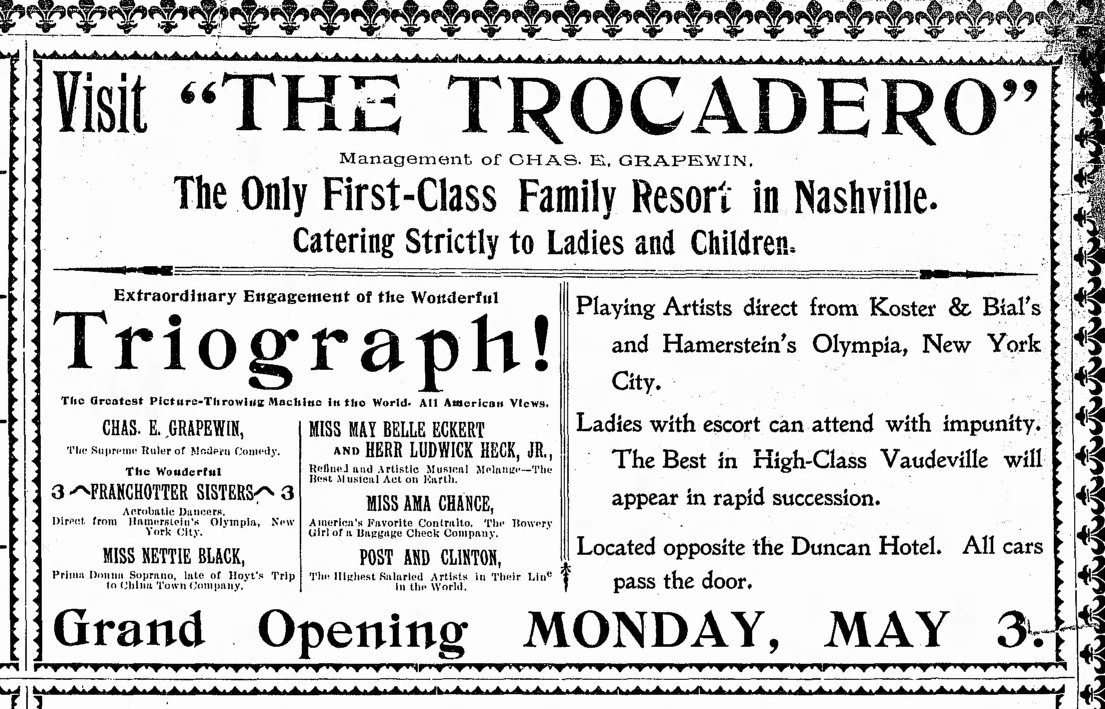
In May 1897, the Trocadero opened in Nashville, Tennessee. The theater catered to families; women and children could attend (although the women had to be escorted). High-class vaudeville artists performed at the Trocadero.
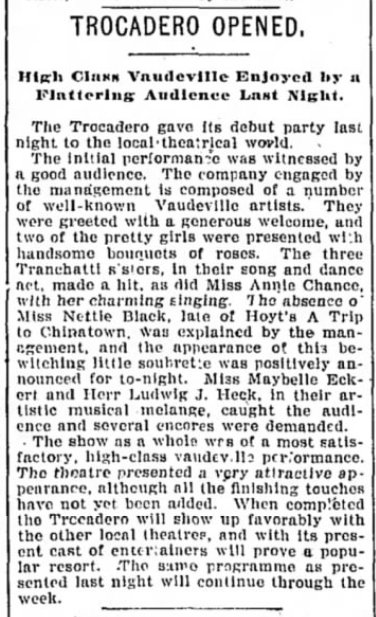
The opening performance on the night of 3 May 1897 was well attended, and the audience enjoyed the performance.
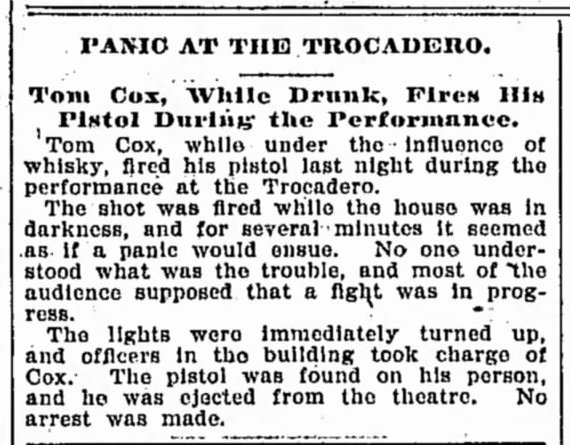
On the following night, 4 May 1897, things did not go as smoothly. While the lights were out, a shot was heard. The audience began to panic, thinking that a fight had broken out. However, there was no fight. My 2nd-great-grandmother's half-brother Tom Cox was in attendance. He had been drinking whiskey, and in his drunken state, decided to fire his pistol in the theater! He was immediately kicked out by security. He was lucky that he was not arrested.
Nashville American, 1 May 1897, page 5
The opening performance on the night of 3 May 1897 was well attended, and the audience enjoyed the performance.
Nashville American, 4 May 1897, page 3
On the following night, 4 May 1897, things did not go as smoothly. While the lights were out, a shot was heard. The audience began to panic, thinking that a fight had broken out. However, there was no fight. My 2nd-great-grandmother's half-brother Tom Cox was in attendance. He had been drinking whiskey, and in his drunken state, decided to fire his pistol in the theater! He was immediately kicked out by security. He was lucky that he was not arrested.
Nashville American, 5 May 1897, page 2
Sunday, November 8, 2015
Black Sheep Sunday: Henry Gatlin and Shirley Coles Charged With Shooting
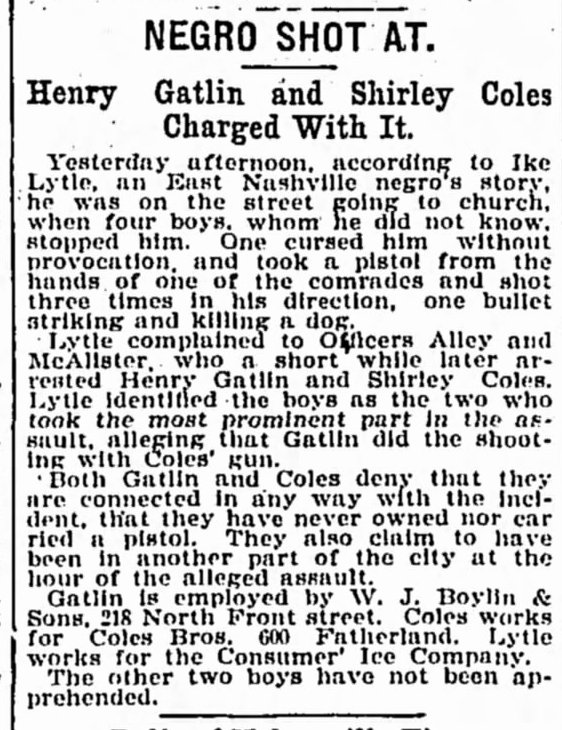
On 23 March 1902 in Nashville, Tennessee, four boys approached Ike Lytle, an African-American man. One of the boys shot at him three times. Lytle was not injured, but a dog was killed.
My great-grandfather Henry Brown Gatlin and Shirley Coles were charged with the shooting. According to Lytle, Henry Gatlin shot at him with Shirley Coles' gun.
Nashville American, 24 March 1902, page 3
Sunday, November 1, 2015
Black Sheep Sunday: Forty Years Ago in Nashville
My 3rd-great-grandfather William Dow Gatlin's murder trial was mentioned in the newspaper forty years after it took place.
Nashville Tennesseean and Nashville American, 19 September 1914, page 6
Wednesday, October 14, 2015
52 Ancestors: Week 41 "Colorful": John Reynold Gatlin
I have many colorful ancestors and collateral relatives. It would have been hard to choose just one to focus on this week, but since I already wrote about many of them in previous 52 Ancestors posts, I have chosen one I have not yet profiled for the 52 Ancestors Challenge.
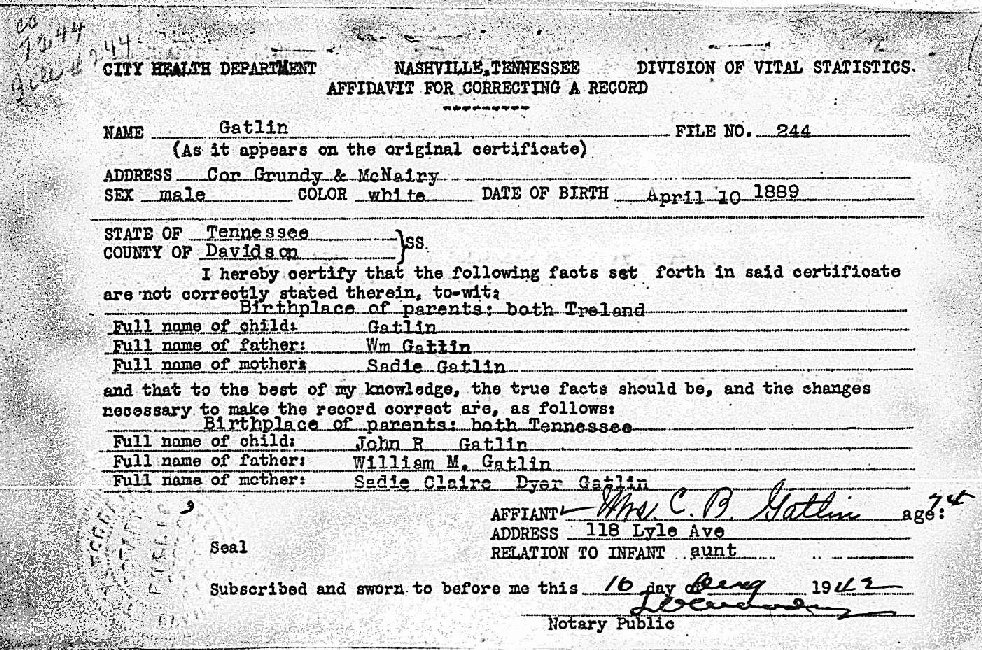
John Reynold Gatlin was born on 10 April 1889 in Nashville, Davidson County, Tennessee. He was the son of my 2nd-great-grandparents John William Morton Gatlin and Sarah Claire "Sadie" Dyer.
Nashville, Tennessee City Health Department, Division of Vital Statistics. Affidavit for Correcting a Record. File #224, John R. Gatlin. 10 August 1942. Ancestry.com. Tennessee, Delayed Birth Records, 1869-1909 [database on-line]. Provo, UT, USA: Ancestry.com Operations, Inc., 2012. Original data: Tennessee Delayed Birth Records, 1869–1909. Nashville, Tennessee: Tennessee State Library and Archives.
As a young man, he joined the United States Navy. I have not yet discovered the date of his enlistment. Although he is listed at his parents' address in the 1910 Nashville City Directory, he was not in their household when the 1910 United States Census was enumerated, and I could not find him elsewhere. He was probably in the navy at that time. If, as he later stated, he was in the navy for six years, he had probably enlisted several years earlier.
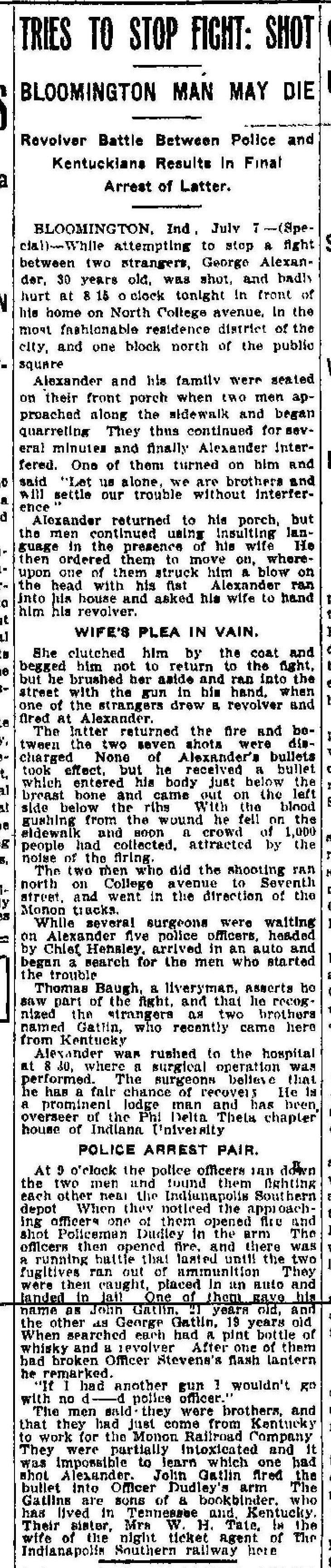
On 7 July 1911, John and his brother William got into a fight. They were in Bloomington, Indiana, where their sister Mary Florence (Gatlin) Pate was living. George Alexander, who witnessed the fight while sitting on his front porch, went inside and came back out with his gun. One of the brothers shot at him, and he was seriously injured. The Gatlin brothers were pursued by the police.
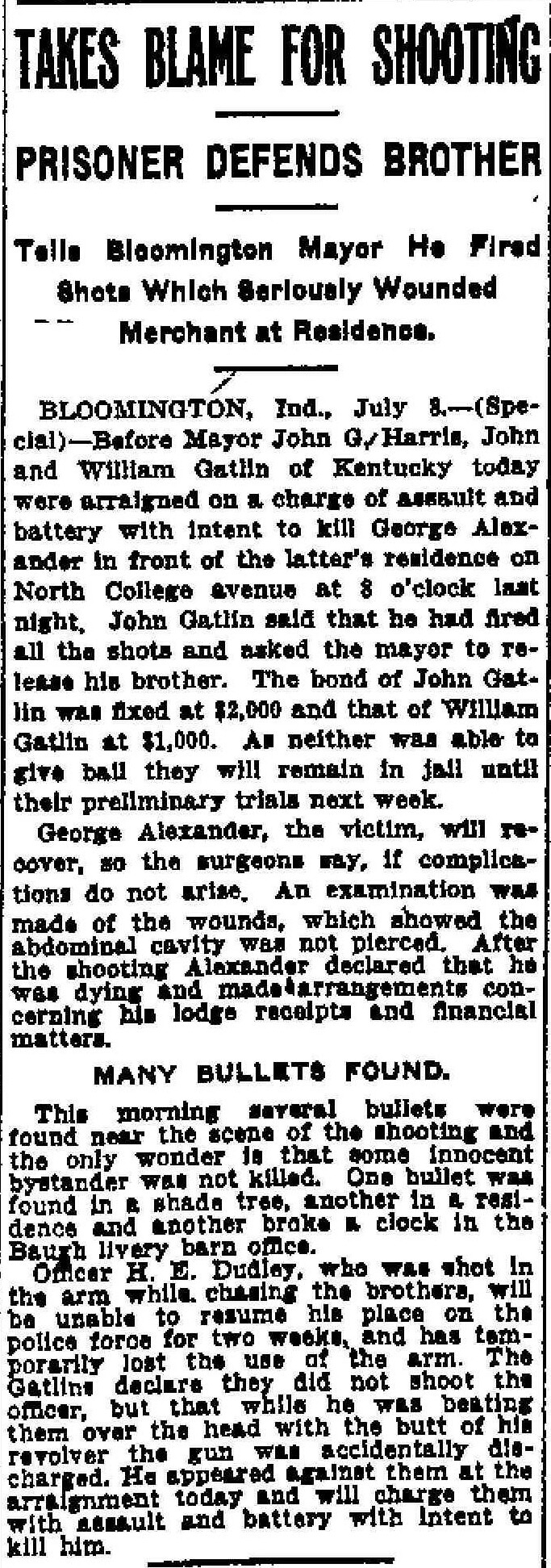
John claimed that he had been the one who had shot George Alexander. I wonder if he was trying to protect his brother William, who was a convicted felon.
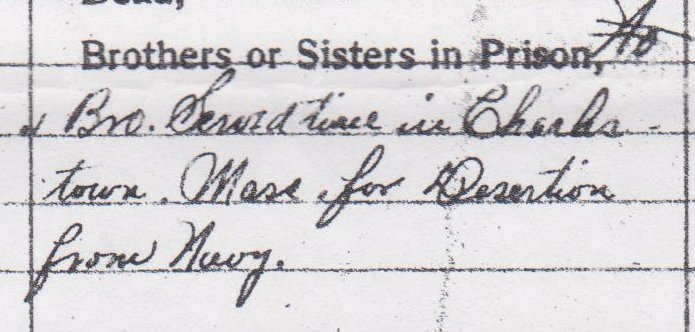
By 1912, John was in Charlestown Naval Prison in Boston, Massachusetts, serving time for desertion.
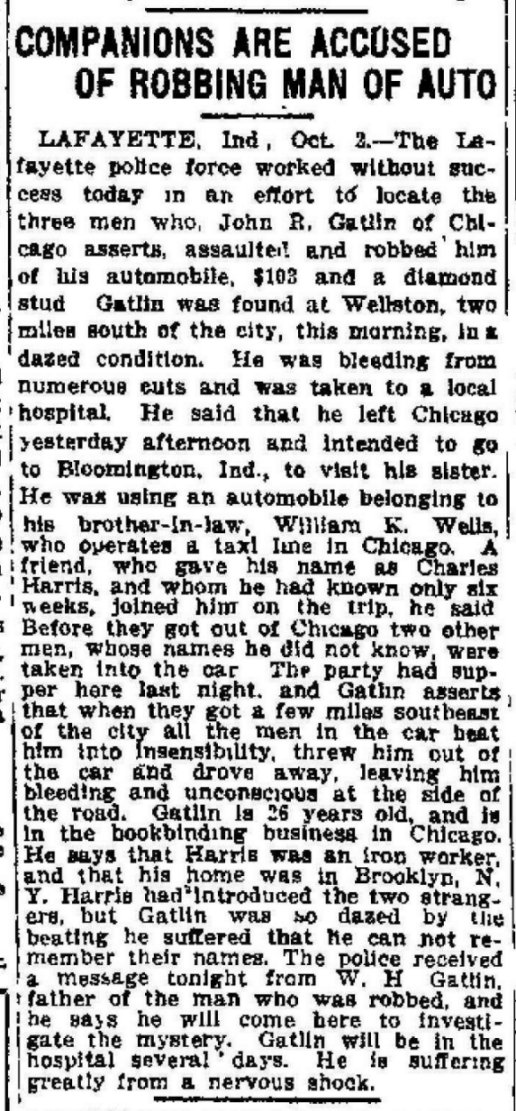
By October 1914, he was out of naval prison and was living in Chicago, Illinois, where he was working as a bookbinder. On 1 October 1914, he, a man named Charles Harris, and two men that Harris knew began driving from Chicago to Bloomington, Indiana. John planned to visit his sister. As they approached Lafayette, Indiana, the three other men beat John, stole a diamond stud and $103, and threw John out of the car.
William K. Wells, John's brother-in-law, was the owner of the car. At the time of the incident, John's sister Mary Florence was married to Downie Campbell Pate, and his sister Anna was married to Frank Joseph Smith. John was probably married to William K. Wells' sister, but I have not yet determined who she was.
On 7 October 1916, John was at Frank Morilli's saloon at 537 North Clark Street, Chicago, Illinois. He and several other men were causing trouble, and Morilli threw them out. John tried to go back inside the saloon, but Morilli shot him in the right leg.
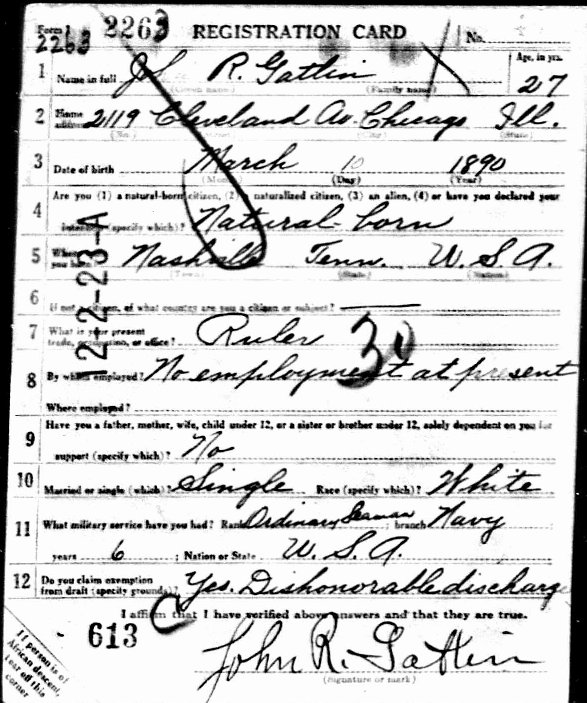
John's World War I draft registration card stated that his occupation was "ruler" but he was unemployed, that he was single, that he was an ordinary seaman in the U.S. Navy for 6 years, and that he had been dishonorably discharged.
In 1920, John was living in a rooming house in Chicago which was owned by Harry R. Arthur. He worked in a factory as a paper ruler. A 21 year old woman named Ermer Gatlin was listed underneath him. Although the relationship given (Roomer) was to the head of the household, she was probably John's wife. Both were listed as married in the census.
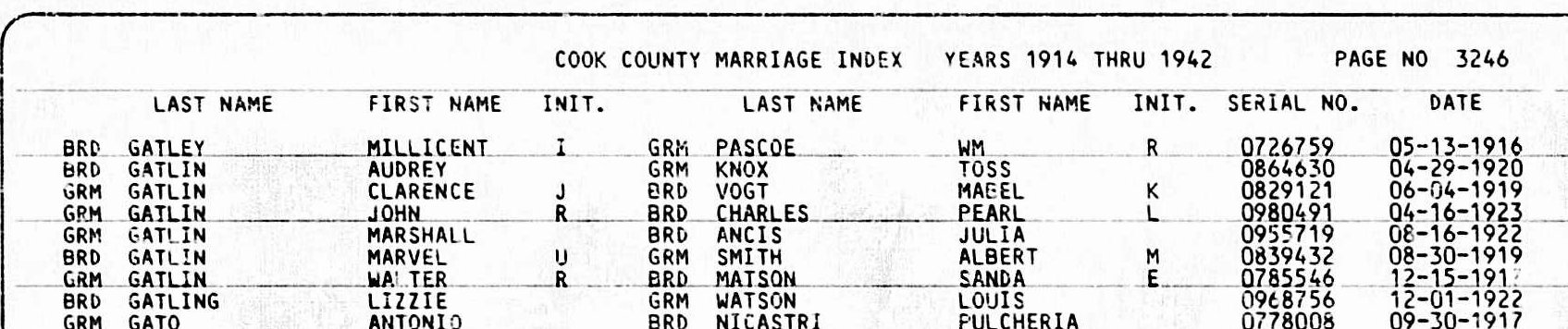
On 16 April 1923 in Cook County, Illinois, John married Pearl L. Charles.
In 1930, John lived in Chicago with his parents and his brothers Walter and Bruce. He was listed as married, but his wife was not in the household. The census record states that John was 18 years old when he first married. This may have been his marriage to the sister of William K. Wells, or he may have had yet another wife. He was working as a printer in a shop.
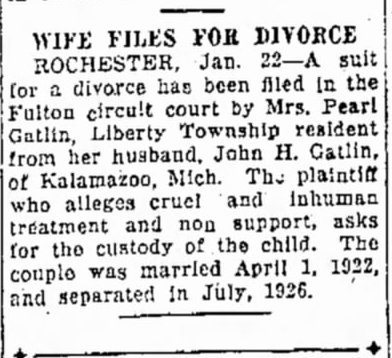
I think that the two items below probably refer to John and his wife Pearl. Although the marriage date is slightly off, it is close. John's sister Mary Florence (Gatlin) Pate lived in Bloomington, Indiana, and his sister Anna was living in Detroit, Michigan. I have not yet been able to locate any information about the child.
At the time of the 1940 U.S. Census, John was living with his brother Walter and mother Sadie. The handwriting is difficult to read, but it looks like his occupation was night watchman at City Yard.
On 9 December 1940 in Chicago, John married Mrs. Kathleen Culberson.
Cook County, Illinois marriage license and return, John R. Gatlin and Mrs. Kathleen P. Culberson, 9 December 1940.
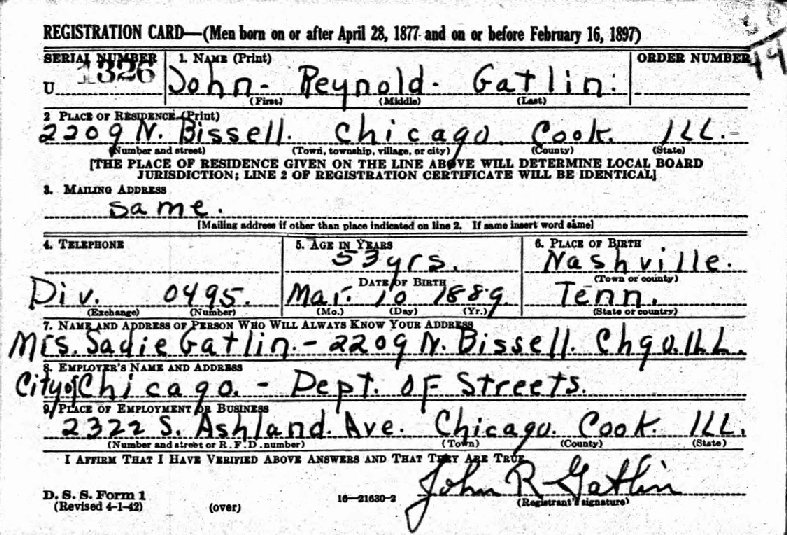
This marriage apparently did not last long. On John's World War II draft registration card, he listed his mother as the person who would always know his address.
The National Archives at St. Louis; St. Louis, Missouri; World War II Draft Cards (Fourth Registration), for The State of Illinois; State Headquarters: Illinois; Microfilm Series: M2097; Microfilm Roll: 95. Ancestry.com. U.S., World War II Draft Registration Cards, 1942 [database on-line]. Provo, UT, USA: Ancestry.com Operations, Inc., 2010.
John died in Chicago on 13 July 1945. He fell on a public sidewalk and fractured his skull. Since he lived such a colorful life, I wonder if there was more to the story. Perhaps he had been drinking. Maybe someone pushed him, although since his death was ruled an accident, it probably did not look like someone intended to kill him.
Illinois Department of Public Health, Division of Vital Statistics. Coroner's certificate of death. John R. Gatlin. Filed 19 July 1945.
John was buried in St. Joseph's Cemetery in River Grove, Cook County, Illinois.
John Reynold Gatlin was born on 10 April 1889 in Nashville, Davidson County, Tennessee. He was the son of my 2nd-great-grandparents John William Morton Gatlin and Sarah Claire "Sadie" Dyer.
Nashville, Tennessee City Health Department, Division of Vital Statistics. Affidavit for Correcting a Record. File #224, John R. Gatlin. 10 August 1942. Ancestry.com. Tennessee, Delayed Birth Records, 1869-1909 [database on-line]. Provo, UT, USA: Ancestry.com Operations, Inc., 2012. Original data: Tennessee Delayed Birth Records, 1869–1909. Nashville, Tennessee: Tennessee State Library and Archives.
As a young man, he joined the United States Navy. I have not yet discovered the date of his enlistment. Although he is listed at his parents' address in the 1910 Nashville City Directory, he was not in their household when the 1910 United States Census was enumerated, and I could not find him elsewhere. He was probably in the navy at that time. If, as he later stated, he was in the navy for six years, he had probably enlisted several years earlier.
On 7 July 1911, John and his brother William got into a fight. They were in Bloomington, Indiana, where their sister Mary Florence (Gatlin) Pate was living. George Alexander, who witnessed the fight while sitting on his front porch, went inside and came back out with his gun. One of the brothers shot at him, and he was seriously injured. The Gatlin brothers were pursued by the police.
Indianapolis Star, 8 July 1911, page 1
John claimed that he had been the one who had shot George Alexander. I wonder if he was trying to protect his brother William, who was a convicted felon.
Indianapolis Star, 9 July 1911, page 16
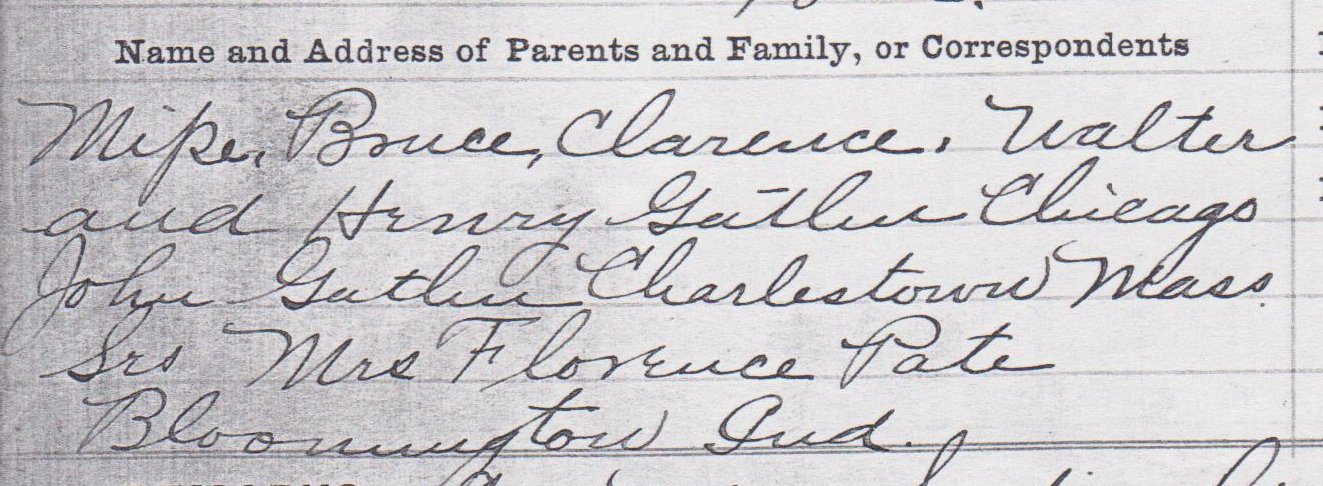
By 1912, John was in Charlestown Naval Prison in Boston, Massachusetts, serving time for desertion.
From Department of Correction Indiana State Prison records for William Gatlin, 1912.
By October 1914, he was out of naval prison and was living in Chicago, Illinois, where he was working as a bookbinder. On 1 October 1914, he, a man named Charles Harris, and two men that Harris knew began driving from Chicago to Bloomington, Indiana. John planned to visit his sister. As they approached Lafayette, Indiana, the three other men beat John, stole a diamond stud and $103, and threw John out of the car.
Indianapolis Star, 3 October 1914, page 4
William K. Wells, John's brother-in-law, was the owner of the car. At the time of the incident, John's sister Mary Florence was married to Downie Campbell Pate, and his sister Anna was married to Frank Joseph Smith. John was probably married to William K. Wells' sister, but I have not yet determined who she was.
On 7 October 1916, John was at Frank Morilli's saloon at 537 North Clark Street, Chicago, Illinois. He and several other men were causing trouble, and Morilli threw them out. John tried to go back inside the saloon, but Morilli shot him in the right leg.
Chicago Tribune, 8 October 1916, page 4
John's World War I draft registration card stated that his occupation was "ruler" but he was unemployed, that he was single, that he was an ordinary seaman in the U.S. Navy for 6 years, and that he had been dishonorably discharged.
World War I draft registration card, John R. Gatlin. Ancestry.com. U.S., World War I Draft Registration Cards, 1917-1918 [database on-line]. Provo, UT, USA: Ancestry.com Operations Inc, 2005.
Original data:
United States, Selective Service System. World War I Selective Service System Draft Registration Cards, 1917-1918.
Washington, D.C.: National Archives and Records Administration. M1509,
4,582 rolls. Imaged from Family History Library microfilm.
In 1920, John was living in a rooming house in Chicago which was owned by Harry R. Arthur. He worked in a factory as a paper ruler. A 21 year old woman named Ermer Gatlin was listed underneath him. Although the relationship given (Roomer) was to the head of the household, she was probably John's wife. Both were listed as married in the census.
On 16 April 1923 in Cook County, Illinois, John married Pearl L. Charles.
Ancestry.com. Cook County, Illinois Marriage Indexes, 1912-1942 [database on-line]. Provo, UT, USA: Ancestry.com Operations, Inc., 2011.
In 1930, John lived in Chicago with his parents and his brothers Walter and Bruce. He was listed as married, but his wife was not in the household. The census record states that John was 18 years old when he first married. This may have been his marriage to the sister of William K. Wells, or he may have had yet another wife. He was working as a printer in a shop.
I think that the two items below probably refer to John and his wife Pearl. Although the marriage date is slightly off, it is close. John's sister Mary Florence (Gatlin) Pate lived in Bloomington, Indiana, and his sister Anna was living in Detroit, Michigan. I have not yet been able to locate any information about the child.
Logansport Pharos-Tribune (Logansport, Indiana), 22 January 1931, page 9
Logansport Pharos-Tribune (Logansport, Indiana), 24 March 1931, page 3
At the time of the 1940 U.S. Census, John was living with his brother Walter and mother Sadie. The handwriting is difficult to read, but it looks like his occupation was night watchman at City Yard.
On 9 December 1940 in Chicago, John married Mrs. Kathleen Culberson.
Cook County, Illinois marriage license and return, John R. Gatlin and Mrs. Kathleen P. Culberson, 9 December 1940.
This marriage apparently did not last long. On John's World War II draft registration card, he listed his mother as the person who would always know his address.
The National Archives at St. Louis; St. Louis, Missouri; World War II Draft Cards (Fourth Registration), for The State of Illinois; State Headquarters: Illinois; Microfilm Series: M2097; Microfilm Roll: 95. Ancestry.com. U.S., World War II Draft Registration Cards, 1942 [database on-line]. Provo, UT, USA: Ancestry.com Operations, Inc., 2010.
John died in Chicago on 13 July 1945. He fell on a public sidewalk and fractured his skull. Since he lived such a colorful life, I wonder if there was more to the story. Perhaps he had been drinking. Maybe someone pushed him, although since his death was ruled an accident, it probably did not look like someone intended to kill him.
Illinois Department of Public Health, Division of Vital Statistics. Coroner's certificate of death. John R. Gatlin. Filed 19 July 1945.
John was buried in St. Joseph's Cemetery in River Grove, Cook County, Illinois.
Sunday, August 2, 2015
Black Sheep Sunday and Census Sunday: Boe Brothers in Jail
In 1930, my 2nd-great-grandfather's brother Gregar or (Gregger) Boe and his family were enumerated in Williston. Williams County, North Dakota. The households of his two married sons were enumerated below his household.
1930 United States Census, Williston, Williams County, North Dakota, population schedule, enumeration district 53-64, sheet no. 9B. Available from Ancestry.com. 1930 United States Federal Census [database on-line]. Provo, UT, USA: Ancestry.com Operations Inc, 2002.
Close up view of names in the above image:
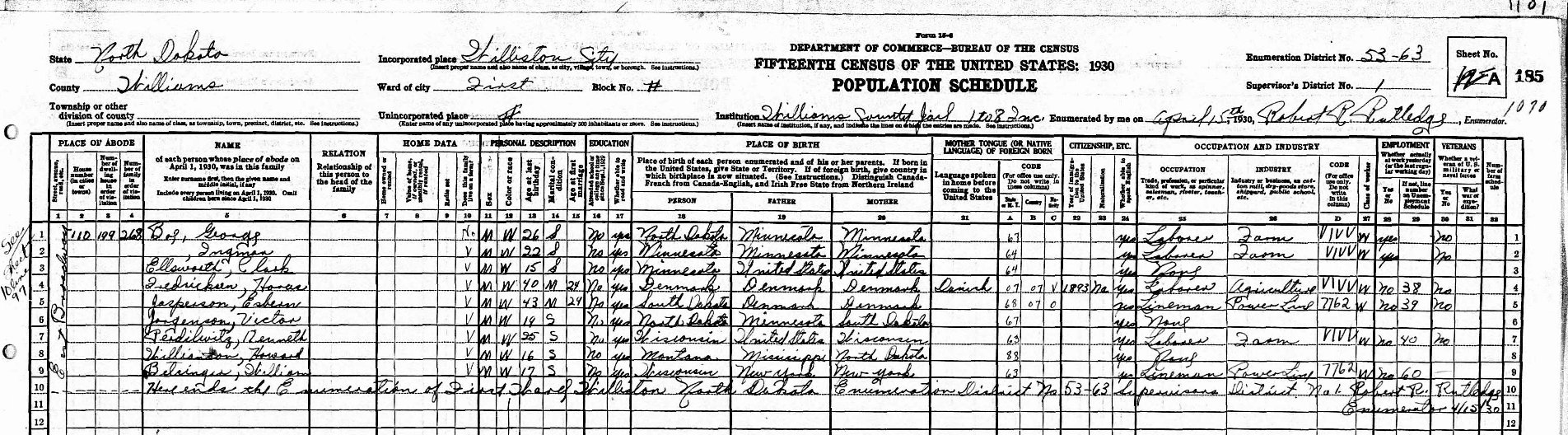
His sons George and Ingmar were enumerated twice in the 1930 United States Census. The second enumeration was in the Williams County Jail!

1930 United States Census, Williston, Williams County, North Dakota, population schedule, enumeration district 53-63, sheet no. 12A. Available from Ancestry.com. 1930 United States Federal Census [database on-line]. Provo, UT, USA: Ancestry.com Operations Inc, 2002.
Close up view of names in the above image:
Ingmar Boe's wife, Louise Ann Decouteau, was a member of the Ojibwe Native American tribe. The 1937 Indian Census of the Turtle Mountain Indian Reservation shows that Ingmar was in the penitentiary.
Census of the Turtle Mountain reservation of the Turtle Mountain jurisdiction, North Dakota. 1 January 1937. Page 71. Ancestry.com. U.S., Indian Census Rolls, 1885-1940 [database on-line]. Provo, UT, USA: Ancestry.com Operations Inc, 2007. Original data: Indian Census Rolls, 1885-1940; (National Archives Microfilm Publication M595, 692 rolls); Records of the Bureau of Indian Affairs, Record Group 75; National Archives, Washington, D.C.
Although the Indian census roll indicated that Ingmar would be in the penitentiary until 1940, he had been released by 5 November 1938, when he married Pearl (Peterson) Gardner in Sidney, Richland County, Montana.
Montana, County Marriages, 1865-1950, database with images, FamilySearch (https://familysearch.org/ark:/61903/1:1:F37L-PSC), Ingmar Boe and Pearl Gardner, 5 Nov 1938; citing Marriage, Sidney, Richland, Montana, county courthouses, Montana; FHL microfilm 1,905,316.
I have not yet learned why George and Ingmar were incarcerated.
1930 United States Census, Williston, Williams County, North Dakota, population schedule, enumeration district 53-64, sheet no. 9B. Available from Ancestry.com. 1930 United States Federal Census [database on-line]. Provo, UT, USA: Ancestry.com Operations Inc, 2002.
Close up view of names in the above image:
His sons George and Ingmar were enumerated twice in the 1930 United States Census. The second enumeration was in the Williams County Jail!
1930 United States Census, Williston, Williams County, North Dakota, population schedule, enumeration district 53-63, sheet no. 12A. Available from Ancestry.com. 1930 United States Federal Census [database on-line]. Provo, UT, USA: Ancestry.com Operations Inc, 2002.
Close up view of names in the above image:
Ingmar Boe's wife, Louise Ann Decouteau, was a member of the Ojibwe Native American tribe. The 1937 Indian Census of the Turtle Mountain Indian Reservation shows that Ingmar was in the penitentiary.
Census of the Turtle Mountain reservation of the Turtle Mountain jurisdiction, North Dakota. 1 January 1937. Page 71. Ancestry.com. U.S., Indian Census Rolls, 1885-1940 [database on-line]. Provo, UT, USA: Ancestry.com Operations Inc, 2007. Original data: Indian Census Rolls, 1885-1940; (National Archives Microfilm Publication M595, 692 rolls); Records of the Bureau of Indian Affairs, Record Group 75; National Archives, Washington, D.C.
Although the Indian census roll indicated that Ingmar would be in the penitentiary until 1940, he had been released by 5 November 1938, when he married Pearl (Peterson) Gardner in Sidney, Richland County, Montana.
Montana, County Marriages, 1865-1950, database with images, FamilySearch (https://familysearch.org/ark:/61903/1:1:F37L-PSC), Ingmar Boe and Pearl Gardner, 5 Nov 1938; citing Marriage, Sidney, Richland, Montana, county courthouses, Montana; FHL microfilm 1,905,316.
I have not yet learned why George and Ingmar were incarcerated.
Thursday, July 30, 2015
Thriller Thursday: Charles Buise Embezzles Stake Money and Flees
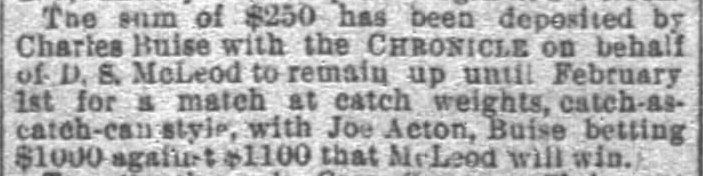
Shortly before the 1892 wrestling match between D. S. McLeod and Joe Acton, Charles Buise deposited $250 with the Chronicle to secure a bet on McLeod, $1000 against $1100. Washington Marion, a traveling salesman, gave Charles Buise $500 to bet on McLeod, and Buise secured a bet of $600 for him.
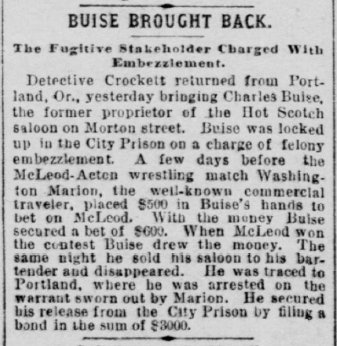
Charles Buise was the proprietor of the Hot Scotch saloon on Morton Street in San Francisco. After he collected his winnings, he did not give Washington Marion his share of the money. He sold his saloon to his bartender, and headed to Portland, Oregon, where his wife was working as a song and dance performer. He was captured there several months later and was brought back to San Francisco. He was charged with embezzlement and placed in the San Francisco City Prison, but was released on $3000 bond.
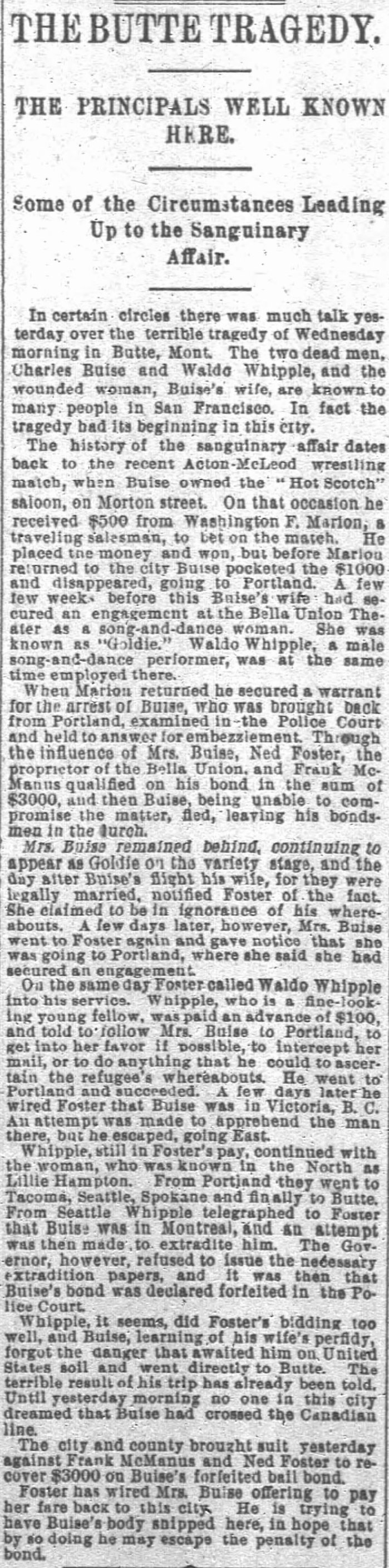
After getting out on bail, Charles Buise left the United States and returned to his home country, Canada. He went to Victoria, British Columbia. The winning wrestler, McLeod, was also from British Columbia; he came from Nanaimo. I wonder if this was coincidental, or if there was some connection. Charles Buise had been born and baptized in Quebec City, and had lived in Montreal before he came to San Francisco (and had allegedly passed a counterfeit bill there in 1887). Although an attempt was made to capture him in British Columbia, he escaped and went to Montreal. When he found out that his wife was cheating on him with actor Waldo Whipple, he tracked them down in Butte, Montana, where he shot them and then shot himself.
San Francisco Chronicle, 22 January 1892
Prior to the match, there was suspicion that the contest would not be a fair one. McLeod won the match.
The Morning Call (San Francisco, CA), 11 March 1892
Charles Buise was the proprietor of the Hot Scotch saloon on Morton Street in San Francisco. After he collected his winnings, he did not give Washington Marion his share of the money. He sold his saloon to his bartender, and headed to Portland, Oregon, where his wife was working as a song and dance performer. He was captured there several months later and was brought back to San Francisco. He was charged with embezzlement and placed in the San Francisco City Prison, but was released on $3000 bond.
The Morning Call (San Francisco, CA), 1 July 1892
After getting out on bail, Charles Buise left the United States and returned to his home country, Canada. He went to Victoria, British Columbia. The winning wrestler, McLeod, was also from British Columbia; he came from Nanaimo. I wonder if this was coincidental, or if there was some connection. Charles Buise had been born and baptized in Quebec City, and had lived in Montreal before he came to San Francisco (and had allegedly passed a counterfeit bill there in 1887). Although an attempt was made to capture him in British Columbia, he escaped and went to Montreal. When he found out that his wife was cheating on him with actor Waldo Whipple, he tracked them down in Butte, Montana, where he shot them and then shot himself.
San Francisco Chronicle, 27 January 1893
Although the above article states that Waldo Whipple also died, he actually survived his injuries.
Charles Buise was probably related to Elizabeth Buise, who married my 3rd-great-grandfather John Bennet Winters. But since his mother Margaret McGillivray's death notice was transcribed in the Winters family Bible and she was not Elizabeth Buise's mother, I wonder if he is also related to me. I have many black sheep in my family. Considering all of Charles Buise's misdeeds, I figure he must be my cousin!
Subscribe to:
Posts (Atom)