
Showing posts with label Netherlands. Show all posts
Showing posts with label Netherlands. Show all posts
Tuesday, January 24, 2017
Tuesday's Tip: Mapire
Mapire (http://mapire.eu/en/) provides access to historical maps of the Habsburg Empire. It contains maps of the First Military Survey (1763-1787), the Second Military Survey (1806-1869), the Third Military Survey (1869-1887), the Military Survey of Hungary (1941), the Austrian Netherlands (1764-1771), and the Hungarian Kingdom (1869-1887). There are cadastral maps from the nineteenth century, and maps of Europe in the eighteenth century, around 1850, and 1850-1890. The site also includes maps from other countries: Italy (nineteenth century), France (eighteenth century), Belgium (eighteenth century), Lower and Upper Alsace (1731), Scotland (nineteenth century), Ordnance Survey of England and Wales (about 1890), Southwest Germany (1797), Germany (nineteenth century), Finland (1918), and Norway (nineteenth century). There are maps of European cities: Vienna (eighteenth century), Budapest (eighteenth-twentieth century), Budapest (1944), London (eighteenth century), Moscow, Paris (1739), and Rome (1829). The Austrian Historic Town Atlas provides information about the history and urban development of sixty-four Austrian towns. It is possible to view the maps synchronized with each other or with today's maps. The maps can also be viewed in 3D. Copies of the maps (reproductions or digital copies) can be purchased. If you have ancestors from these areas, Mapire may be very helpful to you.

Monday, June 8, 2015
Mappy Monday: Wieringen, North Holland, Netherlands
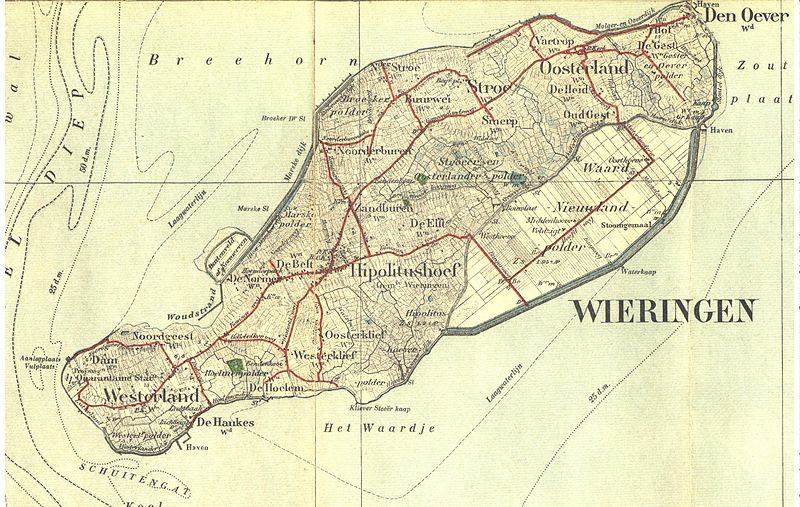
This map from 1909 depicts the former island of Wieringen. It is now part of the municipality of Hollands Kroon, in the North Holland province of the Netherlands. Between 1924 and 1932, dikes were built and the surrounding water was drained and filled in. Wieringen is now connected to the mainland.
My 10th-great-grandfather Meindert Doodes was from Wieringen.
Monday, June 1, 2015
Maritime Monday: Dutch Fluyts
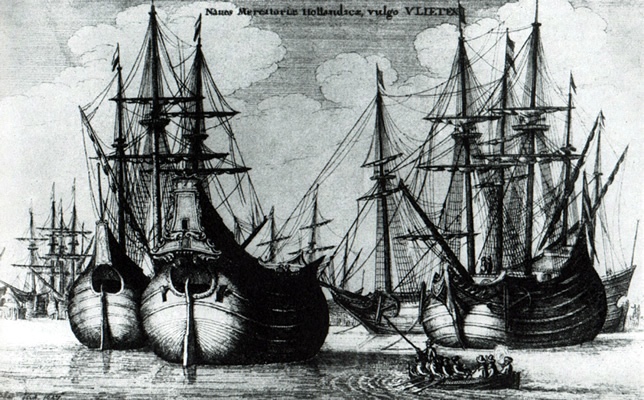
This engraving by Wenceslaus Hollar depicts Dutch fluyts. A fluyt was a type of cargo ship that was first made in 1595. It did not have the capability of being converted to a warship; therefore, it was less expensive to produce, and could carry more cargo. It helped the Dutch to become the leading maritime power of the seventeenth century. Fluyts were used by the Dutch East India Company.
My 10th-great-grandfather Meindert Doodes was a sea captain from Holland. He and his wife and children settled in Virginia by 1656. He probably sailed this type of ship.
References
Fluyt
The Fluyt: The Container Ship of the Golden Age
Monday, August 11, 2014
Mappy Monday: Rhine River (Fluss Rhein)
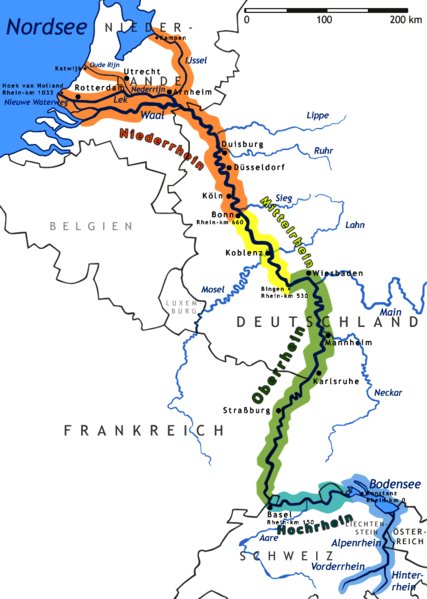
This map shows the Rhine River (Fluss Rhein). The Vorderrhein and Hinterrhein come together in Switzerland. The Hochrhein (High Rhine) flows to the west from Lake Constance to Basel, Switzerland. The Oberrhein (Upper Rhine) flows from Basel to Bingen, Germany. This section of the Rhine flows through Switzerland, France (Alsace), and the German states of Baden-Württemburg, Rhineland-Palatinate (Rheinland-Pfalz), and Hesse. The Mittelrhein (Middle Rhine) flows from Bingen to Bonn. The Niederrhein (Lower Rhine) begins in Bonn. After it enters the Netherlands, it splits into branches, including Waal, Merwede, Nieuwe Maas, and Nederrijn, and flows out to the North Sea.
My German ancestors lived by the Rhine River. My Schneider ancestors were from Erpel and Remagen. My Nagel ancestors lived in Bonn for a while. They were originally from Hürth (Hermülheim, Kendenich), which is near the Rhine. My Gersbacher/Gerspacher ancestors were from the Hotzenwald region in Baden, in Görwihl and Niederwihl (now part of Görwihl). My Dreier ancestors were from Niederwihl. Görwihl is at the edge of the river Alb, which is a tributary of the Rhine.
Sunday, June 29, 2014
Dutch Veterans' Day
Since 2005, Dutch Veterans' Day (Veteranendag) has been observed on the last Saturday in June. The date was chosen in honor of Prince Bernhard, who was born on June 29. Veterans who served the Netherlands in wars or international peacekeeping operations are honored on this day. A parade takes place at The Hague, and the Royal Netherlands Air Force performs a flyby. Local events are also organized in other cities.
On 29 October 1932 in Bowling Green, Wood County, Ohio, my great-grandfather's sister Anna Elizabeth Gatlin (Anna E. Morrison at the time of her marriage) married Cornelius Thomas de Kam. Both were living in Detroit, Michigan. They divorced in Wayne County, Michigan on 26 November 1935, and Cornelius remarried his second wife, also named Anna.
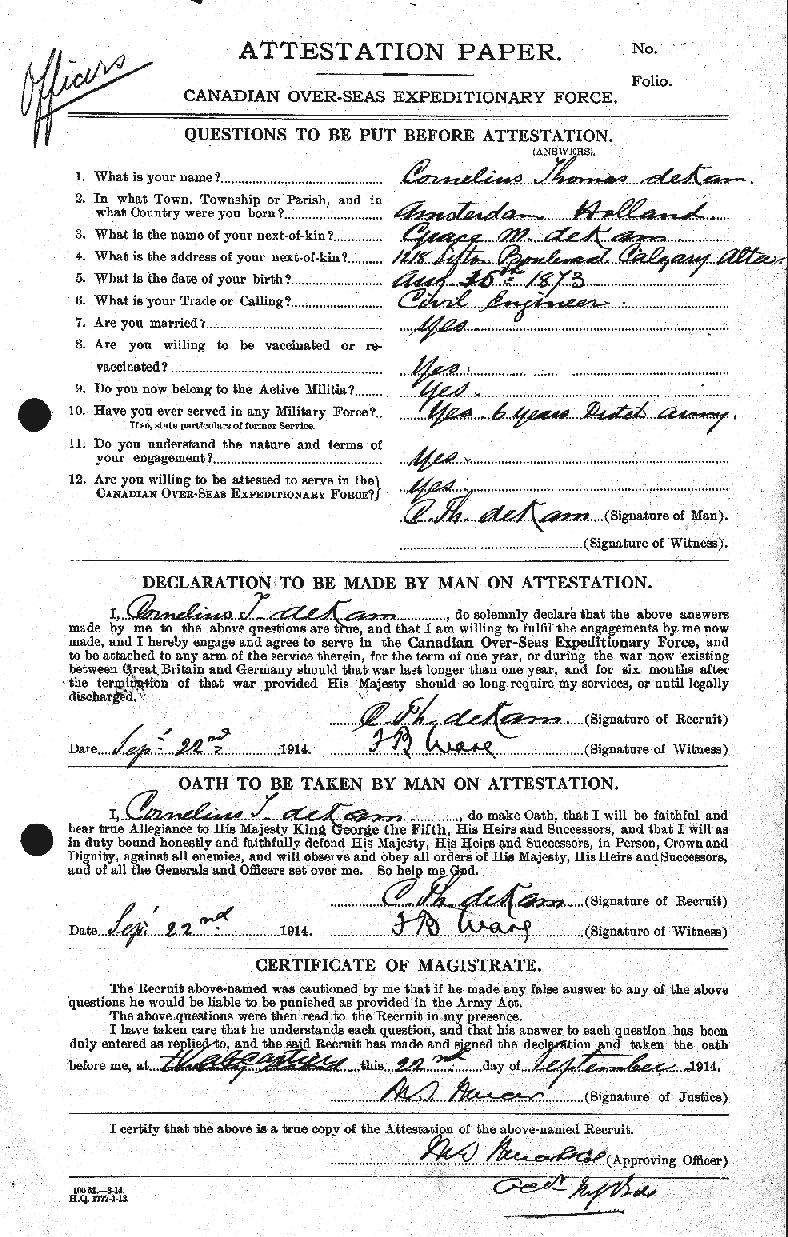
Cornelius (Cornelis) was born on 15 August 1873 in Wissenkerke, Noord-Beveland, Zeeland, Netherlands. He immigrated to Canada, and then to the United States. According to his attestation paper for the Canadian Over-Seas Expeditionary Force, he had served in the Dutch army for six years. I searched militieregisters.nl, which contains militia records from seventeen Dutch archives, and I found that a record is available for Cornelis Thomas de Kam. Unfortunately, payment for the image must be made by bank transfer, and with added bank fees, it would be expensive to purchase the document.

Cornelius continued his military service after he immigrated to Canada. He agreed to serve in the Canadian Over-Seas Expeditionary Force on 22 September 1914.
 Attestation paper, Canadian Over-Seas Expeditionary Force. Cornelius Thomas de Kam. 22 September 1914. Available from Library and Archives Canada.
Cornelius was a major in the Calgary Cycle Corps. He was also director of the provincial military school in Alberta, Canada. The infantry school was conducted in one of the city schools, but moved to Camp Sarcee in Calgary, Alberta in 1916.
References
Dutch Veterans' Day: last Saturday of June
Netherlands Veterans Institute
On 29 October 1932 in Bowling Green, Wood County, Ohio, my great-grandfather's sister Anna Elizabeth Gatlin (Anna E. Morrison at the time of her marriage) married Cornelius Thomas de Kam. Both were living in Detroit, Michigan. They divorced in Wayne County, Michigan on 26 November 1935, and Cornelius remarried his second wife, also named Anna.
Cornelius (Cornelis) was born on 15 August 1873 in Wissenkerke, Noord-Beveland, Zeeland, Netherlands. He immigrated to Canada, and then to the United States. According to his attestation paper for the Canadian Over-Seas Expeditionary Force, he had served in the Dutch army for six years. I searched militieregisters.nl, which contains militia records from seventeen Dutch archives, and I found that a record is available for Cornelis Thomas de Kam. Unfortunately, payment for the image must be made by bank transfer, and with added bank fees, it would be expensive to purchase the document.
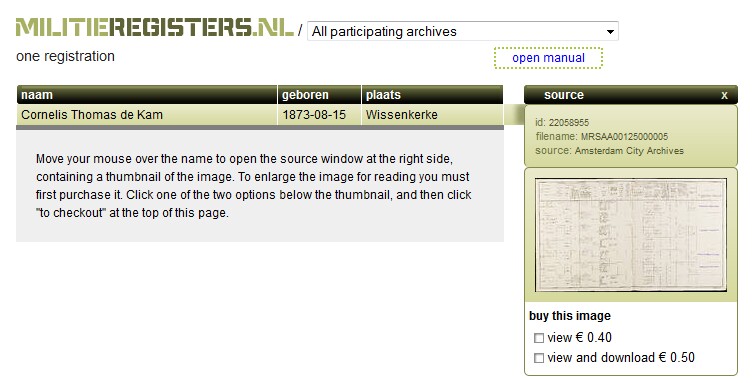
Screen shot from militieregisters.nl, showing that a record is available for Cornelis Thomas de Kam.
Cornelius continued his military service after he immigrated to Canada. He agreed to serve in the Canadian Over-Seas Expeditionary Force on 22 September 1914.
Cornelius was a major in the Calgary Cycle Corps. He was also director of the provincial military school in Alberta, Canada. The infantry school was conducted in one of the city schools, but moved to Camp Sarcee in Calgary, Alberta in 1916.
References
Dutch Veterans' Day: last Saturday of June
Netherlands Veterans Institute
Subscribe to:
Posts (Atom)