Nashville Tennessean, 22 November 1918, page 8
Covering genealogy, family history, historical events and places, and anything else related!
Saturday, November 21, 2015
Shopping Saturday: Christmas Shopping in 1918
In 1918, Americans were encouraged to do their Christmas shopping early. The Council of National Defense placed notices in publications and announced that due to the war, the stores would not have extended shopping hours or additional employees, and would not make extra deliveries.
Friday, November 20, 2015
Friend of Friends Friday: Randal, Slave of Henry Chambers
Nashville Whig, 17 October 1825, page 4
From the Nashville Whig (Nashville, Davidson County, Tennessee):
COMMITTED to the Jail of Davidson county, state of Tennessee, on the 24th September 1825, a black NEGRO MAN, about 5 feet 6 inches high, has lost some of his upper and under teeth, who says his name is RANDAL, and that he belongs to Henry Chambers, in Limestone County, in the Big Prairie, Alabama. The owner is requested to come and bring proof with him, prove his property, pay charges and take him away.
O3 EDWARD DANIEL, Jailer.
Thursday, November 19, 2015
Treasure Chest Thursday: John Schneider's Law School Diploma
My cousin Helen recently sent me our great-grandfather John Schneider's diploma. He graduated from City College of Law and Finance in St. Louis, Missouri on 2 June 1921. He earned a Bachelor of Laws.
I framed the diploma and it is hanging on my living room wall. It is a priceless treasure!
Wednesday, November 18, 2015
52 Ancestors: Week 46 "Changes": C. J. Dahlquist
My 2nd-great-grandfather Carl Johan/Charles John Dahlquist went through many changes during his lifetime, including his name, his country of residence, his citizenship, and his business partners.
Carl Johan was born on 13 June 1862 in Kinneved, Skaraborg, Västergötland, Sweden, and was baptized on 15 June 1862. He was the son of Johannes Christiansson and Maria Christina Jonsdotter.
Birth/baptism record for Carl Johan, 1862. Kinneved C:3 (1851-1885) Image 45 (AID: v55921.b45, NAD: SE/GLA/13283), image 45.
On 23 September 1881, he left Gothenburg, Sweden on the Orlando. By this time, he was using the name C. J. Dahlqvist.
C. J. Dahlqvist. Orlando passenger list. Gothenburg, Sweden. 23 September 1881. Ancestry.com. Gothenburg, Sweden, Passenger Lists, 1869-1951 [database on-line]. Provo, UT, USA: Ancestry.com Operations, Inc., 2010. Original data: Göteborgs Poliskammare, EIX 1-143, 1869–1950. Landsarkivet i Göteborg, Göteborg, Sweden.
On the Orlando, he sailed to Hull, England. The articles Migration from Northern Europe to America via the Port of Hull, 1848-1914 and Conditions for Emigrants on the Voyage from Gothenburg to Hull provide insight regarding his experience. According to the Orlando passenger list, his final destination was New York, but he settled in Chicago, Illinois. In the United States, he was known as Charles John Dahlquist.
In 1882, his younger brother Frans August Johanson left Sweden for Chicago. By 1889, he had changed his name to Frank A. Shirlander. The oldest brother, Alfrid, remained in Sweden. He took his father's patronymic as his surname and was known as Alfrid Kristiansson. Three brothers, three different surnames!
On 20 December 1885, he married Marie (or Mary) Louise Borg at the Swedish Lutheran Church in Baillytown, Porter County, Indiana.
Indiana Marriages, 1811-2007," database with images, FamilySearch (https://familysearch.org/ark:/61903/1:1:KDHQ-35C), Charles J. Dahlquist and Mary Clara Borg, 20 Dec 1885; citing Valparaiso, Porter, Indiana, county clerk offices, Indiana; FHL microfilm 1,686,157. Mary's middle name is incorrect on the document. Note that when Rev. A. Challman filled out the form, he gave her name as Mary L. Borg.
Charles and Marie lived in Chicago after their marriage.Their first child, my great-grandmother Ellen Victoria Dahlquist, was born on 8 September 1886. Their second child and first son, Carl Frederick Dahlquist, was born on 10 January 1888.
Charles was naturalized on 28 August 1888.
Charles J. J. Dahlquist naturalization, 28 August 1888. Superior Court, Cook County, Illinois. National Archives and Records Administration (NARA); Washington, D.C.; Soundex Index to Naturalization Petitions for the United States District and Circuit Courts, Northern District of Illinois and Immigration and Naturalization Service District 9, 1840-1950 (M1285); Microfilm Serial: M1285; Microfilm Roll: 44. Ancestry.com. U.S. Naturalization Record Indexes, 1791-1992 (Indexed in World Archives Project) [database on-line]. Provo, UT, USA: Ancestry.com Operations, Inc., 2010.
Charles and Marie had two more children: Martin Luther Dahlquist (born 22 February 1891), and Juliet Caroline Marie Dahlquist (born 14 July 1896).
In 1900, the Dahlquist family lived at 6031 State Street, Chicago, Illinois. They had moved to 6311 Eggleston Avenue, Chicago by 1910. On 27 September 1911, my paternal grandmother Helen Martha Marie Anderson was born; Charles and Marie became grandparents.
Charles worked as a shoe dealer. He went into business with Axel E. Swanson in 1895. Their store was located at 6031 State Street, Chicago, Illinois. The store had moved to 511 W. 63rd Street by 1902. By 1906 he and Swan J. Burkdahl had gone into business together. The store remained at the same location, but was called Burkdahl & Dahlquist. By 1909, the store was called Dahlquist & Son. He worked with his son Carl Frederick Dahlquist. After Chicago's streets were renumbered, the address changed to 409 W. 63rd Street.
On 30 July 1919, Charles' son Martin Luther Dahlquist died after his appendix ruptured. Martin's only child, his daughter Harriet Grace Dahlquist, had been born nine days earlier.
By 1923, Charles was working as a salesman for Peter P. Hokamp, a chiropodist.
By 1930, Charles and Marie were living in the home of their daughter Juliet and her husband, Fritz Arthur Gilbert, on 509 W. 61st Place, Chicago. They were still living there in 1940.
Charles died in Chicago on 14 September 1942. His funeral was held at the Bethlehem Lutheran Church on 17 September 1942. He was buried in Oak Hill Cemetery.
State of Illinois, Department of Public Health, Division of Vital Statistics. Certificate of death, Charles J. Dahlquist. 14 September 1942.
Carl Johan was born on 13 June 1862 in Kinneved, Skaraborg, Västergötland, Sweden, and was baptized on 15 June 1862. He was the son of Johannes Christiansson and Maria Christina Jonsdotter.
Birth/baptism record for Carl Johan, 1862. Kinneved C:3 (1851-1885) Image 45 (AID: v55921.b45, NAD: SE/GLA/13283), image 45.
On 23 September 1881, he left Gothenburg, Sweden on the Orlando. By this time, he was using the name C. J. Dahlqvist.
C. J. Dahlqvist. Orlando passenger list. Gothenburg, Sweden. 23 September 1881. Ancestry.com. Gothenburg, Sweden, Passenger Lists, 1869-1951 [database on-line]. Provo, UT, USA: Ancestry.com Operations, Inc., 2010. Original data: Göteborgs Poliskammare, EIX 1-143, 1869–1950. Landsarkivet i Göteborg, Göteborg, Sweden.
On the Orlando, he sailed to Hull, England. The articles Migration from Northern Europe to America via the Port of Hull, 1848-1914 and Conditions for Emigrants on the Voyage from Gothenburg to Hull provide insight regarding his experience. According to the Orlando passenger list, his final destination was New York, but he settled in Chicago, Illinois. In the United States, he was known as Charles John Dahlquist.
In 1882, his younger brother Frans August Johanson left Sweden for Chicago. By 1889, he had changed his name to Frank A. Shirlander. The oldest brother, Alfrid, remained in Sweden. He took his father's patronymic as his surname and was known as Alfrid Kristiansson. Three brothers, three different surnames!
On 20 December 1885, he married Marie (or Mary) Louise Borg at the Swedish Lutheran Church in Baillytown, Porter County, Indiana.
Indiana Marriages, 1811-2007," database with images, FamilySearch (https://familysearch.org/ark:/61903/1:1:KDHQ-35C), Charles J. Dahlquist and Mary Clara Borg, 20 Dec 1885; citing Valparaiso, Porter, Indiana, county clerk offices, Indiana; FHL microfilm 1,686,157. Mary's middle name is incorrect on the document. Note that when Rev. A. Challman filled out the form, he gave her name as Mary L. Borg.
Charles and Marie lived in Chicago after their marriage.Their first child, my great-grandmother Ellen Victoria Dahlquist, was born on 8 September 1886. Their second child and first son, Carl Frederick Dahlquist, was born on 10 January 1888.
Charles was naturalized on 28 August 1888.
Charles J. J. Dahlquist naturalization, 28 August 1888. Superior Court, Cook County, Illinois. National Archives and Records Administration (NARA); Washington, D.C.; Soundex Index to Naturalization Petitions for the United States District and Circuit Courts, Northern District of Illinois and Immigration and Naturalization Service District 9, 1840-1950 (M1285); Microfilm Serial: M1285; Microfilm Roll: 44. Ancestry.com. U.S. Naturalization Record Indexes, 1791-1992 (Indexed in World Archives Project) [database on-line]. Provo, UT, USA: Ancestry.com Operations, Inc., 2010.
Charles and Marie had two more children: Martin Luther Dahlquist (born 22 February 1891), and Juliet Caroline Marie Dahlquist (born 14 July 1896).
In 1900, the Dahlquist family lived at 6031 State Street, Chicago, Illinois. They had moved to 6311 Eggleston Avenue, Chicago by 1910. On 27 September 1911, my paternal grandmother Helen Martha Marie Anderson was born; Charles and Marie became grandparents.
Charles worked as a shoe dealer. He went into business with Axel E. Swanson in 1895. Their store was located at 6031 State Street, Chicago, Illinois. The store had moved to 511 W. 63rd Street by 1902. By 1906 he and Swan J. Burkdahl had gone into business together. The store remained at the same location, but was called Burkdahl & Dahlquist. By 1909, the store was called Dahlquist & Son. He worked with his son Carl Frederick Dahlquist. After Chicago's streets were renumbered, the address changed to 409 W. 63rd Street.
Chicago Tribune, 29 September 1912
On 30 July 1919, Charles' son Martin Luther Dahlquist died after his appendix ruptured. Martin's only child, his daughter Harriet Grace Dahlquist, had been born nine days earlier.
By 1923, Charles was working as a salesman for Peter P. Hokamp, a chiropodist.
Polk's Chicago Directory 1923. Chicago, IL: R. L. Polk & Co., 1923. Page 1176. Available from Fold3.
By 1930, Charles and Marie were living in the home of their daughter Juliet and her husband, Fritz Arthur Gilbert, on 509 W. 61st Place, Chicago. They were still living there in 1940.
Charles died in Chicago on 14 September 1942. His funeral was held at the Bethlehem Lutheran Church on 17 September 1942. He was buried in Oak Hill Cemetery.
State of Illinois, Department of Public Health, Division of Vital Statistics. Certificate of death, Charles J. Dahlquist. 14 September 1942.
Chicago Tribune, 15 September 1942, page 22
Marie and Charles Dahlquist
Tuesday, November 17, 2015
Homemade Bread Day
Photo by Klaus Höpfner [GFDL (http://www.gnu.org/copyleft/fdl.html) or CC-BY-SA-3.0 (http://creativecommons.org/licenses/by-sa/3.0/)] Available from Wikimedia Commons.
November 17 is Homemade Bread Day. The day promotes the baking and eating of homemade bread. Bread has been baked and consumed since ancient times. There is archaeological evidence that flour was used during the Upper Paleolithic, about 30,000 years ago. The flour was probably used to make unleavened bread. During the Neolithic, which began about 10,000 years ago, people harvested grain for food. Grinding stones were used in the bread-making process. Bread was baked on stone slabs. Leavened bread was baked by ancient Egyptians.
Throughout the years, bread has been part of the lives of our ancestors. In Norway, flatbrød (flatbread) was eaten almost every day. Lefse, a potato bread, was also popular in Norway. In Sweden, crispbread has been baked for more than 500 years. Bread is an important part of German culture. Germany produces more than 300 kinds of bread and more than 1,200 kinds of rolls and mini-breads.
The newspaper clippings below help to illustrate the importance of bread in the lives of our ancestors.
References
German Bread | German Food Guide
History of Bread
The History of Bread
Homemade Bread Day
Nelson, Carole. "Foods of Norway." Telemark to America: Volume I - Emigration. Telelaget of America, 1989, 2003.
Neolithic Revolution: Discovery of Grains
November 17 Homemade Bread Day
10 Things to Know About Swedish Food
November 17 is Homemade Bread Day. The day promotes the baking and eating of homemade bread. Bread has been baked and consumed since ancient times. There is archaeological evidence that flour was used during the Upper Paleolithic, about 30,000 years ago. The flour was probably used to make unleavened bread. During the Neolithic, which began about 10,000 years ago, people harvested grain for food. Grinding stones were used in the bread-making process. Bread was baked on stone slabs. Leavened bread was baked by ancient Egyptians.
Throughout the years, bread has been part of the lives of our ancestors. In Norway, flatbrød (flatbread) was eaten almost every day. Lefse, a potato bread, was also popular in Norway. In Sweden, crispbread has been baked for more than 500 years. Bread is an important part of German culture. Germany produces more than 300 kinds of bread and more than 1,200 kinds of rolls and mini-breads.
The newspaper clippings below help to illustrate the importance of bread in the lives of our ancestors.
Daily American (Nashville, TN), 13 December 1877, page 4
Daily American (Nashville, TN), 5 December 1884, page 6
Williston Graphic (Williston, ND), 10 May 1917, page 9
References
German Bread | German Food Guide
History of Bread
The History of Bread
Homemade Bread Day
Nelson, Carole. "Foods of Norway." Telemark to America: Volume I - Emigration. Telelaget of America, 1989, 2003.
Neolithic Revolution: Discovery of Grains
November 17 Homemade Bread Day
10 Things to Know About Swedish Food
Monday, November 16, 2015
Mappy Monday: St. Louis, Missouri and Vicinity
St. Louis, Missouri, and environs. Encyclopædia Britannica (9th ed.), v. 21, 1886, p. 184. Available from Wikimedia Commons.
This 1886 map shows some of the locations in St. Louis, Missouri (such as the court house, Bellefontaine Cemetery, parks, and the insane asylum), as well as some of the surrounding areas.
Sunday, November 15, 2015
Black Sheep Sunday: Mike Dyer Arrested for Gambling
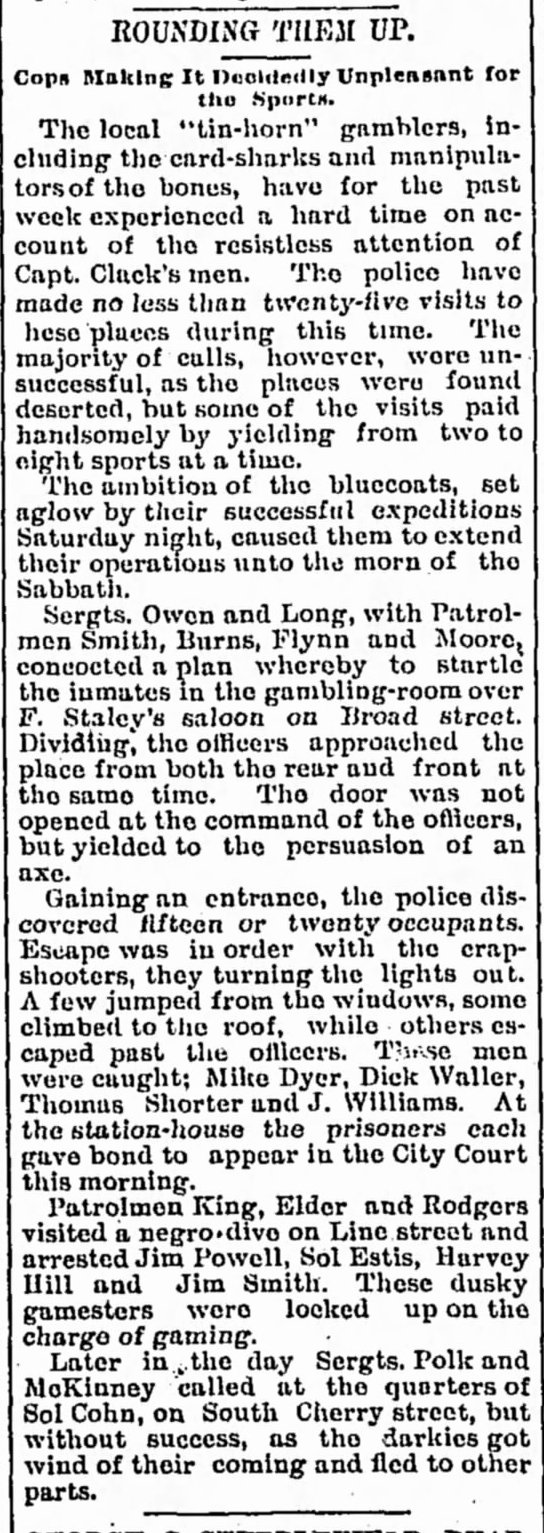
In early September 1894, the Nashville, Tennessee police officers visited gambling rooms at least twenty-five times within a week. They made some arrests, and one of the men arrested was my 2nd-great-grandmother's brother Mike Dyer.
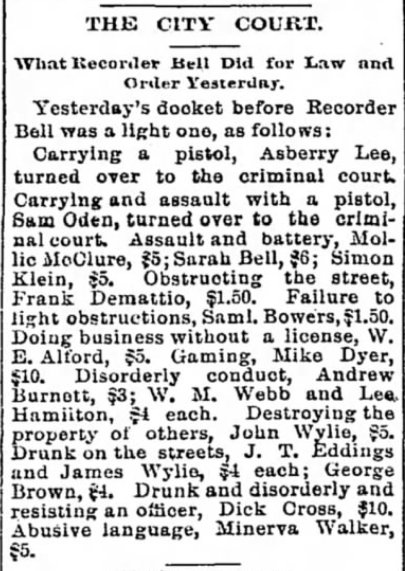
On 10 September 1894, Mike Dyer was fined $10.
This was not the first time that Mike Dyer had been arrested for gambling. On 28 August 1890, he was fined $10 for gaming.
Nashville Daily American, 10 September 1894, page 5
On 10 September 1894, Mike Dyer was fined $10.
Nashville Daily American, 11 September 1894, page 6
This was not the first time that Mike Dyer had been arrested for gambling. On 28 August 1890, he was fined $10 for gaming.
Daily American, 29 August 1890, page 5
Subscribe to:
Posts (Atom)