Documents from the Continental Congress and the Constitutional Convention, 1774-1789. Richmond, state of Virginia. In convention, Wednesday, the 25th of June, 1788. Available from American Memory.
On 25 June 1788, the Virginia Ratifying Convention voted in favor of ratifying the United States Constitution, and Virginia became the 10th state. The convention met in Richmond in the temporary capitol building and was made up of 170 people. The Federalists favored ratification. The Anti-Federalists opposed ratification because they did not want the central government to be too powerful. The vote was close (89 to 79).
Some of my ancestral families (including the Mayo, Isbell, and Gordon families) lived in Virginia at the time of ratification.
References and Additional Resources
Virginia Ratifying Convention Journal, June 25, 1788 (Virginia Memory)
Journal Notes of the Virginia Ratification Convention Journal Proceedings (June 25, 1788)
Virginia Ratification Bicentennial Stamp, 25 June 1988
Covering genealogy, family history, historical events and places, and anything else related!
Wednesday, June 25, 2014
Tuesday, June 24, 2014
Tombstone Tuesday: Julia Elizabeth (Tarkington) Johnson
Julia Elizabeth Tarkington was the daughter of my 3rd-great-grandparents Joseph Tarkington and Amanda Russell. She was born in Tennessee on 9 April 1865. She married Fred R. Johnson in New York City on 13 August 1898. They had one stillborn child. By 1900 they had separated and she was living with her parents in Nashville, Tennessee. She worked as a telephone operator. Julia died in Nashville on 18 March 1950 and was buried in Mount Olivet Cemetery in Nashville, section 13 lot 75.
Monday, June 23, 2014
Military Monday: 4th Australian Field Ambulance, World War I
Group portrait of the 4th Australian Field Ambulance, Steenwerck, France, 11 March 1918. Available from the Australian War Memorial.
My first cousin 3 times removed George Arthur Troedson was the son of Ola Peter Troedson, brother of my great-great-grandfather Andreas Troedsson. George was a private in the 4th Australian Field Ambulance. In this photo, he is third from right in the fourth row.
Sunday, June 22, 2014
Census Sunday: Were They Really Widowed?
My great-grandmother's sister Augusta "Gussie" Gersbacher married Emil Glaser in 1903. By 1910, they were no longer together. In the 1910 United States census, Gussie was enumerated as head of household in St. Louis, Missouri. She ran a rooming house and lived with her younger sister Annie. She was listed as married.
1910 United States census, St. Louis City, Missouri, Ward 7, population schedule, enumeration district 111, sheet no. 5A.
Her estranged husband Emil Glaser was also enumerated in St. Louis. He was living with his mother Lena. His marital status is given as widowed.
Divorced/separated people often claimed to be widowed. I have seen many women listed as widows when their husbands were still alive, but Emil Glaser was the first man that I found listed as a widower when his wife was still living. Gussie was Catholic; maybe Emil was too. Divorce would be an even greater stigma for a Catholic family. Emil or another member of his household may not have wanted to admit that his marriage had failed. Perhaps his mother provided the information to the census taker and did not want to say that her son was married but not living with his wife.
1910 United States census, St. Louis City, Missouri, Ward 7, population schedule, enumeration district 111, sheet no. 5A.
Her estranged husband Emil Glaser was also enumerated in St. Louis. He was living with his mother Lena. His marital status is given as widowed.
1910 United States census, St. Louis City, Missouri, Ward 15, population schedule, enumeration district 243, sheet no. 9A.
Saturday, June 21, 2014
52 Ancestors: #25 William D. Gatlin, Convicted Felon
Crime ran on both sides of the family of William D. Gatlin. His paternal grandfather William Dow Gatlin (who he probably shared a name with; I suspect that his middle initial D stood for Dow) was tried for an ax murder. His mother's half-brother Tom Cox was sentenced to death for killing a police officer. William D. Gatlin never killed anyone (as far as I know), but he was frequently in trouble with the law.
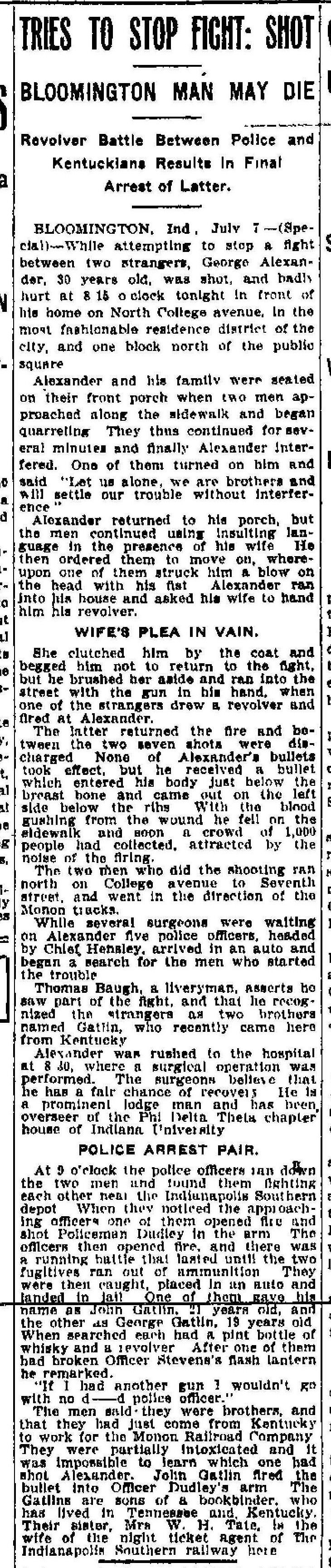
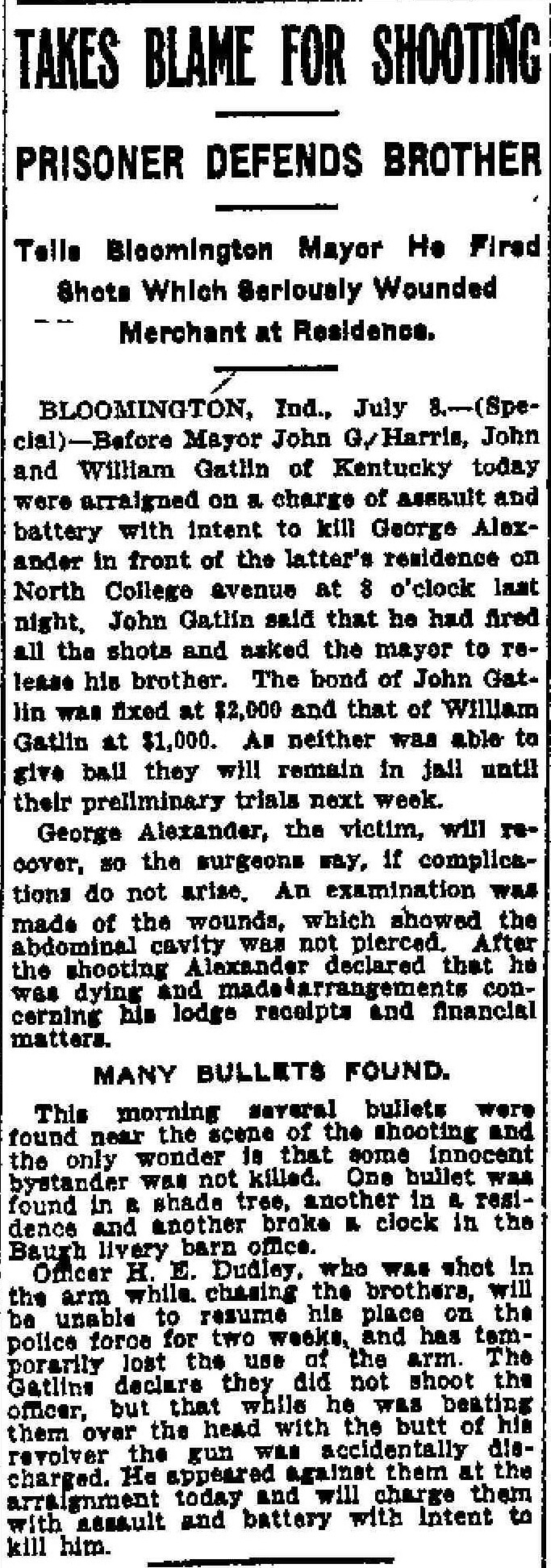
William was born on 10 December 1886 in Nashville, Tennessee. He was the third child of John William Morton Gatlin and Sarah Claire "Sadie" Dyer. By 1904 he and his older brother Henry (my great-grandfather) were living together in Chicago, Illinois. Henry was working at Hazlitt Printing Company. I am not sure what William was doing, but at some point he got himself into trouble, because he was enumerated in the 1910 United States Census as a prisoner in Southern Illinois Penitentiary in Chester, Randolph County, Illinois. He had been released by 1911, when he and his brother John were in Bloomington, Indiana, where their older sister Mary Florence (Gatlin) Pate lived with her husband Downie Campbell Pate. The brothers spent time in Kentucky before going to Indiana. On 7 July 1911, William and John got into a fight. George Alexander was sitting on his front porch and tried to break up the fight. He went inside and got his gun. One of the brothers fired a revolver at George. George fired back and did not hit the men, but he was shot and seriously injured. Five police officers pursued the Gatlin brothers, and the men shot at each other. John claimed that he was the one that had shot George Alexander and asked that William be released. However, because William had a criminal record, had given a false name when arrested (he said his name was George Gatlin), and got into more trouble throughout his life than John did, I am not sure if John was telling the truth.
On 11 August 1912, William was arrested again. He stole guns, ammunition, a knife, and 36 pairs of scissors from a hardware store in Bloomington, Indiana. He then stole a horse and buggy to escape, and when he was arrested, he handed the police officers a $10 bill that he had taken from the till at the hardware store.
William was free by 5 June 1917 when he registered for the World War I draft in Chicago, Illinois, but on 16 October 1917, he was sent to Joliet Prison. On 22 September 1919, he and another prisoner, George Cechota, attempted to attack a prison guard while they were being taken back to solitary confinement. Another guard, Henry Springer, came over to help, and he shot William. Three other prisoners escaped during the conflict. William died the next day at the penitentiary hospital. He was buried in Mt. Carmel Cemetery in Hillside, Cook County, Illinois.
1910 United States Census, Chester precinct, Randolph County, Illinois, population schedule, enumeration district 101, sheet no. 4A.
Indianapolis Star, 8 July 1911
Indianapolis Star, 9 July 1911
Indianapolis Star, 12 August 1912
Chicago Daily Tribune, 24 September 1919
State of Illinois, State Board of Health, Bureau of Vital Statistics. Death certificate, William Gatlin. 23 September 1919.
Labels:
52 Ancestors,
Black sheep,
Bloomington,
Chicago,
Gatlin,
Illinois,
Indiana,
Joliet,
Nashville,
Tennessee
Friday, June 20, 2014
Two Anniversaries
Edward Theodore Anderson, Ellen Victoria (Dahlquist) Anderson, Helen Martha Marie (Anderson) Gatlin, and Henry Cornelius Gatlin
On 20 June 1910, my great-grandparents Edward Theodore Anderson and Ellen Victoria Dahlquist married in Chicago, Illinois.
Twenty-nine years later, on 20 June 1939, my paternal grandparents Henry Cornelius Gatlin and Helen Martha Marie Anderson (daughter of Edward Theodore Anderson and Ellen Victoria Dahlquist) married at the Bethlehem Lutheran Church in Chicago, Illinois. I do not think that this is a coincidence; I think my grandmother intentionally chose to get married on her parents' anniversary. My grandparents were happily married for sixty-two years.
Cook County, Illinois Marriage license and return, Edward T. Anderson and Ella V. Dahlquist, 1910.
Thursday, June 19, 2014
Those Places Thursday: Borg Home, Baillytown, Porter, Indiana
My 3rd-great-grandparents John and Johanna (Samuelson) Borg and their family lived in the Swedish community of Baillytown in Porter County, Indiana. They lived in a gabled ell house which was similar to the nearby Chellberg and Nelson homes. These old family photos show the Borg home, which was designed by A. J. Lundquist. The Borg family had a farm and engaged in animal husbandry.
Unfortunately, the Borg home has deteriorated over the years and is crumbling.
John Borg Home, Porter, Indiana. Photo by Chris Light [CC-BY-SA-3.0-2.5-2.0-1.0 (http://creativecommons.org/licenses/by-sa/3.0) or GFDL (http://www.gnu.org/copyleft/fdl.html)], from Wikimedia Commons.
References
Swedish Baileytown: A Nineteenth Century Rural Enclave
Swedish Farmsteads of Porter County, Indiana
Swedish Historic District
Swedish Homesteads
Subscribe to:
Posts (Atom)