Covering genealogy, family history, historical events and places, and anything else related!

Sunday, November 9, 2014

Fall of the Berlin Wall

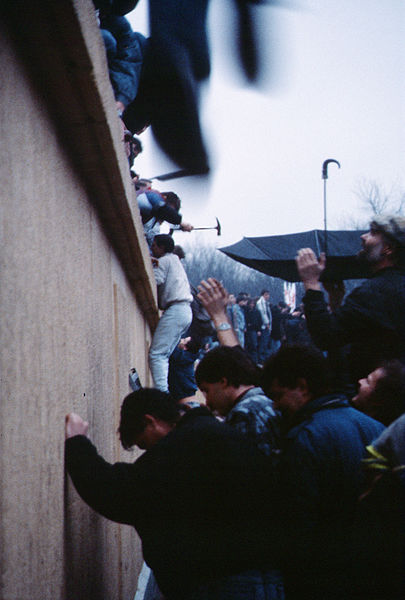
Fall of the Berlin Wall, 1989. Photo by Raphaël Thiémard [CC-BY-SA-2.0 (http://creativecommons.org/licenses/by-sa/2.0)]. Available from Flickr and Wikimedia Commons.

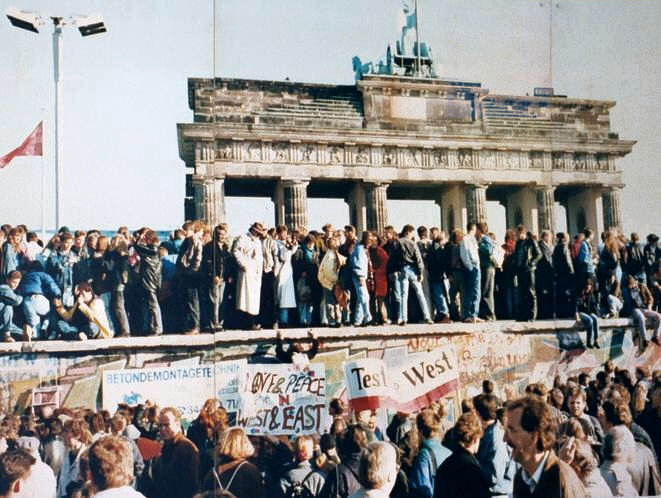
Fall of the Berlin Wall, 1989. Part of  a public photo documentation wall at Former Check Point Charlie, Berlin. Unknown photographer; reproduction by Lear 21. [GFDL (http://www.gnu.org/copyleft/fdl.html), CC-BY-SA-3.0 (http://creativecommons.org/licenses/by-sa/3.0/) or CC-BY-SA-2.5-2.0-1.0 (http://creativecommons.org/licenses/by-sa/2.5-2.0-1.0)]. Available from Wikimedia Commons.

Today is the 25th anniversary of the fall of the Berlin Wall, which surrounded East Berlin from 1961 to 1989.

During a press conference on 9 November 1989,Günter Schabowski, a member of the Politburo of the Socialist Unity Party of Germany, read a note which stated that East Germans would be allowed to cross the border (including the border with West Berlin) with proper permission. The regulations were supposed to take effect the following day, so that there would be time to inform the border guards. However, Schabowski had not been informed of this fact; he assumed that the regulations were to take effect immediately. Thousands of people went to the Berlin Wall's six border crossings.Some people began to chip away at the wall with hammers and picks. At 11:30 PM, Harald Jäger, the officer in charge of the Bornholmer Straße border crossing, opened the gates. He gave the order because he was concerned that people might be injured or killed. Heinz Schafer, an East German Stasi officer, claims that he was the first person to open the border gates; he opened the border crossing at Waltersdorf between 8:30 PM and 9:00 PM.

References

Berlin Wall
Berlin Wall - Cold War - HISTORY.com
East Germans may have arrived in West Berlin hours before previously thought 
The Guard Who Opened the Berlin Wall: 'I Gave my People the Order -- Raise the Barrier' 
Günter Schabowski
Nine surprising facts about the fall of the Berlin Wall

Saturday, November 8, 2014

52 Ancestors: #45 Francis Hardgrave, Revolutionary War Captain and Major

My 6th-great-grandfather Francis Hardgrave was born on 5 March 1745 in Augusta County, Virginia. He was the son of James Hardgrave and Elizabeth Cawley. Francis married Sarah Greer, and the couple moved to Surry County, North Carolina about 1770. They lived near Sarah's father John Greer and other members of the Greer family. Francis was tax assessor for his local tax district in 1777. The area became part of Wilkes County after the county was founded in 1778.

Francis and Sarah had nine children: James (born 12 December 1772), Sarah (born 31 December 1776), Robert (born 17 October 1778), Nancy (born 6 August 1780), my 5th-great-grandmother Hannah (born 22 February 1782), Micajah Lewis (born 1 November 1783), Seeley (born 27 April 1786, died 23 April 1791), John (born 29 October 1787), and Skelton (born 7 May 1792).

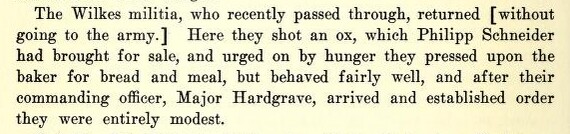
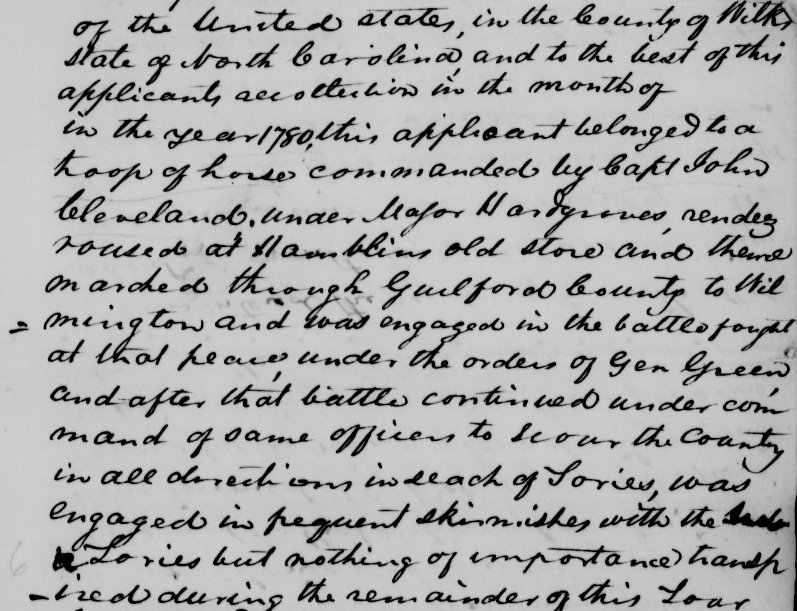
During the American Revolution, Francis was a captain in the Surry County Regiment of Militia in 1776-1777, and was a captain in the Wilkes County Regiment of Militia in 1778-1780. In 1780-1781, he was a major in the Wilkes County Militia, under Col. Benjamin Cleveland. He is known to have participated in the Cherokee Expedition (1 August 1776-1 November 1776) and in the Battle of Hanging Rock (6 August 1780).

Around 1795, Francis and his family moved Lincoln County, Kentucky. In 1799, he moved to Davidson County, Tennessee. His son James and his family also moved to Tennessee and settled in nearby Williamson County. His three daughters remained in Kentucky. His daughter Sarah had married Isaac Lowe in Wilkes County, North Carolina in 1790; they lived in Barren County, Kentucky. Nancy married Archibald Mills in Lincoln County, Kentucky in 1797, and Hannah married Andrew Russell in 1799. Both couples lived in Pulaski County, Kentucky; Nancy and Archibald then moved to Wayne County, Kentucky.

Francis was a member of the Providence Baptist Church in Davidson County, Tennessee. Although he was in his sixties, Francis served in the War of 1812.

Francis' daughters Nancy and Hannah and their families eventually came to Tennessee as well. Nancy, by then a widow, married her husband's brother John Mills in Davidson County, Tennessee in 1820, and they settled in nearby Sumner County, Tennessee. Hannah, who was head of household by 1820, lived near her parents on land that Francis owned.

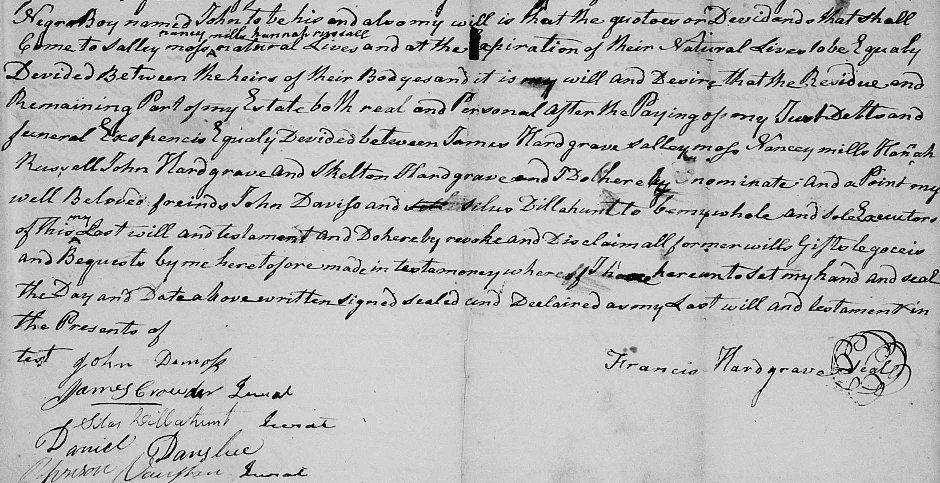
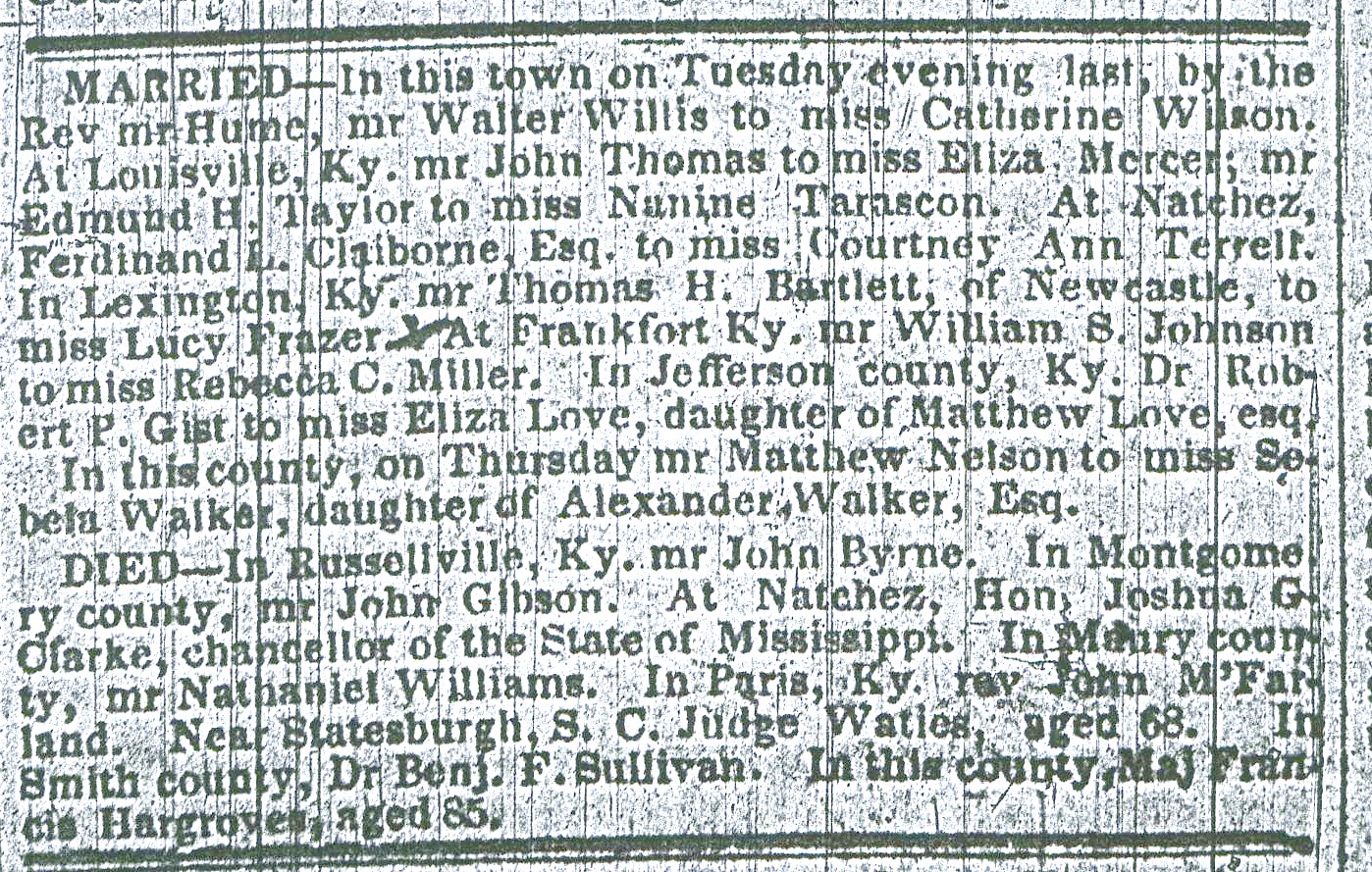
Francis died on 7 August 1828 in Davidson County, Tennessee. He is buried in the Hardgrave Family Cemetery in Williamson County, Tennessee. In his will, he left his daughter Hannah, my 5th-great-grandmother, the land that she was living on, and he stated that after she died, it was to go to her son James Russell. James Russell was Hannah's youngest son, and possibly her youngest child. Hannah appears to have been widowed by 1820, when James was only about three years old. Francis made sure that his young grandson would be provided for. He also specified that after his three daughters died, their shares of the inheritance were to be divided among the heirs of their bodies. He wanted to be sure that the inheritance passed to his daughters' descendants.

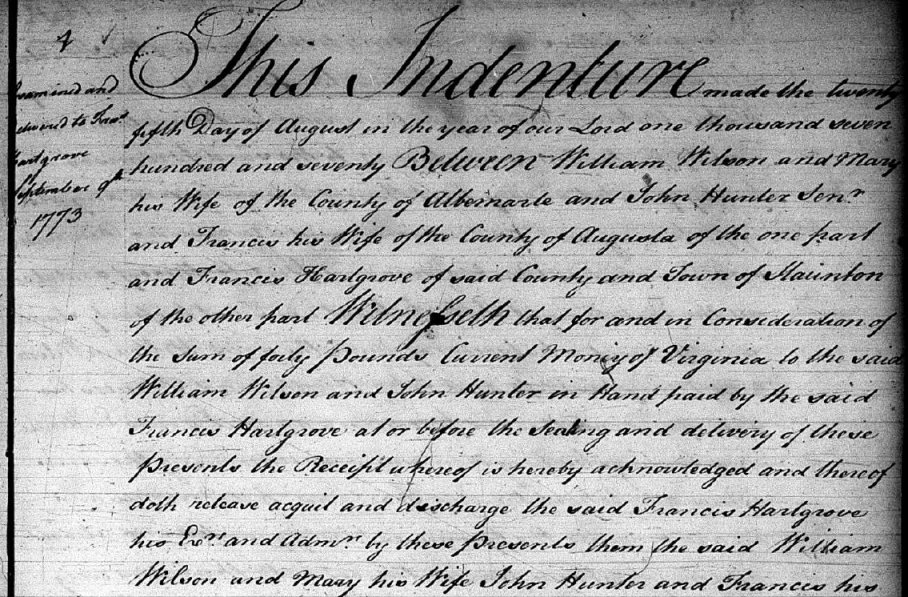
Deed, 25 August 1770. Augusta County Deed Book 17, 1770-1771. Library of Virginia, microfilm reel 9. Francis Hardgrave sold his land in Staunton, Augusta County, Virginia.

Fries, Adelaide L., ed. Records of the Moravians in North Carolina. Volume IV: 1780-1783. Raleigh, NC: Edwards & Broughton, 1930. Available from Internet Archive.

Bennet Tilley pension application file. Case Files of Pension and Bounty-Land Warrant Applications Based on Revolutionary War Service. NARA microfilm publication M804. The National Archives at Washington, D.C. Available from Fold3.

Will of Francis Hardgrave, Davidson County, Tennessee, Will Book No. 9. Available from FamilySearch.

Nashville Banner and Nashville Whig, 9 August 1828

Friday, November 7, 2014

Follow Friday: ArkivDigital English Blog

ArkivDigital now has an English-language blog. Its content will include information about new records available through ArkivDigital, tips on reading Swedish records and on researching Swedish ancestors, and events. A post on Swedish church book tutorials has already been added. The blog Web site includes a Research Tips section, an Event Calendar which lists events in the United States that ArkivDigital will be present at, and links to ArkivDigital Web pages and other Web sites which are useful for Swedish genealogy research.

The blog is located at http://blog.arkivdigital.net/. If you have Swedish ancestors, check it out!

Thursday, November 6, 2014

Those Places Thursday: Day-Deans-King House

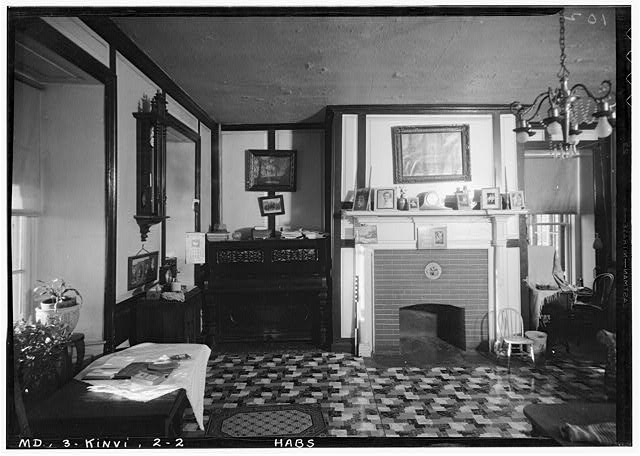
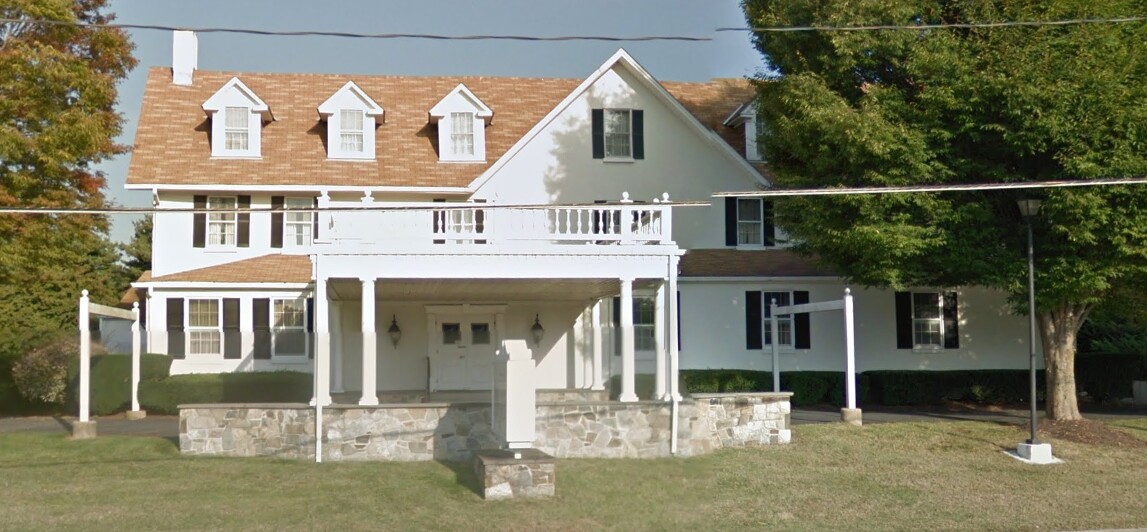
In 1696, my 9th-great-grandfather Nicholas Day purchased land in Baltimore County, Maryland, in the area that is now Kingsville. In 1710, his son, also named Nicholas Day, constructed a stone house on the land. The house is located at 11750 Belair Road (Route 1), Kingsville.

In his will, written on 31 March 1739 and proved on 25 May 1739, the younger Nicholas Day left this land, called William the Conquerer, to his sons Thomas and Laban Day. In 1748, Thomas and Laban sold the property to Reverend Hugh Deans, the rector of In 1748, Thomas and Laban sold the property to Reverend Hugh Deans, the rector of St. John's Parish in Joppa Town. He lived on the property until his death in 1777. The house's two-story ell was probably added while Reverend Deans was living on the property.

In 1816, the property was purchased by Abraham King. The town of Kingsville got its name from Abraham.

In 1913, Frank J. and Caroline Groettner purchased the property, and it became a restaurant, the Kingsville Inn. In 1969, Lassahn Funeral Home purchased the property, and a wood-frame addition was constructed about 1990.

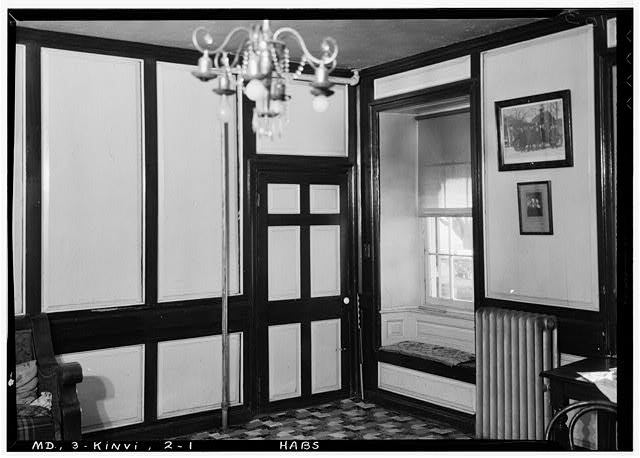
Historic American Buildings Survey. E. H. Pickering, Photographer. December 1936 - Kingsville Inn (Interiors), 11750 Belair Road (U.S. Route 1), Kingsville, Baltimore County, MD. Available from Library of Congress.

Historic American Buildings. Survey E. H. Pickering, Photographer. December 1936 INTERIOR SHOWING MANTEL - Kingsville Inn (Interiors), 11750 Belair Road (U.S. Route 1), Kingsville, Baltimore County, MD. Available from Library of Congress.

11750 Belair Road, Kingsville, Maryland. From Google Earth.

References
Kingsville, Maryland
Maryland Historical Trust Inventory of Historic Properties: Day-Deans-King House
Will of Nicholas Day, of Baltimore Co. dated 31 March 1738

Wednesday, November 5, 2014

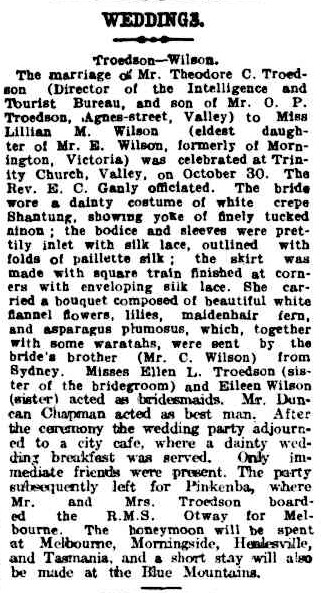
Wedding Wednesday: Theodore Christopher Troedson and Lillian Mary Wilson

On 30 October 1912, Theodore Christopher Troedson (my first cousin three times removed, the son of my great-great-grandfather's brother Ola Peter Troedson) married Lillian Mary Wilson at Trinity Church in Fortitude Valley, Brisbane, Queensland, Australia. Their wedding announcement was published in The Queenslander.

The Queenslander, 16 November 1912, page 6. Available from Trove.

Tuesday, November 4, 2014

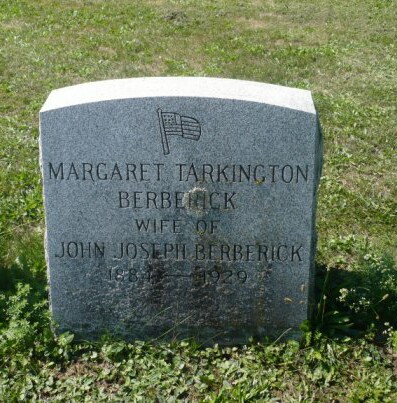
Tombstone Tuesday: Margaret (Tarkington) Berberick


Margaret Tarkington was born in Nashville, Tennessee on 15 February 1884. She was the daughter of my great-great-grandparents James William Tarkington and Anna Malvina Binkley. Margaret worked as a telephone operator. Her daughter Louise Margaret Gray was born on 6 December 1906. Margaret married John Joseph Berberick. They lived in Buffalo, New York, and then moved to Cedarville, Herkimer County, New York. Margaret died on 12 January 1929 and was buried in Cedarville Cemetery on 16 January 1929.

Monday, November 3, 2014

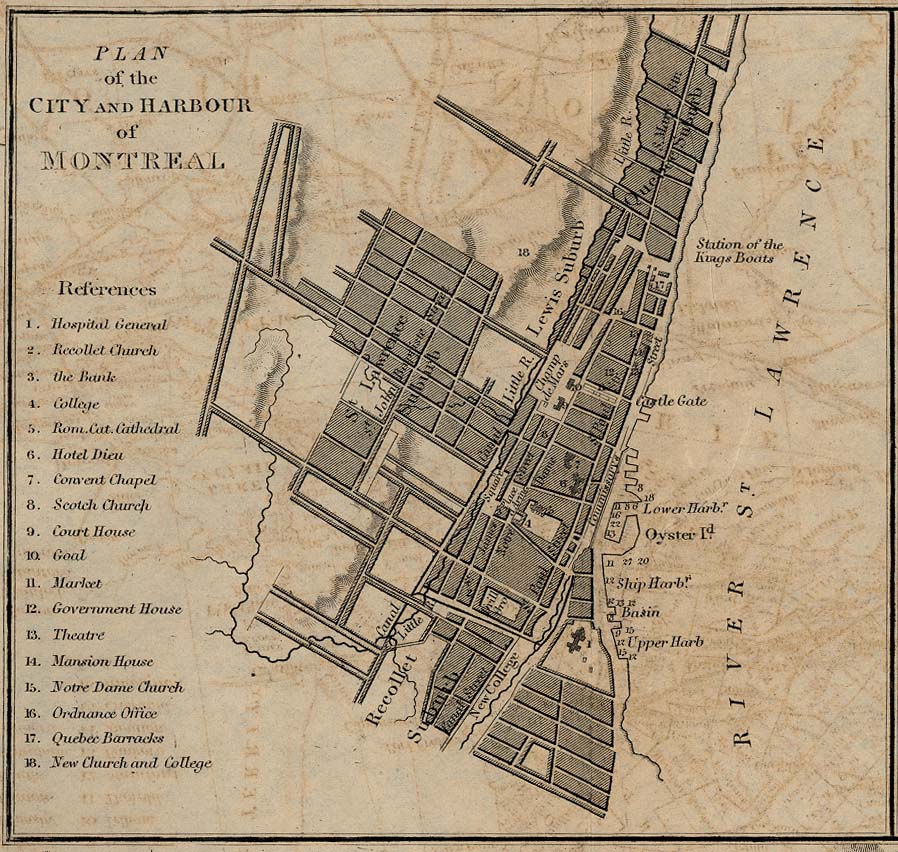
Mappy Monday: Plan of the City and Harbour of Montreal

Plan of the City and Harbour of Montreal. From A Dictionary, Practical, Theoretical, and Historical of Commerce and Commercial Navigation, by J. R. (John Ramsay) McCulloch, 1882. Available from Perry-Castañeda Library Map Collection, University of Texas Libraries: http://www.lib.utexas.edu/maps/historical/montreal_plan_1882.jpg

This map shows the city and harbor of Montreal, Quebec, Canada. It shows the locations of some of the buildings in Montreal, including Montreal General Hospital, where my 3rd-great-grandfather John Bennet Winters died.

My great-great-grandparents James Graham and Catherine Elizabeth Winters and their daughter, my great-grandmother Kathleen Graham, were living in Montreal in 1882. Elizabeth Winters' second husband James Mappleback was also living in Montreal at that time.