

Monday, December 7, 2015
Military Monday: Remember December 7

Sunday, December 6, 2015
Independence Day (Finland)

December 6 is Independence Day (Itsenäisyyspäivä) in Finland. On 6 December 1917, the Parliament of Finland adopted the Finnish Declaration of Independence. Prior to independence, Finland was an autonomous part of the Russian Empire, the Grand Duchy of Finland.
On Independence Day, the Finnish flag is raised on Observatory Hill (Tähtitorninmäki) in Helsinki. There are church services and visits to cemeteries and war memorials. People place blue and white candles in their windows and display Finnish flags. The movie The Unknown Soldier, which is based on Väinö Linna's book of the same name, is shown on television. The film is about the Continuation War between Finland and the Soviet Union during World War II. In the evening, an Independence Day Reception is held at the Presidential Palace. The reception is broadcast on television.
I visited Finland in 2008 and had a wonderful time. Although I have no known Finnish ancestors, according to Family Tree DNA's myOrigins, 4 percent of my DNA comes from Finland and Northern Siberia. I probably inherited this DNA from my Swedish and/or Norwegian ancestors.
References
Continuation War
Finnish Declaration of Independence
Finns Celebrate Freedom Every December
Independence Day (Finland)
Saturday, December 5, 2015
52 Ancestors: Week 49 "Holidays": Mathias Joseph Nagel Decorates the Churches
My 2nd-great-grandmother Christina Nagel's brother Mathias Joseph Nagel was a landscape gardener. Their father Johann Nagel was also a gardener. Mathias came to the United States from Germany in the 1860s. He had a nursery business in Jefferson City, Cole County, Missouri by 1875. In 1891, he moved to Santa Fe, New Mexico. In December 1892, he contributed his gardening and landscaping talents to his new community's holiday celebration. He used green and silver-tipped cedar and mountain laurel to create Christmas decorations for the Catholic churches. He made wreaths and strings of evergreens.

He may have created similar decorations in other years. He had experience planting and growing evergreens.

The laurel that he used was probably Texas mountain laurel. It is listed in the book Native Plants for Southern Landscapes by Judy Mielke (University of Texas Press, 1993). Texas mountain laurel grows in Texas, New Mexico, and Mexico. It blooms in March and April, so its purple flowers would not have been present when Mathias made the wreaths and evergreen strings. I think the plant's white beans would look beautiful on Christmas wreaths.
 Sophora secundiflora beans at the Desert Demonstration Garden in Las Vegas, Nevada, October 2003. Photo by Stan Shebs [GFDL (http://www.gnu.org/copyleft/fdl.html), CC BY-SA 3.0 (http://creativecommons.org/licenses/by-sa/3.0) or CC BY-SA 2.5 (http://creativecommons.org/licenses/by-sa/2.5)]. Available from Wikimedia Commons.
One of the churches that he probably decorated was the Cathedral Basilica of St. Francis of Assisi. The parish was founded in 1714, and the construction of the cathedral was completed in 1887.
 Cathedral Basilica of St. Francis of Assisi. 4 June 2009. Photo by John Fowler [CC BY 2.0 (http://creativecommons.org/licenses/by/2.0)]. Available from Flickr and Wikimedia Commons.
He may also have decorated San Miguel Chapel, which was built between 1610 and 1626.
 San Miguel Chapel. 15 October 2009. Photo by Shiny Things [CC BY 2.0 (http://creativecommons.org/licenses/by/2.0)]. Available from Flickr and Wikimedia Commons.
Perhaps he also decorated Nuestra Señora de Luz Church, which is 13 miles southeast of Santa Fe. The church was built in 1880.
 Front of the Nuestra Señora de Luz Church, Canoncito, New Mexico. Library of Congress, Prints and Photograph Division HABS: NM,25-CANCI,1-1. Image courtesy of the federal HABS—Historic American Buildings Survey of New Mexico project (rotated and retouched). Available from Wikimedia Commons.
I do not have photos of Mathias' Christmas decorations, but this image of evergreen decorations in Santa Fe, New Mexico may help to paint a mental picture of his creations.
 IAIA Museum of Contemporary Native Arts, Santa Fe, New Mexico. Photo by Bill Johnson [CC BY-SA 4.0-3.0-2.5-2.0-1.0 (http://creativecommons.org/licenses/by-sa/4.0-3.0-2.5-2.0-1.0)]. Available from Wikimedia Commons.
New Mexican, 17 December 1892
He may have created similar decorations in other years. He had experience planting and growing evergreens.
Gardeners Monthly, vol. 29, November 1887, page 326. Available from Google Books.
The laurel that he used was probably Texas mountain laurel. It is listed in the book Native Plants for Southern Landscapes by Judy Mielke (University of Texas Press, 1993). Texas mountain laurel grows in Texas, New Mexico, and Mexico. It blooms in March and April, so its purple flowers would not have been present when Mathias made the wreaths and evergreen strings. I think the plant's white beans would look beautiful on Christmas wreaths.
One of the churches that he probably decorated was the Cathedral Basilica of St. Francis of Assisi. The parish was founded in 1714, and the construction of the cathedral was completed in 1887.
He may also have decorated San Miguel Chapel, which was built between 1610 and 1626.
Perhaps he also decorated Nuestra Señora de Luz Church, which is 13 miles southeast of Santa Fe. The church was built in 1880.
I do not have photos of Mathias' Christmas decorations, but this image of evergreen decorations in Santa Fe, New Mexico may help to paint a mental picture of his creations.
Friday, December 4, 2015
Follow Friday: GreatFireOfLondon.net
Dave Fowler has created GreatFireOfLondon.net, which is part of the History in Numbers collection. The site is informative and well-done, and it is definitely worth checking out. It contains a detailed overview of the Great Fire of London (1666). Key facts and a day by day chronology are provided. Background information is provided on some of the people who were involved, such as Thomas Farriner, Samuel Pepys, John Evelyn, Robert Hooke. Christoper Wren, King Charles II, Thomas Bludworth, and Robert Hubert (the innocent man who was executed after making a false confession). The fall and rebuilding of St. Paul's Cathedral is covered. There is an image and a transcription of the September 3 to September 10, 1666 issue of the London Gazette, which reported on the fire. A helpful site map can be used to easily locate information.
Thursday, December 3, 2015
International Day of Persons with Disabilities

December 3 is International Day of Persons with Disabilities. The day has been observed by the United Nations since 1992. The theme for 2015 is "Inclusion matters."
People with disabilities are part of our family history, and we should be sure to include them. My 2nd-great-grandfather's brother Petter Troedsson (31 January 1855 - 27 October 1908) was listed as idiot krympling in Swedish household examination records. His mother was 38 years old when he was born; he may have had Down syndrome. According to the 1850 and 1860 United States Censuses, my 5th-great-grandmother Obedience (Lucas) Gatlin was blind. She was in her 60s and 70s at the time of the censuses; I am not sure when her blindness began. My 4th-great-grandfather Hugh Winters was listed as blind in the 1880 United States Census and was also enumerated in the Defective, Dependent and Delinquent schedule. William A. Paley, the husband of my maternal grandfather's sister Geraldine Boe, lost the use of his legs as a result of a circulation ailment. The "Flag of the Day" news item in the 30 August 1966 issue of the Chicago Tribune noted that for the last ten years, he had seen that the flag was displayed at his home every morning, and that he worked as an assistant to the music director at Columbia Broadcasting System. He seems to have focused on his abilities, not his disabilities.
References
International Day of Persons with Disabilities
UN Enable - International Day of Persons with Disabilities, 3 December 2015
Wednesday, December 2, 2015

Tuesday, December 1, 2015
Travel Tuesday: Elizabeth (Winters) Mapplebeck and Granddaughter Vivian Visit Toledo, Ohio
In 1907, my 2nd-great-grandmother Catherine Elizabeth (Winters) Mapplebeck and her granddaughter Vivian briefly visited Alton, Madison County Illinois. They had moved from Alton to St. Louis, Missouri in 1906. They probably visited Elizabeth's friends. They then went to Toledo, Ohio for a few weeks.
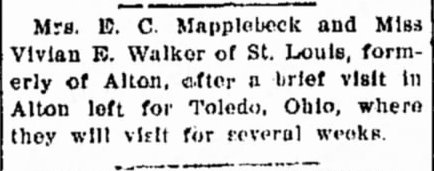
Elizabeth's son Garfield Graham was living in Toledo, Ohio in 1907. They must have been going to visit him.
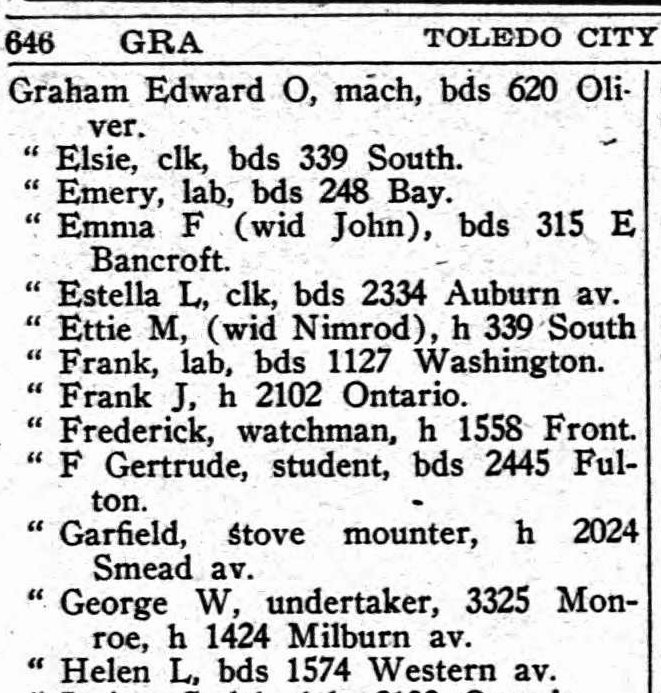 Polk's Toledo Directory for the Year Commencing July 1907, page 646. Ancestry.com. U.S. City Directories, 1822-1995 [database on-line]. Provo, UT, USA: Ancestry.com Operations, Inc., 2011.
Alton Evening Telegraph, 3 June 1907, page 5
Elizabeth's son Garfield Graham was living in Toledo, Ohio in 1907. They must have been going to visit him.
Subscribe to:
Posts (Atom)