Covering genealogy, family history, historical events and places, and anything else related!

Friday, October 21, 2016

Friend of Friends Friday: Slaves of James Neely, Williamson County, Tennessee

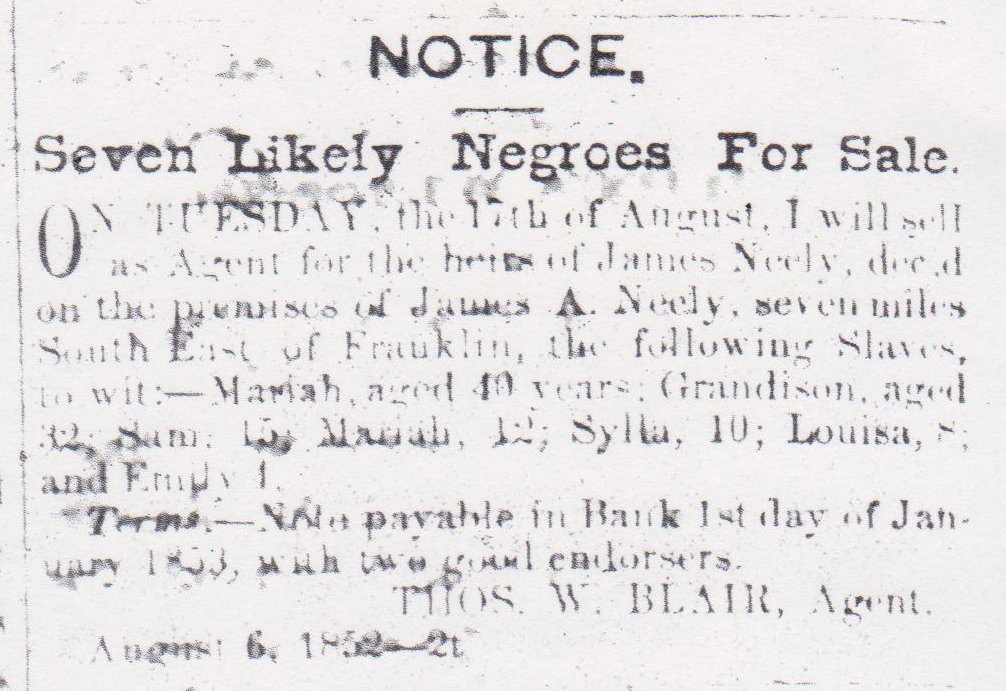
Western Weekly Review (Franklin, TN), 6 August 1852, page 2

NOTICE.
–––––
Seven Likely Negroes For Sale.
ON TUESDAY, the 17th of August, I will sell as Agent for the heirs of James Neely dec,d on the premises of James A. Neely, seven miles South East of Franklin, the following Slaves, to wit:––Mariah, aged 40 years; Grandison, aged 32; Sam, 15; Mariah, 12; Sylla, 10; Louisa, 8; and Emily, 4.
   Terms:––Note payable in Bank 1st day of January 1853, with two good endorsers.
                                                                    THOS. W. BLAIR, Agent.
      August 6, 1852––2t

Thursday, October 20, 2016

Those Places Thursday: Clover Bottom

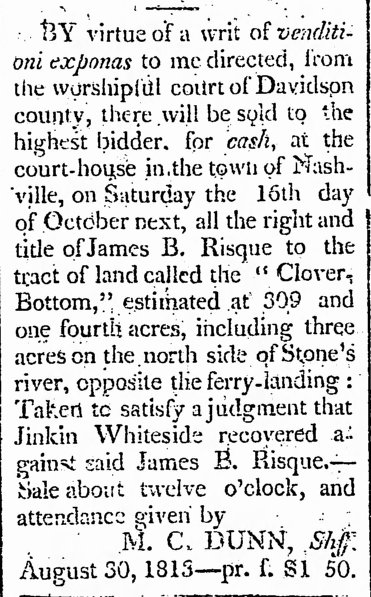
Clover Bottom consists of 309 1/4 acres of land in Davidson County, Tennessee, including three acres on the north side of Stone's River.

Nashville Whig, 31 August 1813, page 3

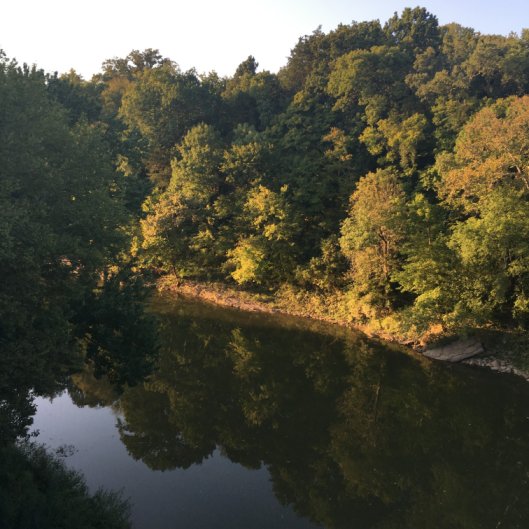
Stone's River

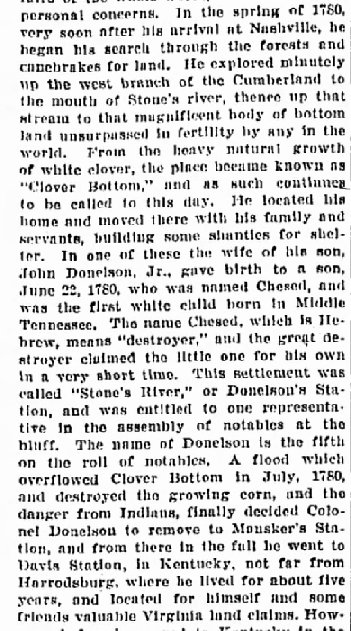
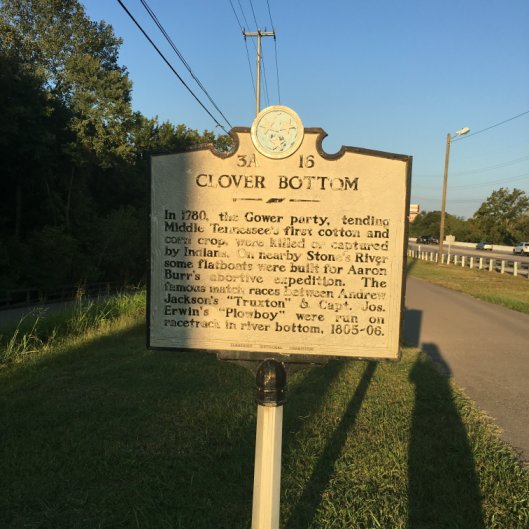
The area was named "Clover Bottom" because of the amount of growth of white clover in the area. John Donelson was one of the settlers who came to the area in 1780.

"Col. John Donelson Was Leader Among Men." Nashville Tennesseean and Nashville American, 15 July 1917, page 25.

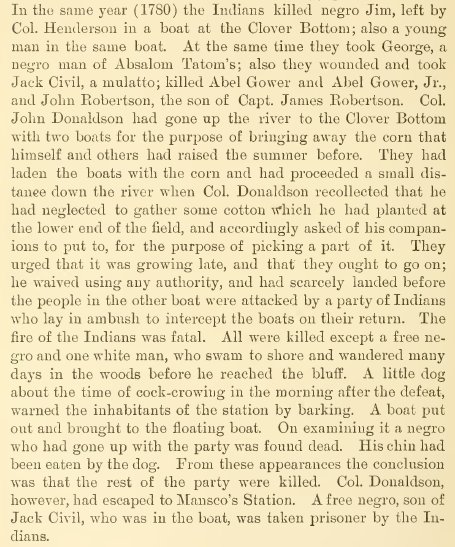
James Robertson and my Gower and Lucas ancestors were among the other settlers in the area. My 7th-great-grandfather Abel Gower, Sr., my 6th-great-grandfather Abel Gower, Jr., and James Robertson's brother John Robertson were killed at Clover Bottom in 1780, after they were attacked by Chickamaugas.

Haywood, John. The Civil and Political History of the State of Tennessee from its Earliest Settlement up to the Year 1796, Including the Boundaries of the State. Nashville,TN: Publishing House of the Methodist Episcopal Church, South, 1891. Originally published in 1823 by W. H. Haywood. Page 128. Available from Internet Archive.


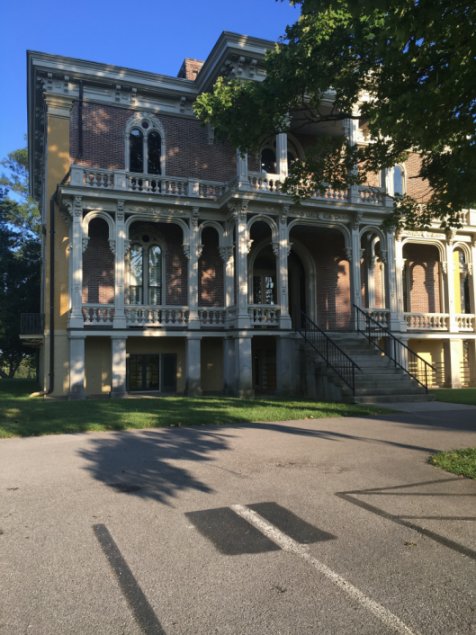
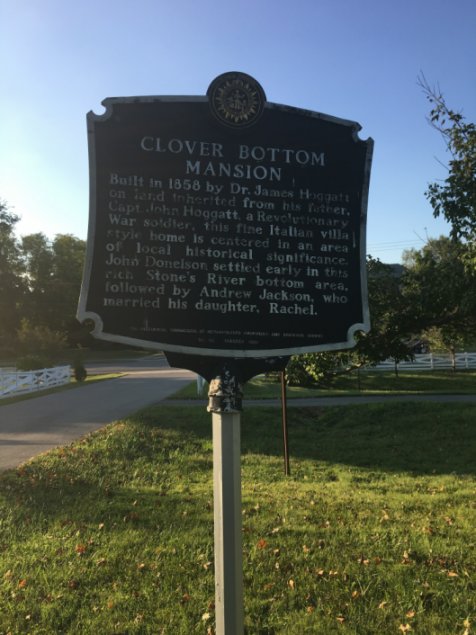
In 1858, Dr. James Hoggatt built a mansion at Clover Bottom. The home is listed on the National Register of Historic Places.


Tuesday, October 18, 2016

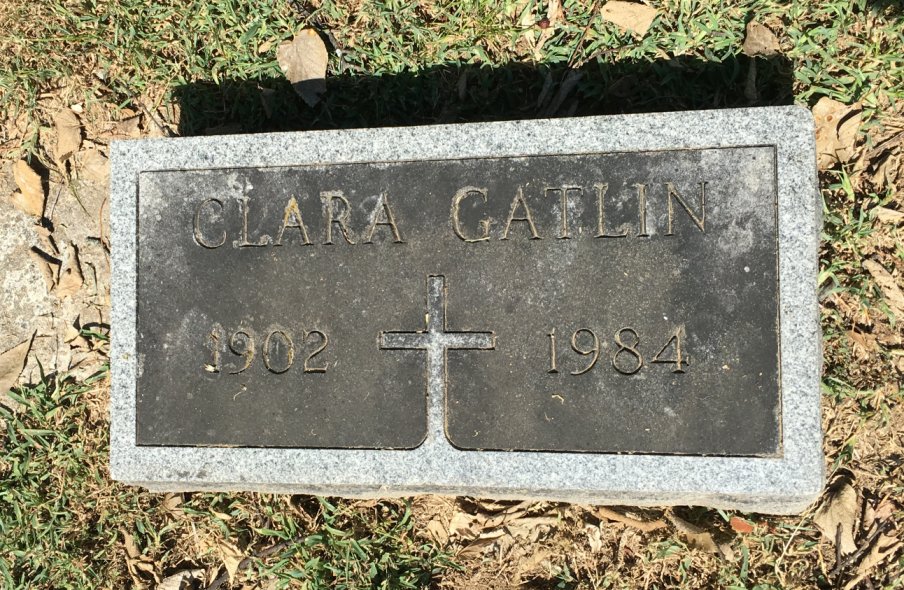
Tombstone Tuesday: Clara Louise Gatlin


My first cousin three times removed Clara Louise Gatlin was born in Nashville, Davidson County, Tennessee on 2 September 1902. She was the daughter of Clarence Bateman Gatlin and Ella Lee. She worked as a clerk for New York Life Insurance Co. in Nashville, Tennessee. She died on 31 January 1984 in Dayton, Montgomery County, Ohio and was buried on 4 February 1984 in Calvary Cemetery, Nashville, section 16, lot 64, space 3.

Monday, October 17, 2016

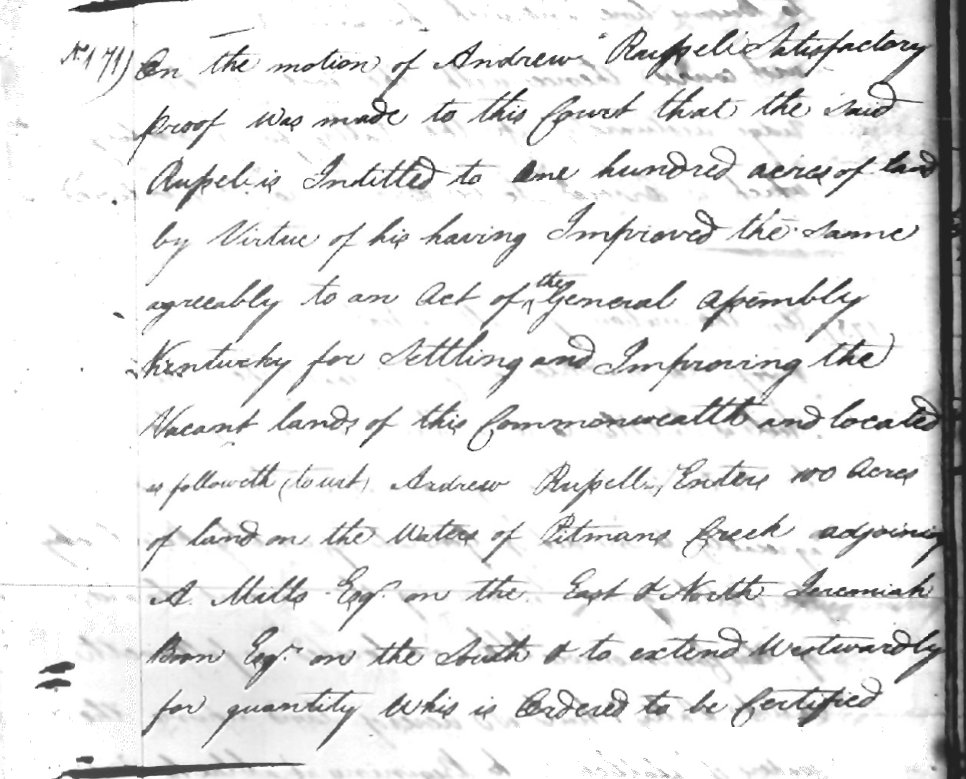
Amanuensis Monday: Andrew Russell Enters 100 Acres of Land on Pitmans Creek, Pulaski County, Kentucky

Pulaski County, Kentucky. Court Orders, Vol. 1, 1799-1803. No. 171, Andrew Russell, 24 June 1801. Salt Lake City, Utah: Filmed by the Genealogical Society of Utah, 1969. Microfilm 804646.

N. 171) On the motion of Andrew Russell Satisfactory proof was made to this Court that the said Russell is Intitled to one hundred acres of land by Virtue of his having Improved the same agreeably to an act of the General assembly Kentucky for Settling and Improving the Vacant lands of this Commonwealth and located as followeth (to wit) Andrew Russell, Enters 100 acres of land on the waters of Pitmans Creek adjoining A Mills Esq on the East & North Jeremiah Boon Esq on the South & to extend westwardly for quantity whis is Ordered to be Certified

Sunday, October 16, 2016

Black Sheep Sunday: Keeping a Disorderly House

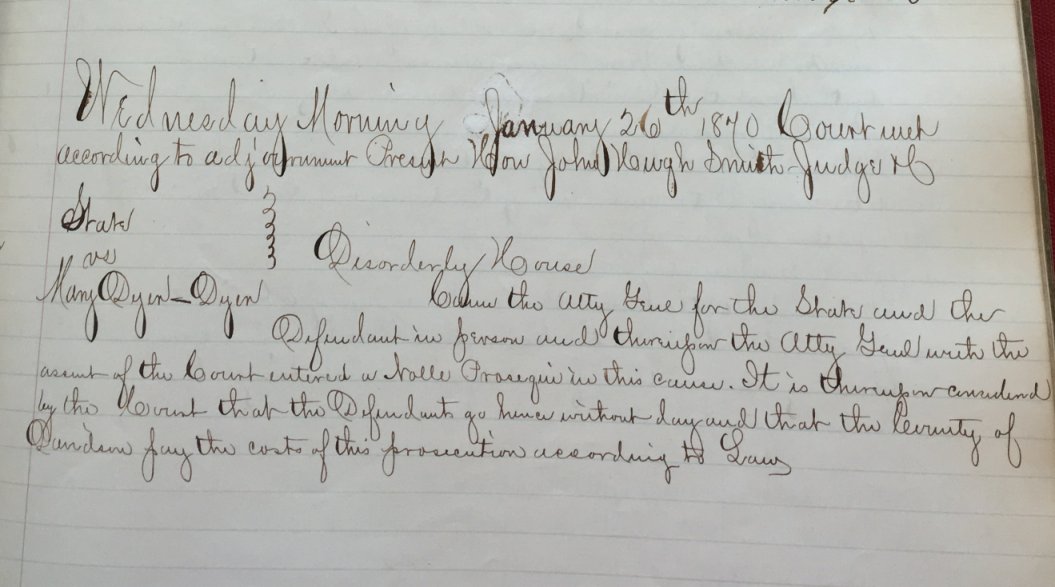
In August 1869, my 3rd-great-grandmother Mary Dyer was charged with keeping a disorderly house.

Davidson County, Tennessee. Criminal Court minutes, 1869, p. 501. Metropolitan Government Archives, Nashville Public Library, Nashville, Tennessee.

A "disorderly house" typically meant a brothel. On the same page of the Davidson County, Tennessee criminal court minutes, others will charged with "keeping house of ill fame." I am not sure what the difference was. Maybe a "house of ill fame" had a larger number of prostitutes. Or perhaps in this case, "disorderly house" meant something else. According to Duhaime's Law Dictionary, a disorderly house could also mean a gambling house. However, no one was charged with gaming at the same time that Mary was charged.

"Dyer," who was also charged, must have been her husband Michael Dyer. Since his first name is not given, perhaps he was not present when Mary was charged, but was also charged because the house was his residence.

On 26 January 1870, the Attorney General for the State of Tennessee entered a Nolle prosequi ("be unwilling to pursue"/"do not prosecute"). Davidson County, Tennessee paid the costs of the prosecution.

Davidson County, Tennessee. Criminal Court minutes, 1870, p. 45.  Metropolitan Government Archives, Nashville Public Library, Nashville, Tennessee.

Saturday, October 15, 2016

Sibling Saturday: Finding a Previously Unknown Half-Brother

When I obtained the Civil War pension application of Samuel August Samuelson, the brother of my 3rd-great-grandmother Johanna Carolina Samuelson, I discovered a previously unknown family member.

Statement of C. J. Johnson. Samuel A. Samuelson (Pvt., Co. E, 73rd Ind. Inf., Civil War, pension application no. 283,424, certificate no. 217,996),Case Files of Approved Pension Applications..., 1861-1934; Civil War and Later Pension Files; Department of Veterans Affairs, Record Group 15; National Archives, Washington, D.C.

C. G. Johnson gave a statement, and was asked if he was in any was related to Samuel A. Samuelson. He answered, "I am what is called a half brother."

I knew that Johanna and Samuel had two older brothers, Johan Peter and Anders Fredrik, but I did not know that they had a half-brother. Their mother, Anna Lisa Torstensdotter, was thirteen years older than their father, Samuel Eriksson, so I wondered if C. G. Johnson was her son from a previous marriage.

I found Carl Gustaf Johnson's death certificate in Ancestry.com's database Indiana, Death Certificates, 1899-2011. He had died in Westchester, Porter County, Indiana on 30 July 1909. The death certificate gave his date of birth: 27 October 1823. His birthplace was listed as Vastra Harg, Sweden.

Indiana State Board of Health. Death certificate no. 109, Carl Gustaf Johnson, 1909. Ancestry.com. Indiana, Death Certificates, 1899-2011 [database on-line]. Provo, UT, USA: Ancestry.com Operations, Inc., 2015.

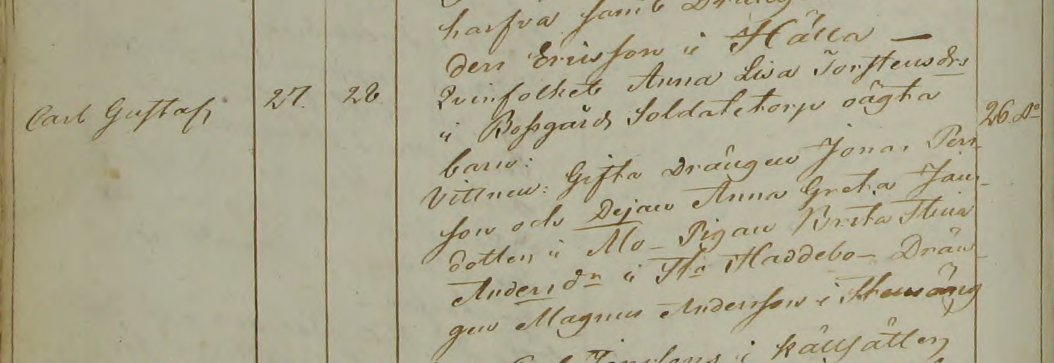
I had already known that the family had come from Västra Harg, Östergötland, Sweden. I looked at the Swedish records on ArkivDigital, and found Carl Gustaf's birth and baptismal record. He was not a child from a previous marriage; he was an illegitimate child. The record did not name his father.

Västra Harg C:1 (1797-1840) Image 179 / page 341 (AID: v42201.b179.s341, NAD: SE/VALA/00446)

I found the family in the household examination records, after Anna Lisa Torstensdotter had married Samuel Eriksson. Carl Gustaf was listed with the patronymic Jaensson.

Västra Harg AI:11 (1835-1840) Image 88 / page 159 (AID: v27140.b88.s159, NAD: SE/VALA/00446)

Carl Gustaf Johnson married Matilda Sofia Johnson. According to the 1900 United States Census, Matilda had six children.

1900 United States census, Westchester, Porter County, Indiana, population schedule, enumeration district 94, page 3B. Ancestry.com. 1900 United States Federal Census [database on-line]. Provo, UT, USA: Ancestry.com Operations Inc, 2004.

However, I have only discovered four of the children: Albertena Johnson (born 15 August 1868), Albert L. Johnson (born about 1874), Ida Johnson (born 24 March 1875 or 1876), and Gustaf Johnson (born 29 March 1883).