Covering genealogy, family history, historical events and places, and anything else related!

Saturday, March 14, 2015

Sports Center Saturday: Rudolf Caracciola


This statue of racing driver Rudolf Caracciola is located in Remagen, Kreis Ahrweiler, Rheinland-Pfalz (Rhineland-Palatinate), Germany. Remagen is his birthplace, and is also one of my ancestral towns.

Rudolf Caracciola was born on 30 January 1901. His ancestors came to Germany from Italy during the Thirty Years' War. He began driving before he was eighteen years old (the legal age). In 1922, while he was working at the Fafnir automobile factory in Aachen, he drove one of Fafnir's cars in the Automobil-Verkehrs- und Übungs-Straße (AVUS) race in Berlin, and was fourth overall. He won his next race, at the Opelbahn in Rüsselsheim. In 1923 he moved to Dresden, and won the ADAC (Allgemeiner Deutscher Automobil-Club e.V.) race. At first he continued to work for Fafnir, but he became a car salesman for Daimler later that year. He won eight races in 1925. In 1926, he won the German Grand Prix. He married Charlotte Liesen, and opened a Mercedes-Benz dealership on the Kurfürstendamm in Berlin. He finished third in the Monaco Grand Prix in 1929.

After Mercedes-Benz withdrew from racing in 1931, he raced for Alfa-Romeo. In 1933, after Alfa-Romeo withdrew from racing, he and his friend Louis Chiron formed their own team, Scuderia C.C. (Caracciola-Chiron). While practicing for the Monaco Grand Prix, he was seriously injured in an accident. In February 1934, his wife died in an avalanche while skiing.

Rudolf Caracciola returned to racing in 1934. He won his first European Drivers' Championship in 1935; he won two more in 1937 and 1938. He died on 28 September 1959.

When my great-grandfather's brother Carl (or Karl) Schneider was baptized in Remagen on 25 March 1885,  Karl Caracciola was one of the sponsors. I am not sure what the relationship was between Karl Caracciola  and Rudolf Caracciola, but they probably were related somehow.

References
Biography: Rudolf Caracciola (1901 - 1959)
Die Familie Caracciola in Remagen
Rudolf Caracciola
Rudolf Caracciola - Biography
Rudolf Caracciola: Official Website
Rudolf Otto Wilhelm Caracciola (1901-1959), Automobilrennfahrer

Friday, March 13, 2015

Friend of Friends Friday: John Greer's Bequests to His Daughters Ann Mitchell and Hannah Demoss

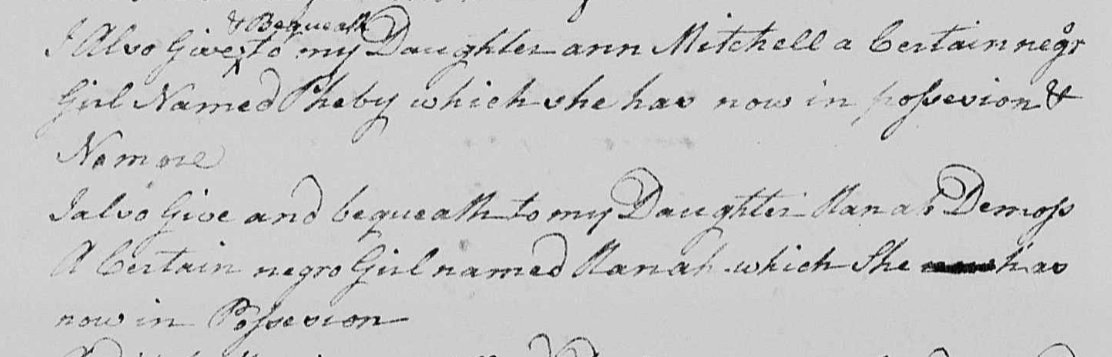
Excerpt from will of John Greer, 2 April 1782, Wilkes County, North Carolina, Wills. North Carolina Probate Records, 1735-1970, FamilySearch.

In his will, dated 2 April 1782, my 7th-great-grandfather John Greer included the following bequests to his daughters Ann Mitchell and Hannah Demoss:

I also give & bequeath to my daughter Ann Mitchell a certain negro girl named Pheby which she has now in possession & no more

I also give and bequeath to my daughter Hanah Demoss a certain negro girl named Hanah which she has now in possession

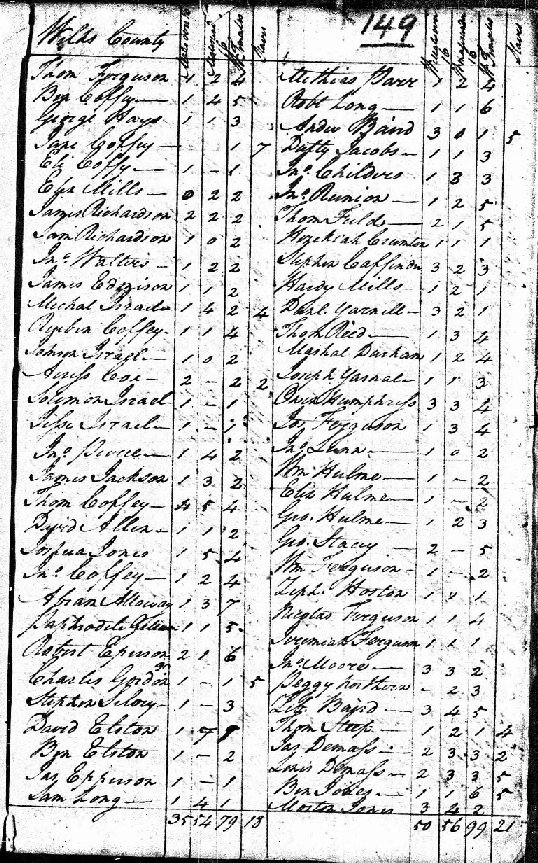
John Greer's daughter Hannah was the wife of Abraham Louis (or Lewis) Demoss (or DeMoss). The 1790 United States census enumeration for Wilkes County, North Carolina shows that the household of Louis Demoss included 5 slaves.

1790 United States Census, Wilkes County, North Carolina, page 149, Available from Ancestry.com. 1790 United States Federal Census [database on-line]. Provo, UT, USA: Ancestry.com Operations, Inc., 2010. Images reproduced by FamilySearch.

Thursday, March 12, 2015

Those Places Thursday: Pfarrkirche St. Severinus, Erpel, Germany


Pfarrkirche St. Severinus is a Roman Catholic Church in Erpel, Kreis Neuwied, Rheinland-Pfalz (Rhineland-Palatinate), Germany.

 
The church is a late Gothic column basilica which was built in the mid-13th century.  The tower basement is from an earlier nave church which was built in the 11th or early 12th century.


In 1751, the galleries were removed, a new roof was put on the tower, the height was increased on the roofs of the side naves, and the side towers were dismantled.


The church was renovated again in 1960-1967, and the galleries were restored.


According to legend, the original church hosted the remains of the Three Wise Men in 1164, when Rainald von Dassel, Archbishop of Cologne, brought them from Milan, Italy to Cologne.

My great-great-grandfather Carl Joseph Schneider and his siblings were baptized at St. Severinus. His parents Johann Wilhelm Schneider and Anna Sibylle Lindlohr were married there. Many earlier generations of the Lindlohr family attended St. Severinus.

References
A gem of  sacral archiecture: Erpel's parish church St. Severinus gets renovated - modifications are part of history
Parish Church St. Severinus
St. Severin (Erpel)

Tuesday, March 10, 2015

52 Ancestors: Week 10 "Stormy Weather": Thorkel Halvorson: Storms of Grasshoppers and Hail

My great-great-grandmother's brother Thorkel (or Torkel, Torkild, or Tarkild, and also known as Tom) Halvorson experienced "stormy weather" between 1876 and 1882, but things turned out well for him in the end.

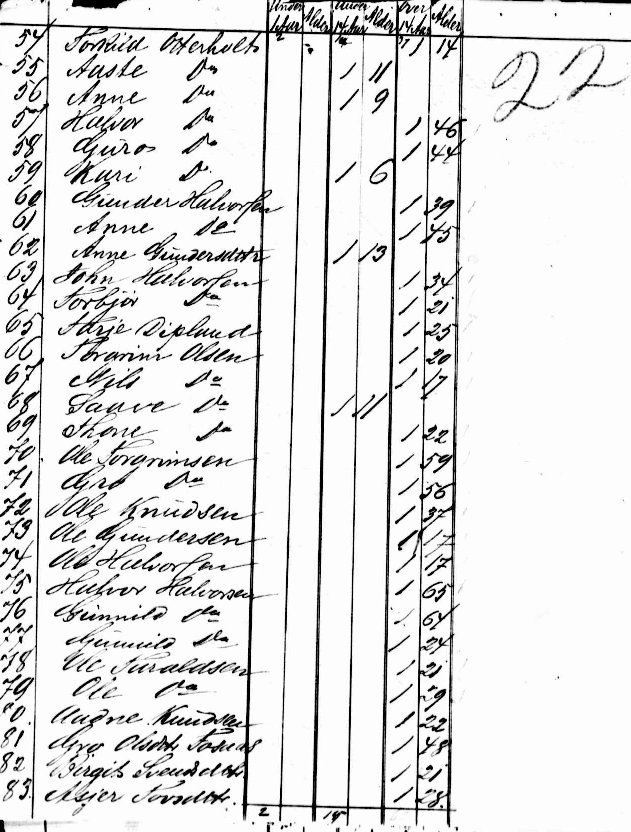
Thorkel was born on 6 September 1852 in Bø, Telemark Norway. He was the son of my 3rd-great-grandparents Halvor Eriksen Otterholt and Guro Hansdatter.

Telemark county, Bø, Parish register (official) nr. 8 (1849-1861), Birth and baptism records 1852, page 44. http://www.arkivverket.no/URN:NBN:no-a1450-kb20051011050493.jpg

In 1865, the family lived on the Otterholdt (or Otterholt) farm in Bø.The family immigrated to the United States in 1867. On 20 April 1867, the family departed from Skien, Telemark, Norway on the Rjukan. They arrived in Quebec, Canada on 30 May 1867.

Passenger list, Rjukan, 1867. Passenger Lists, 1865–1935. Microfilm Publications T-479 to T-520, T-4689 to T-4874, T-14700 to T-14939, C-4511 to C-4542. Library and Archives Canada, n.d. RG 76-C. Department of Employment and Immigration fonds. Library and Archives Canada Ottawa, Ontario, Canada. Available from Ancestry.com. Canadian Passenger Lists, 1865-1935 [database on-line]. Provo, UT, USA: Ancestry.com Operations Inc, 2010.

The family settled in Canisteo, Dodge County, Minnesota, and were enumerated there in the 1870 United States Census. On 28 February 1877, Thorkel applied for a land patent through the Homestead Act of 1862 for land located in the north half, northwest quarter, section 32 of Township 120 North of Range No. 41 west of the Principal Meridian, Swift County, Minnesota.
Thorkel Halvorson land entry case file no. 5986, 1884. Benson, Minnesota Land Office. Records of the Bureau of Land Management, Record Group 49; National Archives, Washington, D.C.

However, his application was suspended because he was not on the land in time.

Thorkel Halvorson land entry case file no. 5986, 1884. Benson, Minnesota Land Office. Records of the Bureau of Land Management, Record Group 49; National Archives, Washington, D.C.

 Thorkel became a United States citizen on 5 June 1883. 
 
Thorkel Halvorson naturalization, 5 June 1883. Lac qui Parle District Court, State of Minnesota. From Thorkel Halvorson land entry case file no. 5986, 1884. Benson, Minnesota Land Office. Records of the Bureau of Land Management, Record Group 49; National Archives, Washington, D.C.

In a deposition taken on 25 July 1883, Thorkel explained that he had lost his crops to grasshoppers in 1876 and 1877, so he had to go off to work to support himself, and was unable to establish residence on the land until May 1878. He had to go to work in 1882 as well, when he lost his crops as a result of hail.

Thorkel Halvorson land entry case file no. 5986, 1884. Benson, Minnesota Land Office. Records of the Bureau of Land Management, Record Group 49; National Archives, Washington, D.C.

In 1873, grasshoppers came to Minnesota and began to destroy crops. R.L. Cartwright states in the MNopedia article Grasshopper Plagues, 1873-1877: "On June 12, 1873, farmers in southwestern Minnesota saw what looked like a snowstorm coming towards their fields from the west. Then they heard a roar of beating wings and saw that what seemed to be snowflakes were in fact grasshoppers." The grasshoppers were Rocky Mountain locusts. Between 1873 and 1877, they ate crops of all varieties, and even ate blankets and fence posts. They spread further into Minnesota each year. In 1876, they destroyed 500,000 acres of crops in 40 Minnesota counties.

Minnesota locusts (Rocky Mountain locust, Melanoplus spretus) of the 1870s. Jacoby's Art Gallery. Public domain. Available from Wikimedia Commons.

Farmers tried to get rid of the grasshoppers in many different ways: beating them with flails, crushing them, drowning them,burning fields, digging ditches, creating "hopper dozers" made of sheet metal covered in coal tar or molasses, shooting at swarms, and making loud noises.

Grasshopper plague in Minnesota. Frank Leslie's Illustrated Newspaper, 1 September 1888, volume 67, page 37. Held by Minnesota Historical Society. Available from MNopedia.

Minnesota Governor John S. Pillsbury required men to destroy grasshopper eggs one day a week for five weeks in a row. He also proclaimed 26 April 1877 as a day of prayer and fasting. The grasshoppers finally left in the summer of 1877.

As Thorkel learned the hard way in 1882, hail could also be devastating to crops. Some farmers purchased hail insurance.

 Standard (Albert Lea, Minnesota), 22 June 1882, page 10

On 29 May 1884, Thorkel married Rosa Haukos in Lac qui Parle County, Minnesota. A month later, on 30 June 1884, he finally received his land patent. 

Thorkel Halvorson, Swift County, Minnesota. Certificate no. 5986. United States Bureau of Land Management, 30 June 1884.

In 1885, Thorkel and Rosa were living in Riverside, Lac qui Parle County, Minnesota. Their son Ervin Fremont Halvorson was born on 27 November 1885. Another son, Henry A. Halvorson, was born on 25 December 1887.

In 1895, Thorkel and his family were living in Madison, Lac qui Parle County, Minnesota. Thorkel remained in Madison for the rest of his life. In the 1900 United States Census, he is listed as a dealer in general merchandise.  He had survived the storms and had done well enough to own his home free and clear.

1900 United States census, Madison Village, Lac qui Parle County, Minnesota, population schedule, enumeration district 130, sheet no. 12. Available from Ancestry.com. 1900 United States Federal Census [database on-line]. Provo, UT, USA: Ancestry.com Operations Inc, 2004.

Thorkel died in Madison on 10 July 1908, and was buried on 13 July 1908 in Hayden City Cemetery, Madison, Lac qui Parle County, Minnesota.

References
Bring Warm Clothes: Grasshopper Plague, 1873-1877
Grasshopper Plagues, 1873-1877 
Looking Back at the Days of the Locust
Pillsbury's Best - A Tale of Faith & Grasshopper Chapel
A Plague of Locusts 
Rocky Mountain locust

Monday, March 9, 2015

Military Monday: World War I Memorial Plaque, Sts. Peter and Paul Catholic Church, Remagen, Germany


Inside Sts. Peter and Paul's Catholic Church in Remagen, Kreis Ahrweiler, Rheinland-Pfalz (Rhineland-Palatinate), Germany, there is a memorial plaque which lists the names of local men who died during World War I. In the bottom section of the last column, names of missing men are listed.

Sunday, March 8, 2015

Census Sunday: Can No Longer Read and Write

United States federal census records between 1850 and 1880 consistently show that Miriam (Hill) Russell, the wife of my 4th-great-grandmother's brother James Russell, was able to read and write.

The 1850 United States census shows that James' mother Hannah (my 5th-great-grandmother) and sister Sobrina (my 4th-great-grandmother) cannot read and write. There is no mark in the Persons over 20 years of age who cannot read and write column for James or Miriam.

1850 United States census, Davidson County, Tennessee, population schedule, page 279B, image 564. Available from Ancestry.com. 1850 United States Federal Census [database on-line]. Provo, UT, USA: Ancestry.com Operations, Inc., 2009. Images reproduced by FamilySearch.

In 1860,  There is no mark in the Persons over 20 years of age who cannot read and write column for any members of the Russell family.

1860 United States census, 14th District, Davidson County, Tennessee, population schedule, page 243, image 285. Available from Ancestry.com. 1860 United States Federal Census [database on-line]. Provo, UT, USA: Ancestry.com Operations, Inc., 2009. Images reproduced by FamilySearch.

In 1870, there is no mark in the Cannot Read or Cannot Write column for Miriam Russell or her daughter.

1870 United States census, 1st Civil District, Williamson County, Tennessee, population schedule, page 10B, image 27. Available from  Ancestry.com. 1870 United States Federal Census [database on-line]. Provo, UT, USA: Ancestry.com Operations, Inc., 2009. Images reproduced by FamilySearch.

In 1880, there is no mark in the Cannot Read or Cannot Write column for Miriam Russell or any member of her family.

1880 United States census, 1st District, Williamson County, Tennessee, population schedule, page 4C. Available from Ancestry.com and The Church of Jesus Christ of Latter-day Saints. 1880 United States Federal Census [database on-line]. Provo, UT, USA: Ancestry.com Operations Inc, 2010.

However, in 1900, "no" is written in the Can read and Can write columns for Miriam Russell.

1900 United States census, District no. 1, Williamson County, Tennessee, population schedule, page 8B. Available from Ancestry.com. 1900 United States Federal Census [database on-line]. Provo, UT, USA: Ancestry.com Operations Inc, 2004.

1900 United States census, District no. 1, Williamson County, Tennessee, population schedule, page 8B. Available from Ancestry.com. 1900 United States Federal Census [database on-line]. Provo, UT, USA: Ancestry.com Operations Inc, 2004. 

It is possible that this is a mistake. But perhaps Miriam could no longer read and write. Maybe her eyesight was failing and she could no longer see well enough to read. Maybe she was no longer physically able to write. Maybe this census record is a clue to the physical ailments that she may have experienced in her old age. She was in her 80s at the time of the census enumeration.