Covering genealogy, family history, historical events and places, and anything else related!

Sunday, December 7, 2014

Church Record Sunday: Catholic Church Records in New York City

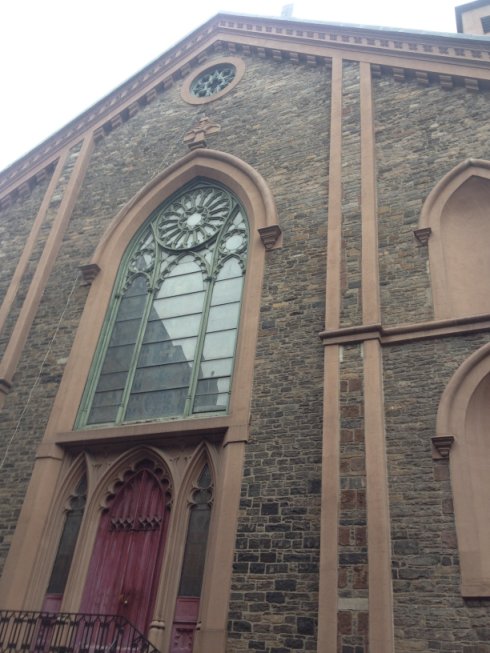
Basilica of Saint Patrick's Old Cathedral, Mulberry Street, New York, New York

Yesterday I attended the lecture "Finding Your Ancestors in Catholic New York" at the Parish House of the Basilica of Saint Patrick's Old Cathedral in New York City. The lecture was sponsored by the New York Irish History Roundtable. Kate Feighery, Archival Manager for the Archdiocese of New York, talked about different types of sacramental records, where to find the records, and finding an ancestor's parish.

The Archdiocese of New York covers Manhattan, the Bronx, Staten Island, as well as Dutchess, Orange, Putnam, Rockland, Sullivan, Ulster, and Westchester Counties. The Archives of the Archdiocese of New York are located at 201 Seminary Avenue, Yonkers, NY 10704.

The Diocese of Brooklyn covers Brooklyn and Queens. The Archives of the Diocese of Brooklyn are located at 310 Prospect Park West, Brooklyn, NY 11215.

Sacramental records are kept by parishes. The Archives of the Archdiocese of New York do not have sacramental records, and the Archives of the Diocese of Brooklyn only have the sacramental records of nine closed parishes, three closed hospitals, and two orphanages.

Saturday, December 6, 2014

52 Ancestors: #49 Anna Gertrude Tarkington

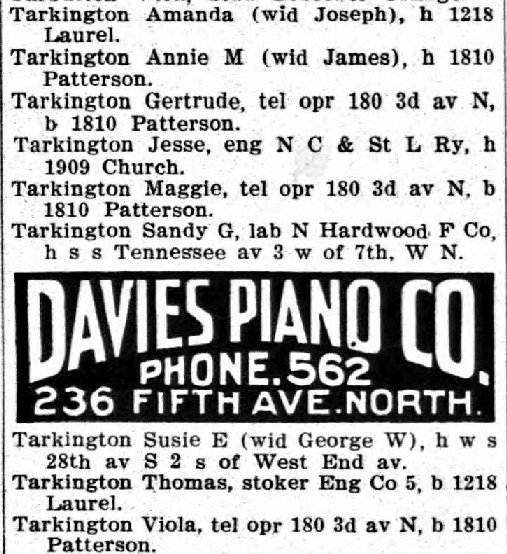
My great-grandmother Anna Gertrude Tarkington was born on 16 April 1889 in Nashville, Tennessee. She was the fourth of five children, and youngest daughter, of James William Tarkington and Anna Malvina Binkley. When she was five years old, her father died. In 1900, she lived with her mother, her maternal grandmother Angeline (Mayo) Binkley, her sister Viola Maydell, and her brother Robert. Her oldest sister Laura Belle had married Patrick Henry Leech and lived nearby. When the 1900 United States census was taken, her sister Margaret was enumerated in the household of their paternal grandparents. By 1905, Gertrude was working as a telephone operator for the East Tennessee Telephone Company.

Nashville City Directory, 1905. Nashville, TN: Marshall-Bruce-Polk Co. Available from Ancestry.com. U.S. City Directories, 1821-1989 [database on-line]. Provo, UT, USA: Ancestry.com Operations, Inc., 2011.

On 12 June 1907, Gertrude gave birth to a son, Robert Leland Taylor. He died on  4 July 1907 and was buried in the family cemetery in Vaughn's Gap, Tennessee. Gertrude's sister Margaret "Maggie" was the informant on the death certificate; she stated that the father was unknown. But since her child had a different surname, Gertrude must have known who his father was. I suspect that Maggie also knew, but did not wish to reveal his name.

On 19 November 1909, Gertrude married Henry Brown Gatlin in Nashville. She probably did not know it, but he had not yet divorced his first wife Rose Kuenninger. Shortly after their marriage, Henry and Gertrude moved to Chicago, Illinois. Their first child, my paternal grandfather Henry Cornelius Gatlin, was born in Chicago on 14 April 1910. My grandfather should have been enumerated in the 1910 United States census; it was supposed to include everyone who was in the household on 15 April 1910. However, he was not enumerated. Henry and Gertrude were incorrectly enumerated under the surname Galter. They were lodgers in the household of N. King, and several other lodgers also resided in the household. Gertrude and Henry were probably not the ones who provided the information to the census taker. Henry divorced his first wife Rose in 1916, probably without telling Gertrude.

On 26 June 1923, Gertrude gave birth to a stillborn son, Eugene Joseph Gatlin. The stillbirth was caused by placenta previa. Eugene Joseph was buried in Oak Forest Cemetery, Oak Forest, Cook County, Illinois.

On 29 November 1929, Gertrude filed for divorce. On 26 August 1929, while he was drunk, her husband Henry had threatened her life and thrown her out of their home. He later tried to break into her new residence with the intention of hurting her. She obtained a restraining order against him. Because no one appeared to prosecute the case, it was dismissed. She and her husband remained separated. In the 1930 United States census, Gertrude and her son (my grandfather) were living in the household of Walter E. Davis. They were listed as lodgers. Like Gertrude, Walter had been born in Tennessee. They later married. I suspect that they were already in a relationship at the time that the 1930 U.S. Census was taken. Gertrude was listed as widowed, but her husband was still alive.

On 24 January 1935, Gertrude's mother passed away in Memphis, Tennessee. She had been visiting her granddaughter (Gertrude's niece) Nina (Leech) Clark. Gertrude was the informant on her mother's death certificate; she may have been visiting prior to her mother's death, or may have traveled to Memphis immediately after hearing the news.

In late 1939, Gertrude's niece Louise (her sister Margaret's daughter) came to stay with her and Walter (called "Bill") at their residence, 4710 No. Wolcott Av., Chicago, Illinois. Louise's husband and former stepfather John Joseph Berberick had recently passed away. They had been living in Cedarville, New York. Margaret had passed away in 1929.

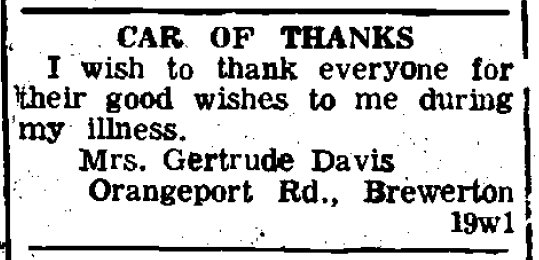
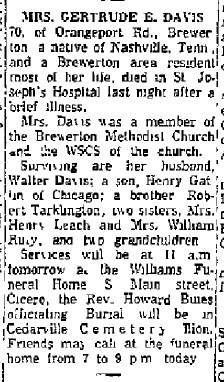
In the 1940 United States census, Gertrude and Walter were listed as married. However, they may not have actually been married at that time. According to my father's baby book, for his first birthday in 1942, he received a birthday gift from Grandma Gatlin and Bill Davis. For his second birthday in 1943, he received a gift from Grandma Davis. There is a section about trips in my father's baby book, and it says that on August 1, 1943 he took a train to Utica, New York to see his Grandma Davis. Gertrude and Bill moved to New York sometime in the early 1940s. They must have been in New York by 1943.They lived on Orangeport Road in Brewerton, Onondaga County, New York. I am not sure if their home on Orangeport Road was their only New York residence. or just their last one. My father remembers that they had wild strawberries in their backyard. Gertrude was a member of the Brewerton Methodist Church and its Women's Society of Christian Service (now United Methodist Women).

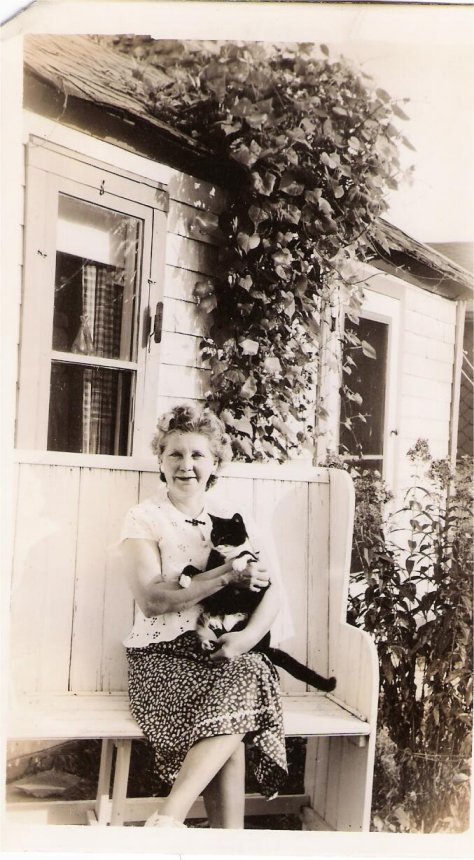
There were many "black sheep" on my grandfather's father's side of the family, but my grandfather was a good man. He must have taken after his mother's side of the family. Gertrude must have been a good mother, and raised him well. Looking at the photo below, I definitely see a resemblance between my grandfather and his mother. As a cat lover, I am glad to see that Gertrude appears to have liked cats.


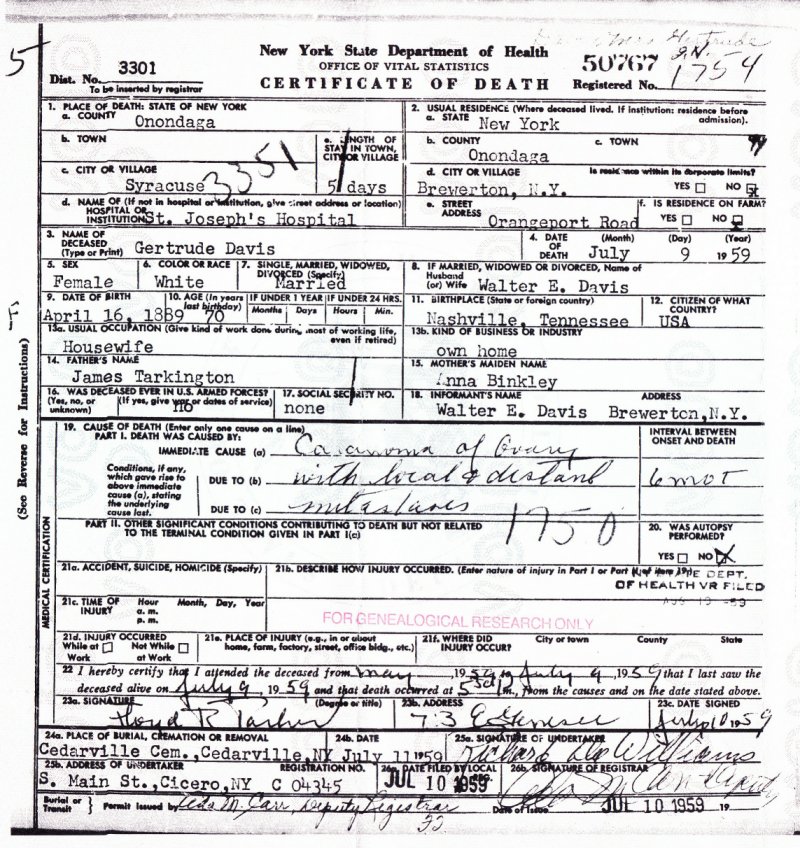
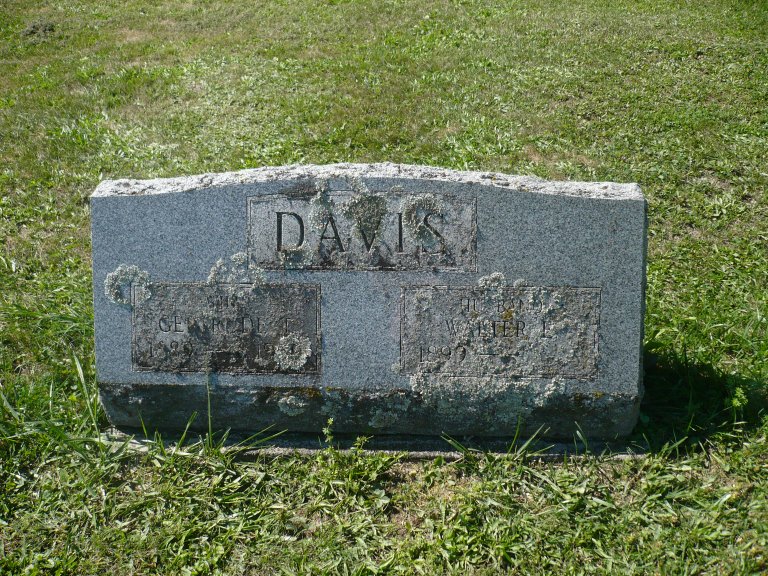
Gertrude died in St. Joseph's Hospital in Syracuse, New York on 9 July 1959, as a result of ovarian cancer. She was buried in Cedarville Cemetery in Cedarville, New York, near her sister Margaret.

 Mexico Independent, 17 May 1959, page 13

Certificate of death, Gertrude Davis. 9 July 1959. New York State Department of Health, Office of Vital Statistics.

Syracuse Post Standard, 10 July 1959, page 9.

Friday, December 5, 2014

Repeal Day

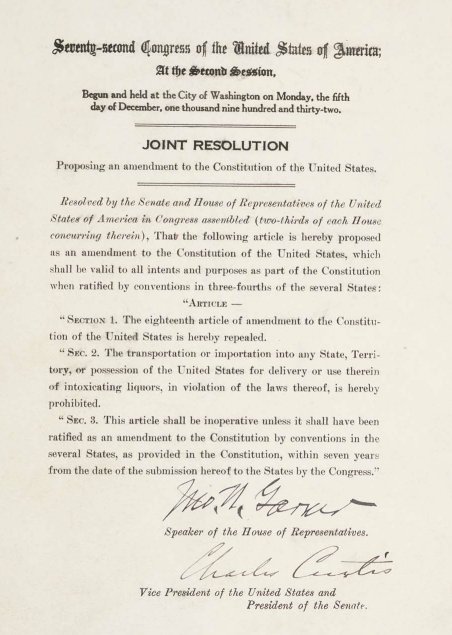
Joint Resolution Proposing the Twenty-first Amendment to the United States Constitution. National Archives and Records Administration.

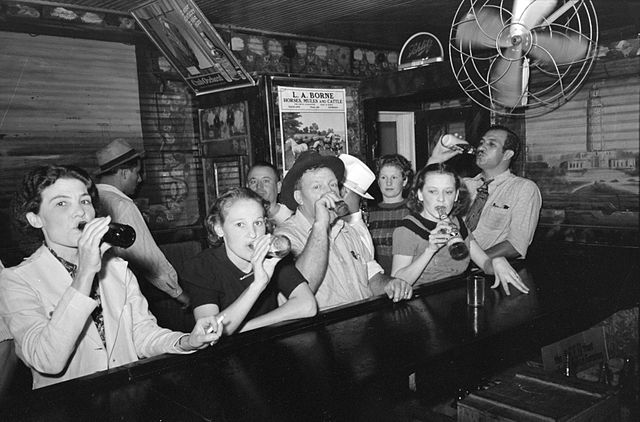
Drinking beer at the bar, Raceland, Louisiana. Photo by Russell Lee for Farm Security Administration/WPA [Public domain]. Available from Wikimedia Commons.

Repeal Day (a registered trademark of the Museum of the American Cocktail) is celebrated on December 5.

 After the Great Depression began, the United States government needed more tax revenue; a tax on alcohol would be a source of revenue. During his presidential campaign, Franklin D. Roosevelt promised to repeal Prohibition if elected. On 7 April 1933, after the Cullen-Harrison Act was passed, it became legal to sell beer with a 3.2% alcohol content, and wine with a similar alcohol content. Anheuser-Busch introduced the Budweiser Clydesdales, and the next day the horses delivered a ceremonial case of beer to President Franklin D. Roosevelt. Yuengling also sent beer to President Roosevelt.

On 5 December 1933, the Twenty-First Amendment to the United States Constitution was ratified. It repealed the Eighteenth Amendment, which prohibited the manufacture, sale, or transportation of alcoholic beverages. The consumption of alcohol was not prohibited.

The Twenty-First Amendment is the only amendment which was ratified by state ratifying conventions; all other amendments were ratified by state legislatures. South Carolina rejected the amendment, and North Carolina rejected holding a convention to consider the amendment. Georgia, Kansas, Louisiana, Mississippi, Nebraska, North Dakota, Oklahoma, and South Dakota did not consider the amendment. Prohibition continued in Mississippi until 1966.

I think that many members of my family were probably opposed to Prohibition. In 1910, my 2nd-great-grandfather's brother John William Schneider  was a saloon keeper. My maternal grandmother Margaret Ann Schneider played piano in a beer garden in the 1930s; she met my grandfather John Boe there when a fight broke out one night and they hid under the piano together. My paternal grandmother's brother Earl Theodore Anderson brewed his own beer (but not during Prohibition; he was only 16 in 1933).

References
American Spirits: The Rise and Fall of Prohibition 
Budweiser Clydesdales
Cullen-Harrison Act
Document for December 5th:Presidential Proclamation 2065 of December 5, 1933, in which  President Franklin D. Roosevelt announces the Repeal of Prohibition
Eighteenth Amendment to the United States Constitution 
Five interesting facts about Prohibition’s end in 1933
Happy Repeal Day: Party like it’s 1933
Prohibition in the United States
Repeal Day
Twenty-First Amendment to the United States Constitution

Thursday, December 4, 2014

Thriller Thursday: Skeleton Discovered in Haystack

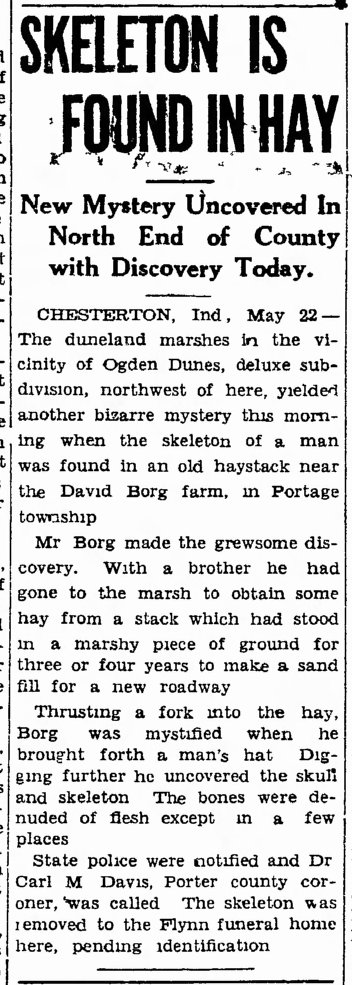
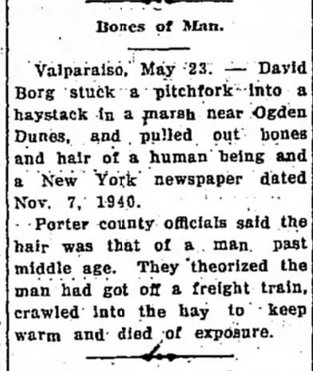
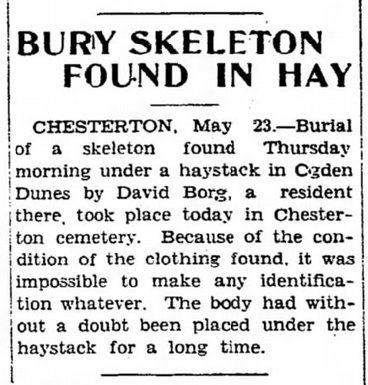
On 22 May 1941, my first cousin 3 times removed David Borg and his brother went to the marshes near his farm in Porter County, Indiana. David stuck his pitchfork into a haystack, and he pulled out a skeleton. The skeleton was taken to the Flynn Funeral Home in Chesterton, Porter County, Indiana. It could not be identified, and it was buried in Chesterton Cemetery on 23 May 1941.

 Vidette Messenger, 22 May 1941, page 1

Tipton Tribune, 23 May 1941, page 8

Vidette Messenger, 23 May 1941, page 12

Wednesday, December 3, 2014

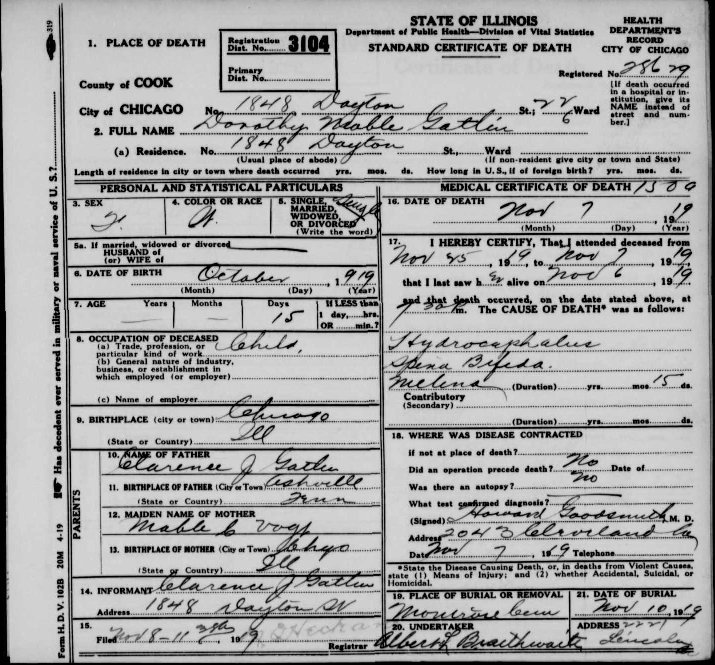
Wednesday's Child: Dorothy Mabel Gatlin

Death certificate, Dorothy Mable Gatlin. 7 November 1919. State of Illinois. Department of Public Health. Division of Vital Statistics.

Dorothy Mabel Gatlin was born on 25 October 1919 in Chicago, Illinois. She was the daughter of Clarence Joseph Gatlin (my great-grandfather Henry Brown Gatlin's brother) and Mabel K. Vogt. She died of hydeocephalus and spina bifida in Chicago on 7 November 1919. Although her death certificate gives her middle name as Mable, it was recorded as Mabel on her birth certificate. She was buried in Montrose Cemetery in Chicago.

Tuesday, December 2, 2014

Tombstone Tuesday: Vivian Evelyn (Boe) Schaefering


My great-grandmother Kathleen Graham's oldest child, Vivian Evelyn, was born on 9 August 1901 in Alton, Madison County, Illinois. Vivian's biological father was Samuel R. Bowen. She was known as Vivian Walker until her mother married John Boe;  Vivian then took his surname and was raised as his daughter. Vivian married Erwin Edgar Schaefering on 7 February 1922 in Obion County, Tennessee. Vivian died on 12 December 1978 in St. Louis, Missouri. Her ashes are interred at Hillcrest Abbey Crematory and Mausoleum in St. Louis.

Monday, December 1, 2014

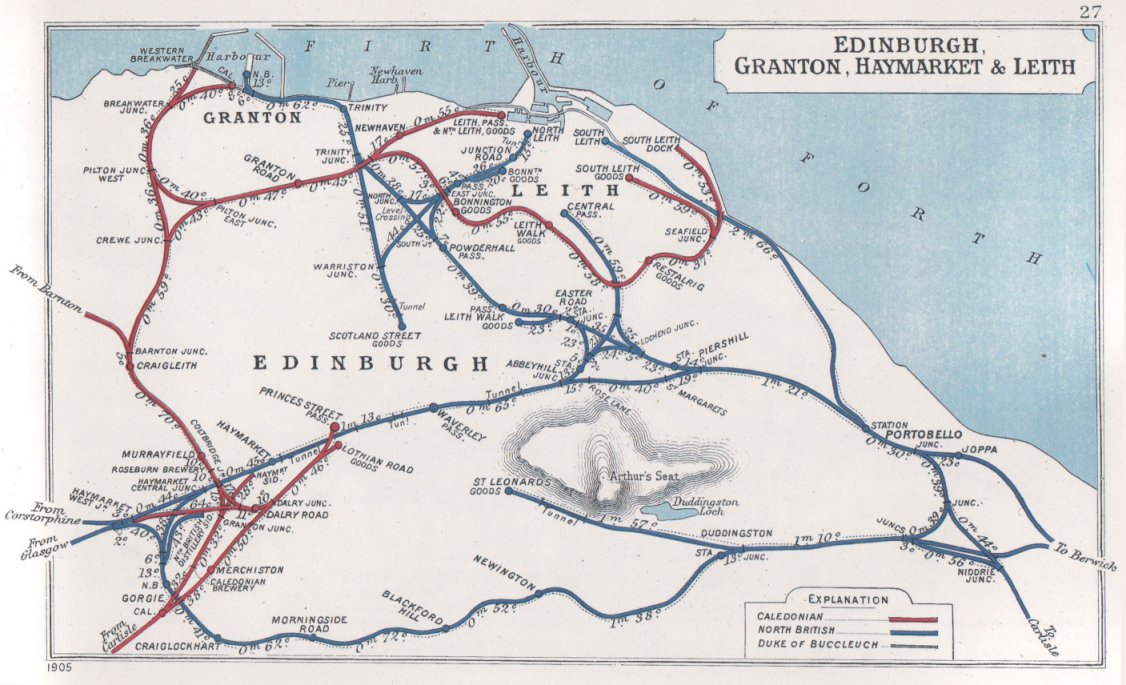
Mappy Monday: Railway Junctions in Edinburgh, Granton, Haymarket, and Leith

Railway Junctions in Edinburgh, Granton, Haymarket & Leith pre grouping. Railway Junction Diagram, Railway Clearing House, 1905 and 1914 [Public domain]. Available from Wikimedia Commons.

This map shows the railway junctions in Edinburgh, Granton, Haymarket, and Leith, Scotland. My Winters ancestors lived in Leith, which is now part of Edinburgh.