Through a recent article in the Chronicle of Higher Education, I learned about eHistory, the Web site of the Center for Virtual History, Franklin College of Arts and Sciences, University of Georgia. The Center was founded by Stephen Berry and Claudio Saunt.The Center has created online projects.
The Invasion of America is an interactive map which shows Native American land cessions between 1784 and 1887.When the slider on the map is moved, changes from year to year are visible. By clicking on the map, one can see who ceded the land, and when it was ceded. Pop-up boxes link to documents, including the text of treaties.
IndianNation contains pages for Native Americans counted in the census of 1900. I found Louis Thifault, the father-in-law of my first cousin 3 times removed Ralph Edwin Boe, listed on the site. Louis lived in Rolette, North Dakota and was a member of the Ojibwe tribe. The site did not have much information on him. People can register and add information to the site. I registered and began adding information.
Pox Americana contains information on the smallpox epidemic of 1775-1782. Cases of smallpox are shown on an interactive map; if you click on a case, details about it are provided.
The Georgia Virtual History Project includes maps, tutorials, and videos on the history of the state of Georgia. A mobile app is also available.
Other projects being developed by the Center are Born Unfree (biographies of former slaves interviewed by the Works Progress Administration), Common Tongues (the Corpus of American Civil War Letters Project, a collection of letters by Civil War soldiers who wrote "by ear"), CSI Dixie (coroners' inquests for the state of South Carolina between 1840 and 1880), Freedmen's Teacher Project (biographies of teachers in freed people's schools), Fugitive Federals (Union prisoners who escaped the Confederacy), and Mapping the American Population (demographic changes in North America between 1500 and 1800).

Friday, September 12, 2014

Thursday, September 11, 2014
Remembering 9/11
I was driving to work the morning of September 11, 2001 when I heard the news about a plane crashing into the World Trade Center. My first thought was that it must have been a terrible accident, but then I heard that a second plane had also crashed into the World Trade Center. At work, we brought a small TV into the workroom to keep up to date on the news. I also searched online for updates. We then heard that a plane had crashed into the Pentagon. I looked out the window and saw planes circling around the area. They were probably doing surveillance, since we were in northern New Jersey, close to New York City. But at the time, under those circumstances, the sight of those planes made me nervous. I was horrified when I heard that the World Trade Center towers had collapsed.
We were sent home early and had the next day off as well. My Birman cat Velvet had died on March 23, 2001, and since then, I had not been able to bring myself to wear my two Birman T-shirts. But on September 11 and 12, I wore them. Feeling like Velvet was close to me brought me comfort. It was a very frightening time. I had always thought that I lived in a nice, safe neighborhood. But the terrorists were so close to me. They did practice runs for the 9/11 attacks at the Essex County Airport in Fairfield, New Jersey (the next town over from me, about 5 minutes away). The hijackers of the plane that crashed into the Pentagon had shopped at Willowbrook Mall in Wayne, New Jersey (also the next town over from me, about 5 minutes away) the weekend before the attacks. They had gone to the sporting goods store. They were probably buying box cutters, knives, and other supplies for the attacks. Flight 93, which crashed in Pennsylvania, had been hijacked at Newark Airport, the airport I use when I travel.What if my flight had been hijacked? For quite some time, I could not look at a plane in the air in the same way. The view over the New York skyline was sickening; the gray dust hovered over the city. My aunt and cousin live in New York City, fairly close to the World Trade Center. It must have been even worse for them, having to breathe that air.
A woman from my hometown, Sara Manley, was killed in the September 11 attacks. She was working in the World Trade Center. I didn't know her very well because she was younger than me, so she was in a different class at school, but my parents know her parents. A woman that I work with knew a priest, Mychal Judge, who was killed on September 11 while serving as chaplain to the New York City Fire Department.
Last December, I visited the 9/11 Memorial at the site of the former Twin Towers, and took the pictures below.


We were sent home early and had the next day off as well. My Birman cat Velvet had died on March 23, 2001, and since then, I had not been able to bring myself to wear my two Birman T-shirts. But on September 11 and 12, I wore them. Feeling like Velvet was close to me brought me comfort. It was a very frightening time. I had always thought that I lived in a nice, safe neighborhood. But the terrorists were so close to me. They did practice runs for the 9/11 attacks at the Essex County Airport in Fairfield, New Jersey (the next town over from me, about 5 minutes away). The hijackers of the plane that crashed into the Pentagon had shopped at Willowbrook Mall in Wayne, New Jersey (also the next town over from me, about 5 minutes away) the weekend before the attacks. They had gone to the sporting goods store. They were probably buying box cutters, knives, and other supplies for the attacks. Flight 93, which crashed in Pennsylvania, had been hijacked at Newark Airport, the airport I use when I travel.What if my flight had been hijacked? For quite some time, I could not look at a plane in the air in the same way. The view over the New York skyline was sickening; the gray dust hovered over the city. My aunt and cousin live in New York City, fairly close to the World Trade Center. It must have been even worse for them, having to breathe that air.
A woman from my hometown, Sara Manley, was killed in the September 11 attacks. She was working in the World Trade Center. I didn't know her very well because she was younger than me, so she was in a different class at school, but my parents know her parents. A woman that I work with knew a priest, Mychal Judge, who was killed on September 11 while serving as chaplain to the New York City Fire Department.
Last December, I visited the 9/11 Memorial at the site of the former Twin Towers, and took the pictures below.


Wednesday, September 10, 2014
Workday Wednesday: Telephone Operators
To keep up with the growth of telephone networks, multiple switchboards were introduced. Operators sat before the middle panel of a three-panel board which contained jacks for subscriber lines, and could stretch to reach the jacks on the left and right panels. They sometimes worked in groups of three. Almost all telephone operators were women. They often answered 125 calls or more per hour.
Telephone service came to Middle Tennessee in 1880. In 1885, my great-great-grandfather's sister Jennie Tarkington worked for the Cumberland Telephone & Telegraph Co. in Nashville. The following year, her sister Julia also worked for the company, which moved its headquarters to Nashville in 1888. For more than thirty years, members of the Tarkington family were telephone operators. My great-grandmother's sister Margaret "Maggie" Tarkington was working for the Cumberland Telephone & Telegraph Co. in 1898, at the age of 14. In 1903, her sister Viola Maydell Tarkington and her cousin Susie Tarkington were also working for the company. Jennie and Julia's sister Adeline Sophronia "Fronie" Tarkington worked as a telephone operator for the East Tennessee Telephone Co. in Chattanooga in 1904. In 1905, Maggie, Viola, and my great-grandmother Gertrude Tarkington were all working at 180 3rd Av. N. in Nashville, where the East Tennessee Telephone Co. was located. By 1910, Maggie was the only one still working as a telephone operator, and she continued working in this field through 1917, when she was an operator at the post office.
References
Hello! The Telephone Girl
Lipartito, Kenneth. "When Women Were Switches: Technology, Work, and Gender in the Telephone Industry, 1890-1920." American Historical Review 99 (1994): 1074-1111.
Telephone service comes to Robertson


Telephone service came to Middle Tennessee in 1880. In 1885, my great-great-grandfather's sister Jennie Tarkington worked for the Cumberland Telephone & Telegraph Co. in Nashville. The following year, her sister Julia also worked for the company, which moved its headquarters to Nashville in 1888. For more than thirty years, members of the Tarkington family were telephone operators. My great-grandmother's sister Margaret "Maggie" Tarkington was working for the Cumberland Telephone & Telegraph Co. in 1898, at the age of 14. In 1903, her sister Viola Maydell Tarkington and her cousin Susie Tarkington were also working for the company. Jennie and Julia's sister Adeline Sophronia "Fronie" Tarkington worked as a telephone operator for the East Tennessee Telephone Co. in Chattanooga in 1904. In 1905, Maggie, Viola, and my great-grandmother Gertrude Tarkington were all working at 180 3rd Av. N. in Nashville, where the East Tennessee Telephone Co. was located. By 1910, Maggie was the only one still working as a telephone operator, and she continued working in this field through 1917, when she was an operator at the post office.
References
Hello! The Telephone Girl
Lipartito, Kenneth. "When Women Were Switches: Technology, Work, and Gender in the Telephone Industry, 1890-1920." American Historical Review 99 (1994): 1074-1111.
Telephone service comes to Robertson

Newspaper advertisement, 1901. Available from http://archive.tennessean.com/article/20070718/MTCN0303/307180058/Telephone-service-comes-Robertson.

Cumberland Telephone and Telegraph Company stamp. Available from http://gb-precancels.org/Telegraphs/World/USA-TP.html.

Nashville, Tennessee city directory, 1885
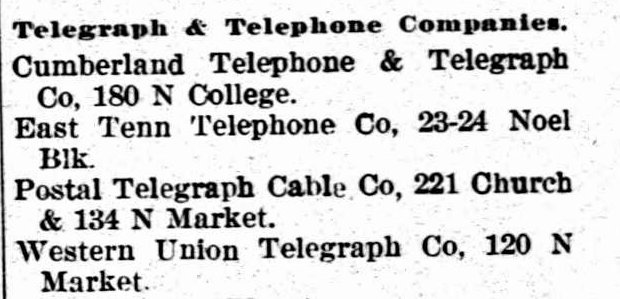
Nashville, Tennessee city directory, 1898

Nashville, Tennessee city directory, 1908
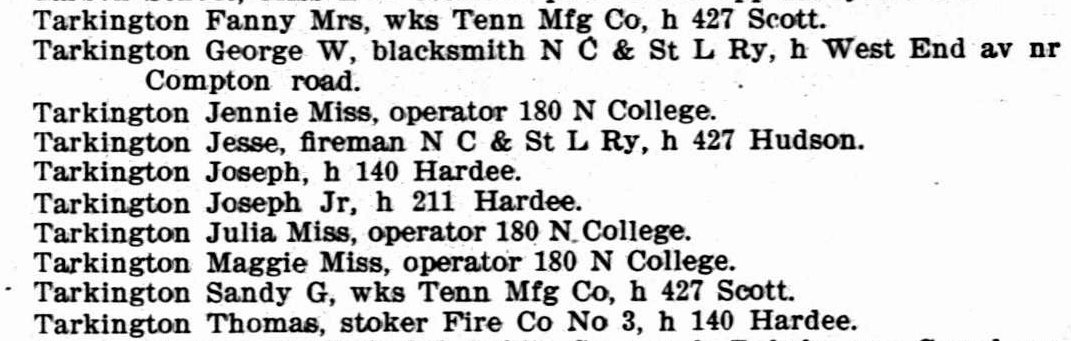
Nashville, Tennessee city directory, 1898

Nashville, Tennessee city directory, 1903

Chattanooga, Tennessee city directory, 1904
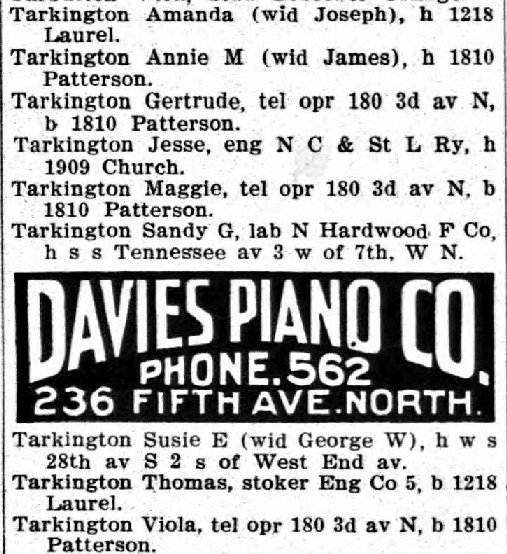
Nashville, Tennessee city directory, 1905
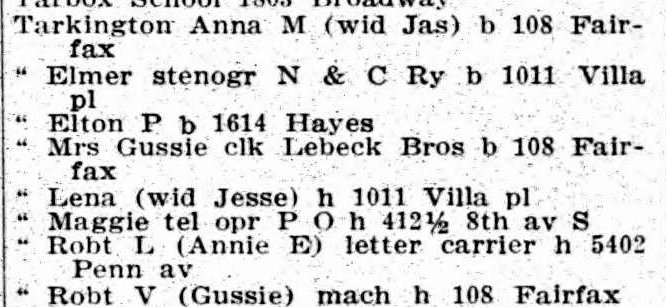
Nashville, Tennessee city directory, 1917

"Operators at Work in the Telephone Exchange", New Orleans, 1893. Artist not credited; signed but not legible (Via Times-Picayune archive) [Public domain]. Available from Times-Picayune Archive and Wikimedia Commons.
Tuesday, September 9, 2014
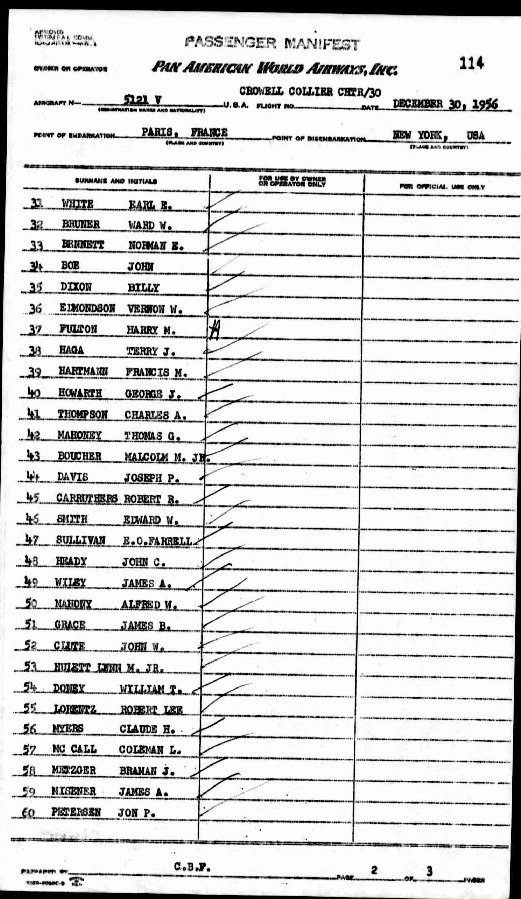
Travel Tuesday: John Boe's Business Trip to Paris, 1956
In 1956, my maternal grandfather John Boe traveled to Paris, France with P. F. Collier and Son. He was Vice President of the company at the time. He and John G. Ryan, President of P. F. Collier, presented a hand-tooled leather set of the anniversary edition of Collier's Encyclopedia to M. Julien Caen, the administrator general of the Bibliothèque nationale de France. He also met Guy Mollet, Prime Minister of France.
He returned to New York on 30 December 1956 on a Crowell Collier charter flight on Pan American World Airways.
 Ancestry.com. New York, Passenger Lists, 1820-1957 [database on-line]. Provo, UT, USA: Ancestry.com Operations, Inc., 2010. Year: 1956; Arrival: New York, New York; Microfilm Serial: T715, 1897-1957; Microfilm Roll: Roll 8823; Line: 4; Page Number: 114.
He returned to New York on 30 December 1956 on a Crowell Collier charter flight on Pan American World Airways.
Monday, September 8, 2014
52 Ancestors: #36 Ellen Victoria (Dahlquist) Anderson
My great-grandmother Ellen Victoria (Dahlquist) Anderson was the only one of my great-grandparents that I knew. Although she was my great-grandmother, she was always "Grandma Anderson" to me. Today is the 128th anniversary of her birth.
Ellen was born on 8 September 1886 at the home of her parents, Charles John (Carl Johan) Dahlquist and Mary (or Marie) Borg, 425 25th Street, Chicago, Illinois. In 1900, she lived with her family at 6031 State Street, Chicago, in the area that had been Hyde Park Township from 1861 to 1889. Between 1901 and 1902, the family moved to 6317 Eggleston Ave., Chicago (6311 Eggleston Ave. after 1909). The 1906, 1907, and 1908 Chicago city directories list Ellen as working in millinery. In 1910 she was a dressmaker. On 20 June 1910, she married Edward Theodore Anderson in Chicago. They took a honeymoon trip to White Bear Lake, Minnesota and the Dells in Wisconsin, and traveled by boat to Muskegon, Michigan. 6638 Sangamon Street, Chicago was their first residence. Their daughter Helen Martha Marie (my paternal grandmother) was born on 27 September 1911. They then moved to 208 E. 70th Street, to 7244 Lowe Street, and to 6547 S. Peoria Street. On 7 July 1917, their son Earl Theodore was born. In April 1924, they moved to 8241 S. Peoria Street, a two-story brick house which had been built for them.
Ellen and Edward moved to St. Petersburg, Pinellas County, Florida by 1951. Edward died on 2 December 1965.
I remember my great-grandmother's visits to New Jersey when I was a child. I last saw her in 1982, during a family trip to Florida. She died on 26 April 1986 at Majestic Towers in South Pasadena, Pinellas County, Florida.


Ellen was born on 8 September 1886 at the home of her parents, Charles John (Carl Johan) Dahlquist and Mary (or Marie) Borg, 425 25th Street, Chicago, Illinois. In 1900, she lived with her family at 6031 State Street, Chicago, in the area that had been Hyde Park Township from 1861 to 1889. Between 1901 and 1902, the family moved to 6317 Eggleston Ave., Chicago (6311 Eggleston Ave. after 1909). The 1906, 1907, and 1908 Chicago city directories list Ellen as working in millinery. In 1910 she was a dressmaker. On 20 June 1910, she married Edward Theodore Anderson in Chicago. They took a honeymoon trip to White Bear Lake, Minnesota and the Dells in Wisconsin, and traveled by boat to Muskegon, Michigan. 6638 Sangamon Street, Chicago was their first residence. Their daughter Helen Martha Marie (my paternal grandmother) was born on 27 September 1911. They then moved to 208 E. 70th Street, to 7244 Lowe Street, and to 6547 S. Peoria Street. On 7 July 1917, their son Earl Theodore was born. In April 1924, they moved to 8241 S. Peoria Street, a two-story brick house which had been built for them.
Ellen and Edward moved to St. Petersburg, Pinellas County, Florida by 1951. Edward died on 2 December 1965.
I remember my great-grandmother's visits to New Jersey when I was a child. I last saw her in 1982, during a family trip to Florida. She died on 26 April 1986 at Majestic Towers in South Pasadena, Pinellas County, Florida.
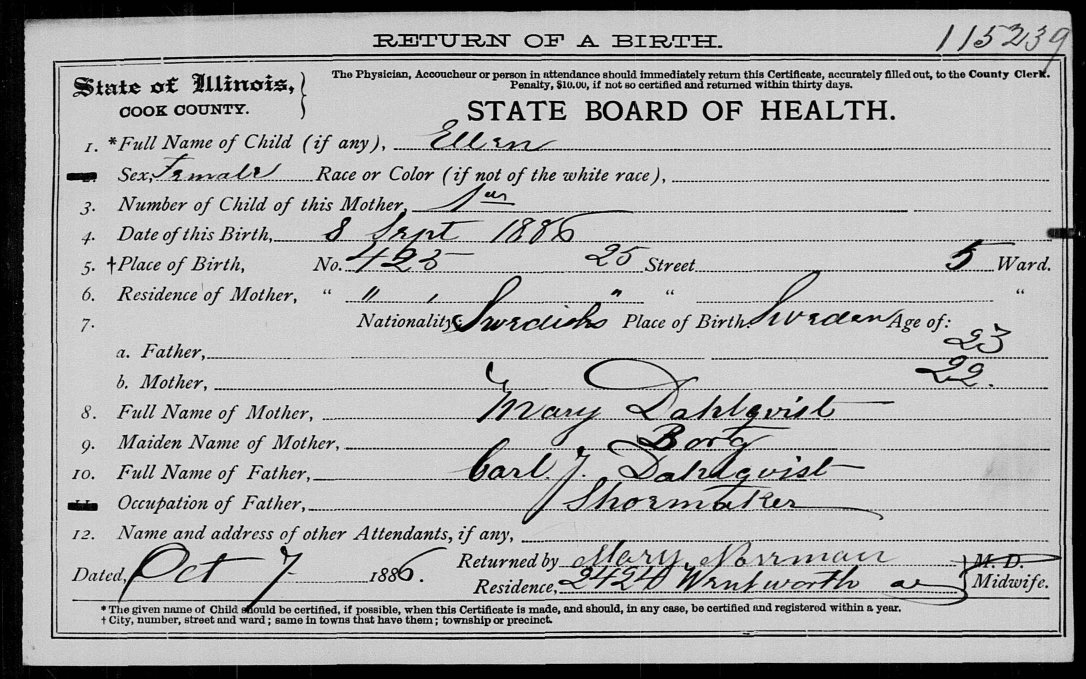
Return of a Birth, Ellen Dahlquist. State of Illinois, Cook County. No. 115239, dated 7 October 1886.
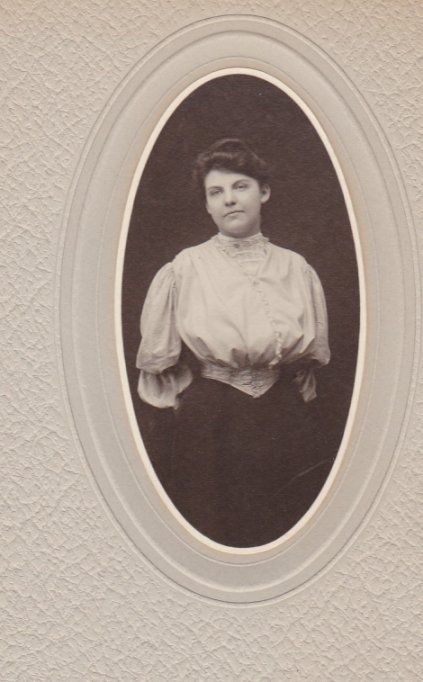
Ellen Dahlquist, 1906
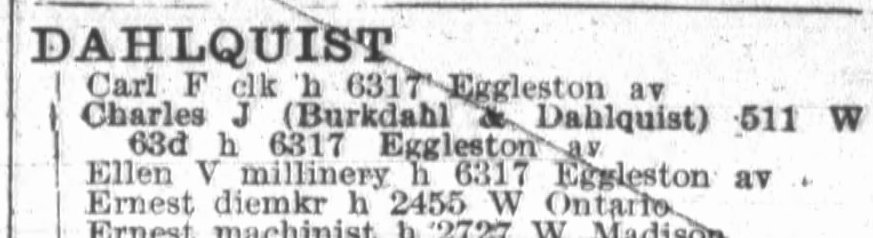
Chicago, Illinois city directory, 1908
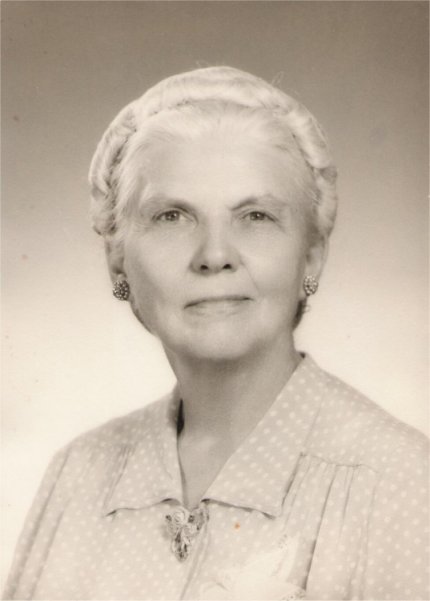
Ellen (Dahlquist) Anderson
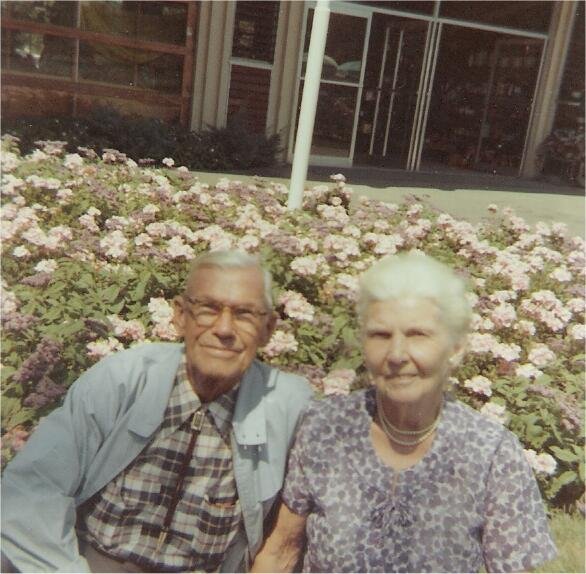
Edward and Ellen Anderson
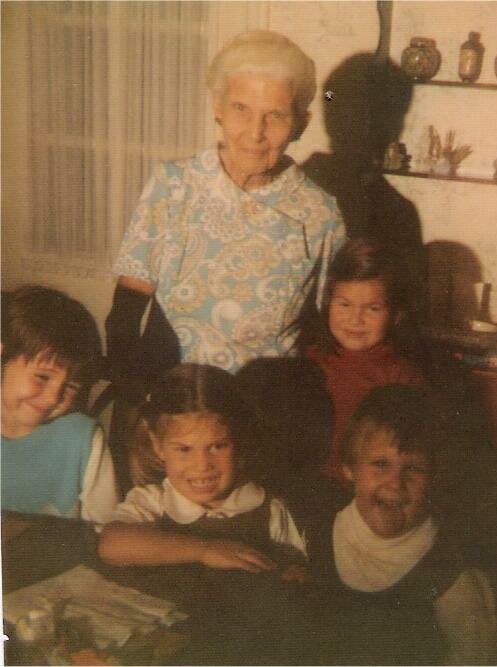
"Grandma Anderson" with me (far left), my cousins, and my brother.
Sunday, September 7, 2014
Church Record Sunday: Südbadische Standesbücher
Church records from southern Baden are available online at http://www.landesarchiv-bw.de/web/49484. The records, which are held by Staatsarchiv Freiburg, cover the years 1810-1870, although the full date range may not be available for every locality.
I have ancestors from southern Baden, so I was very excited when I learned that these records are available online. I have been looking at Catholic church records from Görwihl and Niederwihl.
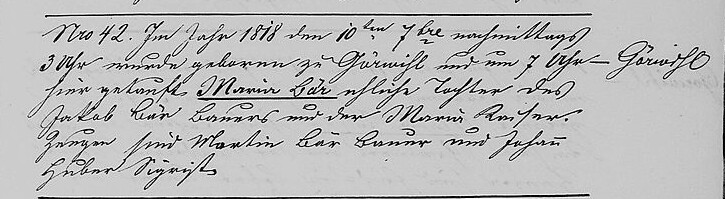
I found the birth record for my 3rd-great-grandmother Maria Bär in the Görwihl Catholic church records:
 Birth record, Maria Bär, 10 September 1818. Staatsarchiv Freiburg L 10 Nr. 5711, Bild 94. Permalink: http://www.landesarchiv-bw.de/plink/?f=5-497910-94. Standesbücher / 1810-1870 > Waldshut; Amtsgericht > Görwihl WT; Katholische Gemeinde: Geburtenbuch 1810-1869.
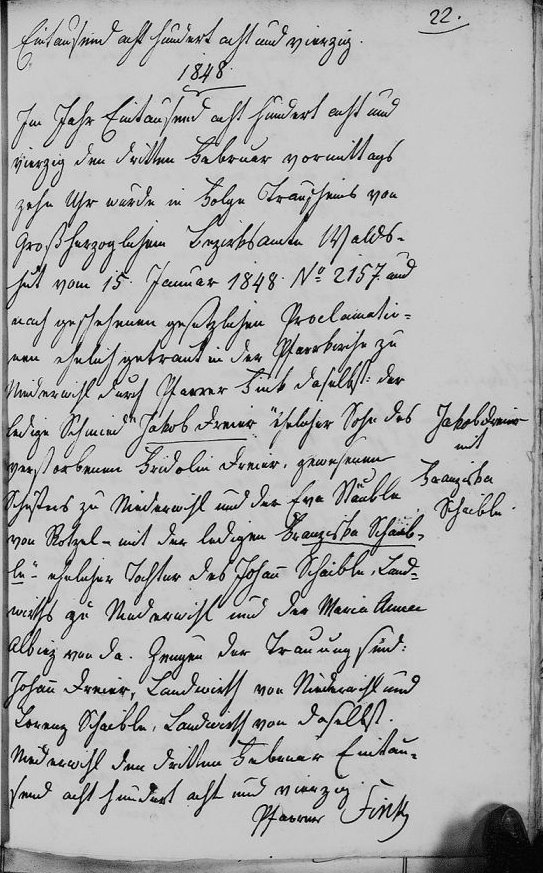
I found the marriage record for my 3rd-great-grandparents Jakob Dreier and Franziska Schäuble in the Niederwihl Catholic church records:
 Marriage record, Jakob Dreier and Franziska Schäuble, 1848. Staatsarchiv Freiburg L 10 Nr. 5776, Bild 81. Permalink: http://www.landesarchiv-bw.de/plink/?f=5-498377-81. Standesbücher / 1810-1870 > Waldshut; Amtsgericht > Niederwihl, Görwihl WT; Katholische Gemeinde: Heiratsbuch 1810-1869.
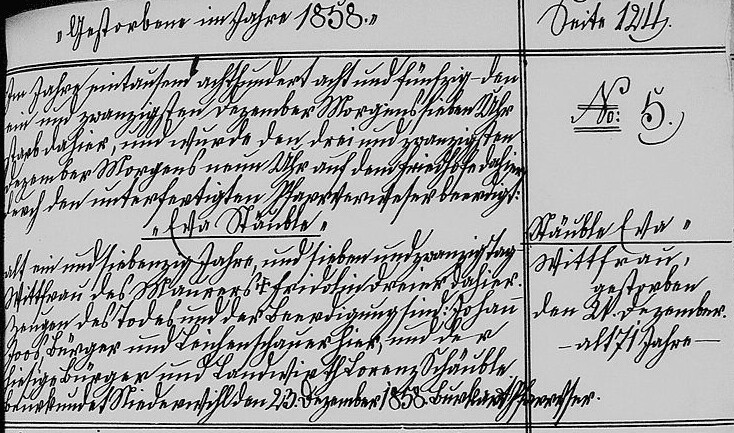
I found the death record for my 4th-great-grandmother Eva Stäuble in the Niederwihl Catholic church records:
 Death record, Eva Stäuble, 21 December 1858. Staatsarchiv Freiburg L 10 Nr. 5777, Bild 174. Permalink: http://www.landesarchiv-bw.de/plink/?f=5-498378-174. Standesbücher / 1810-1870 > Waldshut; Amtsgericht > Niederwihl, Görwihl WT; Katholische Gemeinde: Sterbebuch 1810-1869.
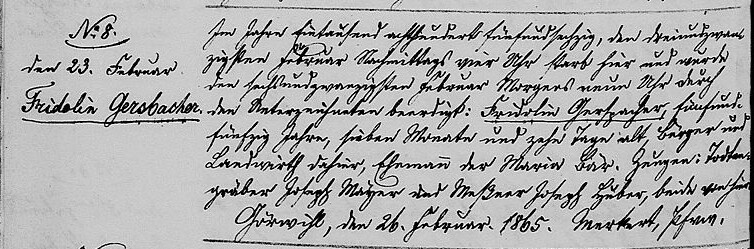
I found the death record for my 3rd-great-grandfather Fridolin Gersbacher (also known as Fridolin Gerspacher) in the Görwihl Catholic church records:
 Death record, Fridolin Gersbacher, 23 February 1865. Staatsarchiv Freiburg L 10 Nr. 5713, Bild 221.
Permalink: http://www.landesarchiv-bw.de/plink/?f=5-497912-221. Standesbücher / 1810-1870 > Waldshut; Amtsgericht > Görwihl WT; Katholische Gemeinde: Sterbebuch 1810-1869.
I have ancestors from southern Baden, so I was very excited when I learned that these records are available online. I have been looking at Catholic church records from Görwihl and Niederwihl.
I found the birth record for my 3rd-great-grandmother Maria Bär in the Görwihl Catholic church records:
I found the marriage record for my 3rd-great-grandparents Jakob Dreier and Franziska Schäuble in the Niederwihl Catholic church records:
I found the death record for my 4th-great-grandmother Eva Stäuble in the Niederwihl Catholic church records:
I found the death record for my 3rd-great-grandfather Fridolin Gersbacher (also known as Fridolin Gerspacher) in the Görwihl Catholic church records:
Permalink: http://www.landesarchiv-bw.de/plink/?f=5-497912-221. Standesbücher / 1810-1870 > Waldshut; Amtsgericht > Görwihl WT; Katholische Gemeinde: Sterbebuch 1810-1869.
Saturday, September 6, 2014
Unification Day (Bulgaria)
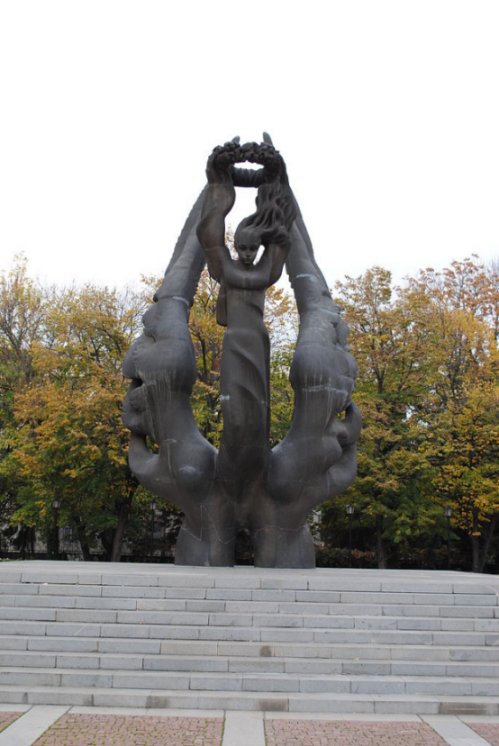
In 1878, after the Russo-Turkish War, the Treaty of Berlin divided Bulgaria into two parts: the Principality of Bulgaria (capital: Sofia) and Eastern Rumelia (capital: Plovdiv). On 6 September 1885, the two parts were reunited. Unification Day (Ден на Съединението), September 6, is a national holiday in Bulgaria. In 1985, the Monument of Unification was created by sculptor Velichko Minekov in honor of the 100th anniversary of unification. The mother country holds the laurel wreath of victory, and the wings symbolize the two united parts of Bulgaria. The monument is located in Plovdiv.
The wife of one of my cousins is from Bulgaria.
References
Monument to the Unification of Bulgaria in 1885
Reunification of the Principality of Bulgaria with Eastern Rumelia in 1885
Unification Day (Bulgaria)
Subscribe to:
Posts (Atom)