Covering genealogy, family history, historical events and places, and anything else related!

Friday, September 19, 2014

National POW/MIA Recognition Day

2014 National POW/MIA Recognition Day poster. Available from Defense Prisoner of War/Missing Personnel Office.

The third Friday in September is National POW/MIA Recognition Day. Prisoners of war and missing Americans are honored on this day. The first POW/MIA Recognition Day was observed on July 18, 1979, after President Jimmy Carter issued Proclamation 4664 on June 4, 1979. Until 1995, National POW/MIA Recognition Day legislation was introduced every year. Since then, a presidential proclamation has been signed annually. Commemorative posters are printed by the Defense Prisoner of War/Missing Personnel Office. Ceremonies are held throughout the country and at military installations around the world.

My 3rd-great-grandfather's brother John G. Gatlin was a prisoner of war at Rock Island Barracks in Rock Island, Illinois during the Civil War.

References
National POW/MIA Recognition Day
Presidential Proclamation --- National POW/MIA Recognition Day, 2014
Recognition Day – Background

Thursday, September 18, 2014

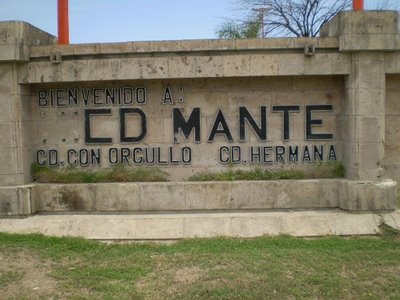
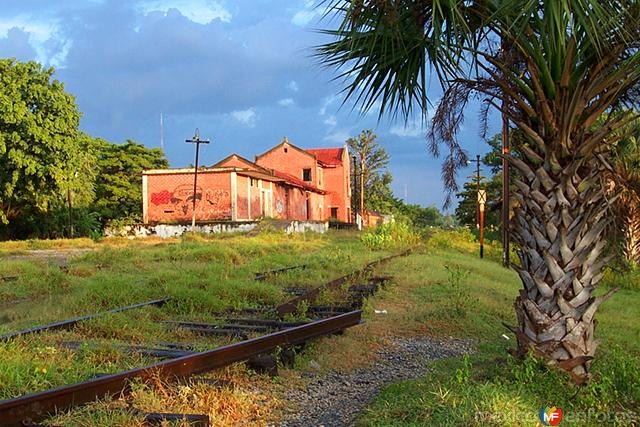
Those Places Thursday: Ciudad Mante, Tamaulipas, Mexico


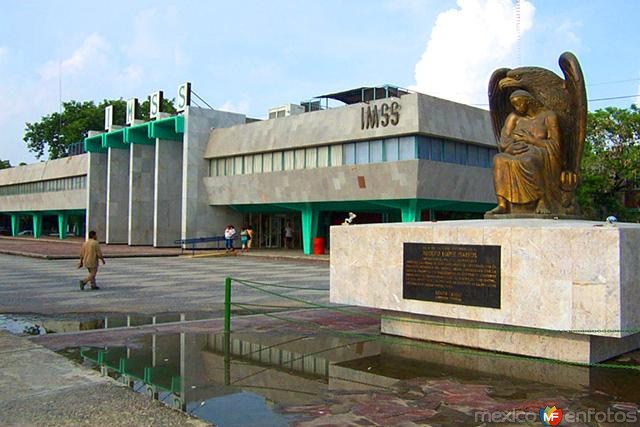
After the death of his second wife Verna in 1970, my maternal grandmother's brother Carl Schneider left the United States and moved to Mexico. He died in the Instituto Mexicano del Seguro Social in Ciudad Mante on 1 August 1974, and was buried in Ciudad Mante Cemetery.

Ciudad Mante is located in the extreme southern part of the Mexican state of Tamaulipas. It is the seat of the municipality of El Mante. In 2005, the population of Ciudad Mante was 81,884, and the population of El Mante was 112,061. Regional air traffic is handled by Ciudad Mante National Airport.

The economy of Ciudad Mante used to be based on sugar cane. The sugar mill, Ingenio el Mante,  opened in 1930. The official slogan of Mante is "Donde el Azucar es mas Dulce que la Miel." ("Where sugar is sweeter than honey.") Agricultural products such as sorghum, cotton, corn, and tomatoes are grown and exported. Other exports are mangos, fertilizer, and soap.

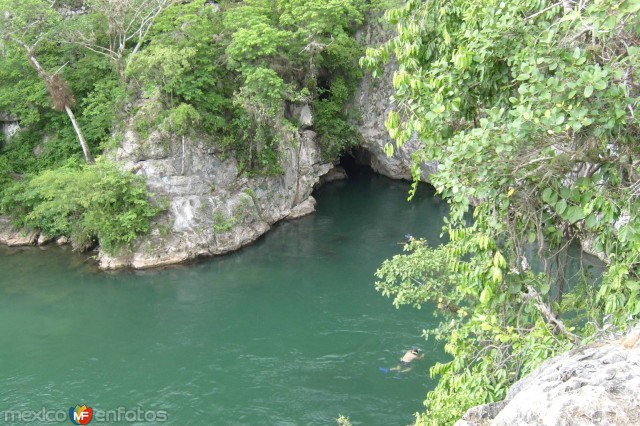
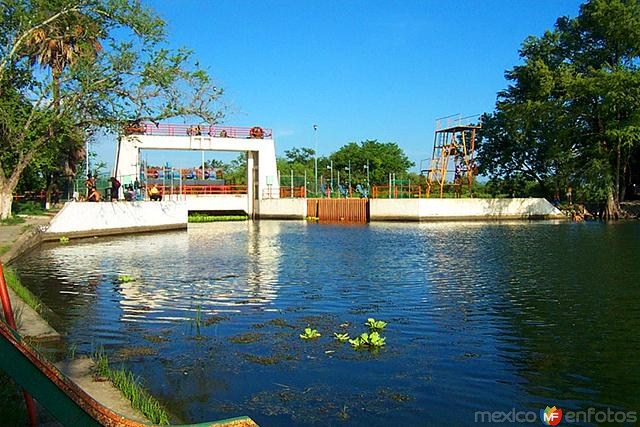
There are many tourist attractions in and around the area. Places to swim include El Nacimiento ("The Birthplace"), a spring located 7 miles from the city; La Aguja ("The Needle"), constructed between 1927 and 1929 along with a dam on the Mante River; and the beaches of Limon, located 7.5 miles away. Caverns in the Sierra de Cucharas mountain range include La Cava del Abra and La Gruta del Quintero.  El Cielo ("The Heaven") is a biosphere reserve which is inhabited by 175 species of migratory birds, 225 local fowl, butterflies, jaguars, ocelots, white-tailed deer, black bear, and other forms of wildlife. 4 wooden cabins are available.

The U.S. Department of State has issued a travel warning, advising the deferment of non-essential travel to Tamaulipas. The Mexican Drug War has led to violence in the area, including robberies, carjackings, kidnappings, and murder. Los Zetas control Ciudad Mante.

Instituto Mexicano del Seguro Social. Available from MexicoEnFotos. My great-uncle Carl Schneider died here.
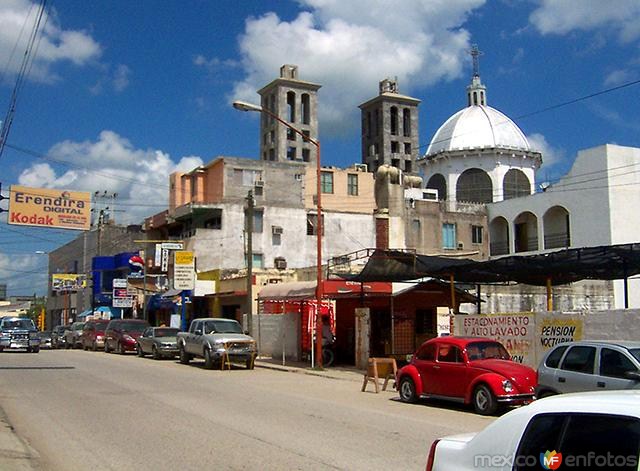
Zona Centro. Available from MexicoEnFotos.

Wednesday, September 17, 2014

Constitution Day

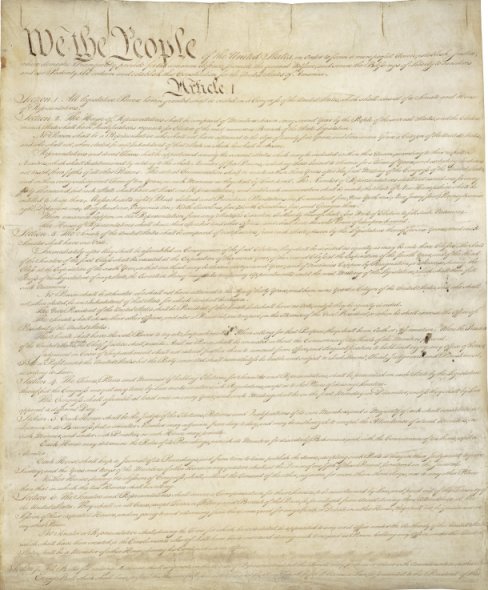
Constitution of the United States. National Archives and Records Administration. Record Group 11: General Records of the United States Government, 1778 - 2006. National Archives Identifier: 1667751  Available from National Archives Online Public Access.

On 17 September 1787, the final draft of the Constitution was signed 39 delegates of the United States Constitutional Convention. Constitution Day was recognized by Iowa schools in 1911, and in 1917, the Sons of the American Revolution formed a committee to promote Constitution Day. In 2004, Constitution Day was established when Senator Robert Byrd added provisions to the Consolidated Appropriations Act of Fiscal Year 2005. September 17 had previously been known as Citizenship Day.

On Constitution Day, federal agencies and educational institutions which receive federal funds are required to provide educational programs about the history of the United States Constitution.

References
Commemorating Constitution Day and Citizenship Day
Constitution Day
Constitution Day
Constitution Day
Constitution Day Resources
Teaching with Documents: Observing Constitution Day

Tuesday, September 16, 2014

El Grito de Dolores/Mexican Independence Day

Municipal president giving the "grito" of "Viva Mexico" at the commencement of Independence Day festivities in Mexico at 11 PM, 15 Sept 2008. Photo by Thelmadatter (Own work) [CC-BY-SA-3.0 (http://creativecommons.org/licenses/by-sa/3.0) or GFDL (http://www.gnu.org/copyleft/fdl.html)]. Available from Wikimedia Commons.

On 16 September 1810 in Dolores, Mexico, the Catholic priest Miguel Hidalgo y Costilla gave a speech known as El Grito de Dolores. He called for the end of 300 years of Spanish rule, redistribution of land, and racial equality. Since October 1825, Mexico's independence has been celebrated on September 16.

At around 11:00 PM on September 15, the president of Mexico rings the bell of the National Palace in Mexico City, shouts a "grito" based on El Grito de Dolores, and waves the Mexican flag. A military parade is held on September 16. Parties are held and flags are displayed. In September, schoolchildren often paint pictures and perform plays based on El Grito de Dolores and Mexican independence.

The wife of one of my cousins is from Mexico, and my maternal grandmother's brother Carl Schneider lived in Mexico at the end of his life.

Church and statue of Hidalgo. March 2004. Photo by Paigemorrison [CC-BY-SA-2.5 (http://creativecommons.org/licenses/by-sa/2.5), GFDL (http://www.gnu.org/copyleft/fdl.html) or CC-BY-SA-3.0 (http://creativecommons.org/licenses/by-sa/3.0)]. Available from Wikimedia Commons.

References
El Grito de Dolores
Grito de Dolores
Mexican War of Independence begins
Miguel Hidalgo y Costilla
Teach September 16! El Grito de Dolores, Mexican independence, and the Zapatistas

Monday, September 15, 2014

National Hispanic Heritage Month

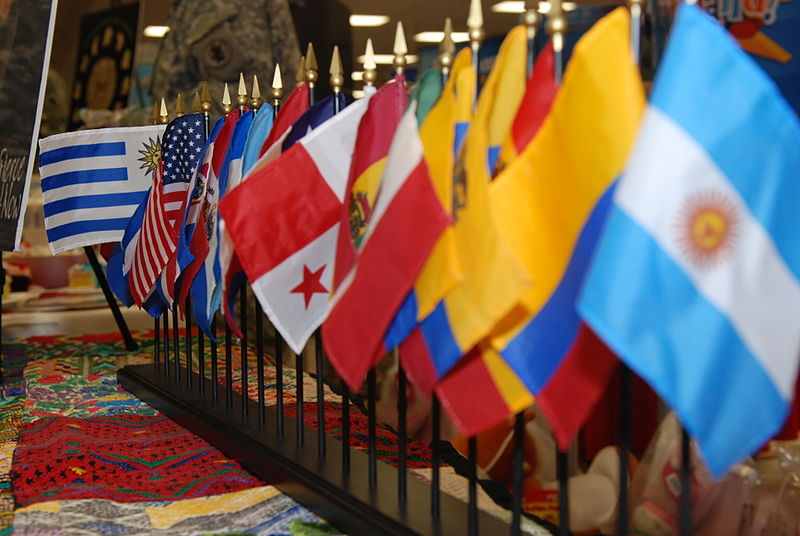
U.S. Army South celebrates Hispanic Heritage Month. 30 September 2009.  Photo by Army Sgt. Nina Ramon 345th Public Affairs Detachment (United States Army) [Public domain]. Available from the United States Army and Wikimedia Commons.

September 15 to October 15 is National Hispanic Heritage Month. During the month, the histories, cultures, and contributions of Hispanic Americans are celebrated. September 15 was chosen as the starting date because it is Independence Day in Costa Rica, El Salvador, Guatemala, Honduras and Nicaragua. Also, September 16 is Independence Day in Mexico, and September 18 is Independence Day in Chile.

On 17 September 1968, Congress passed Public Law 90-498, which authorized the President to designate the week including September 15 and 16 as National Hispanic Heritage Week and on 24 December 1968, President Lyndon Johnson issued Proclamation 3869. On 17 August 1988, Public Law 100-402 was enacted, and the period between September 15 and October 15 was proclaimed National Hispanic Heritage Month.

Although I am not of Hispanic heritage, members of my family are. My sister-in-law is from Peru, and my niece is half Peruvian. The wife of one of my cousins is from Mexico.

Sunday, September 14, 2014

National Pet Memorial Day

More than 40 years ago, the International Association of Pet Cemeteries and Crematories established the second Sunday in September as National Pet Memorial Day. Pets are members of the family, so today I would like to honor my beloved pets that have passed away.

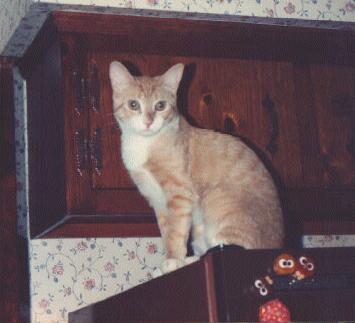
Sunshine (July 15, 1990 - November 13, 2010) was the first cat that was all mine. I adopted her when she was 8 weeks old. We had a very special bond.

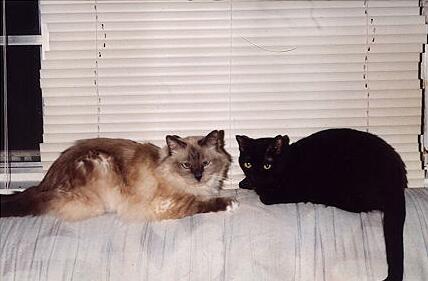
Velvet (left, March 23, 1991 - March 23, 2001) and Ember (right, July 15, 1994 - July 6, 2009) were inseparable. Velvet was a blue point Birman. Ember was a Bombay. Velvet was an alpha female and Bombays like to be dominant, so it would seem more likely that they would not get along. However, they bonded almost instantly (within a few hours after Ember moved in) and were constantly together. Being co-dominant worked for them.

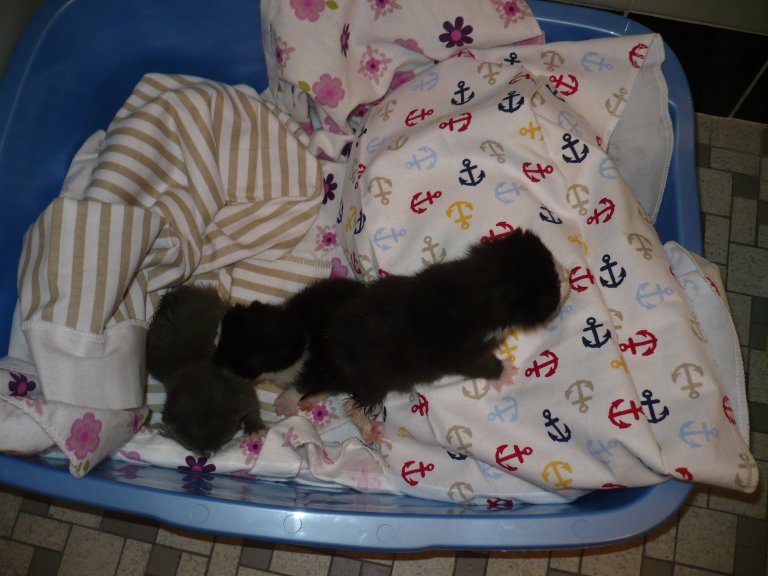
In May, I found three two-week old kittens abandoned in my backyard. Unfortunately two of them did not survive. I never even had a chance to name the tuxedo boy on the right. I called the girl on the left Willow because she was like a pussy willow: small, soft, and gray. Fortunately the tuxedo boy in the middle, Flash, is still with me.

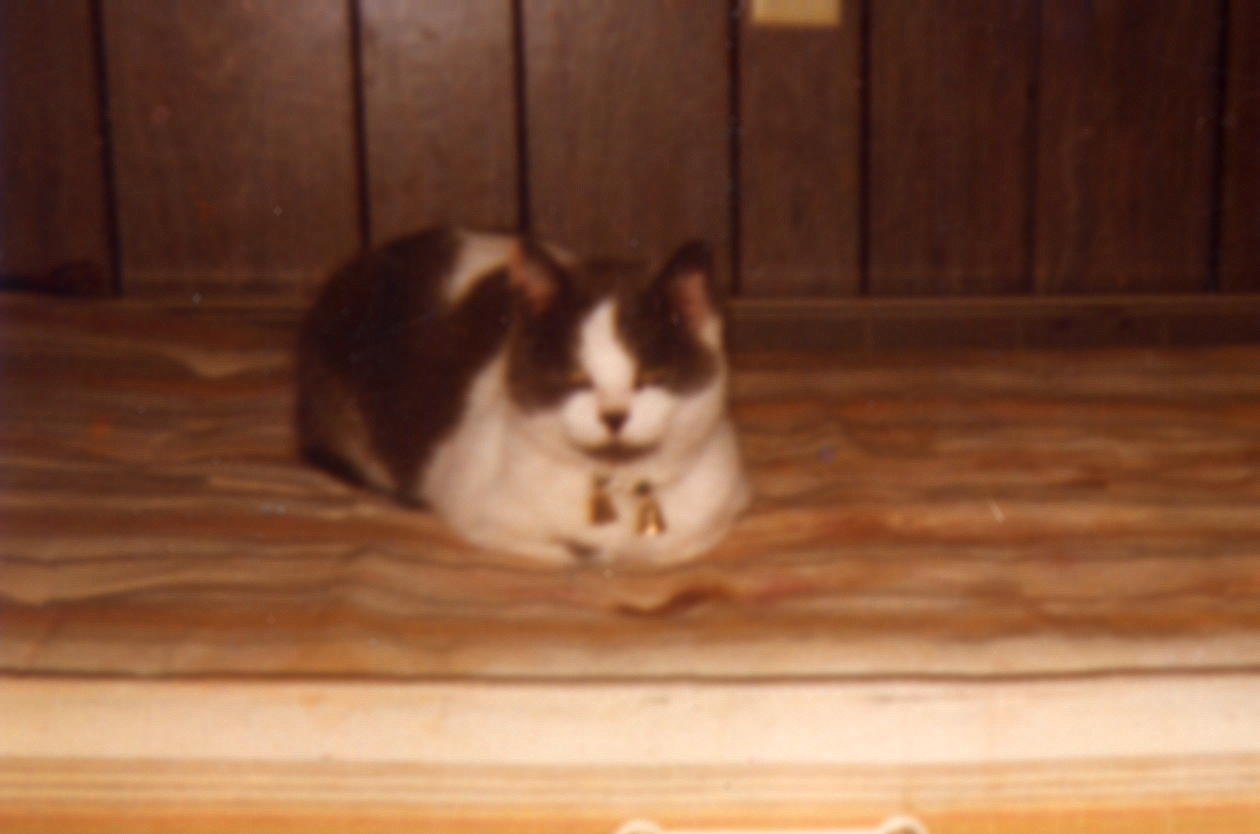
Schatzi was my first cat. I got her as a kitten when I was four years old. I named her after my maternal grandparents's dog.

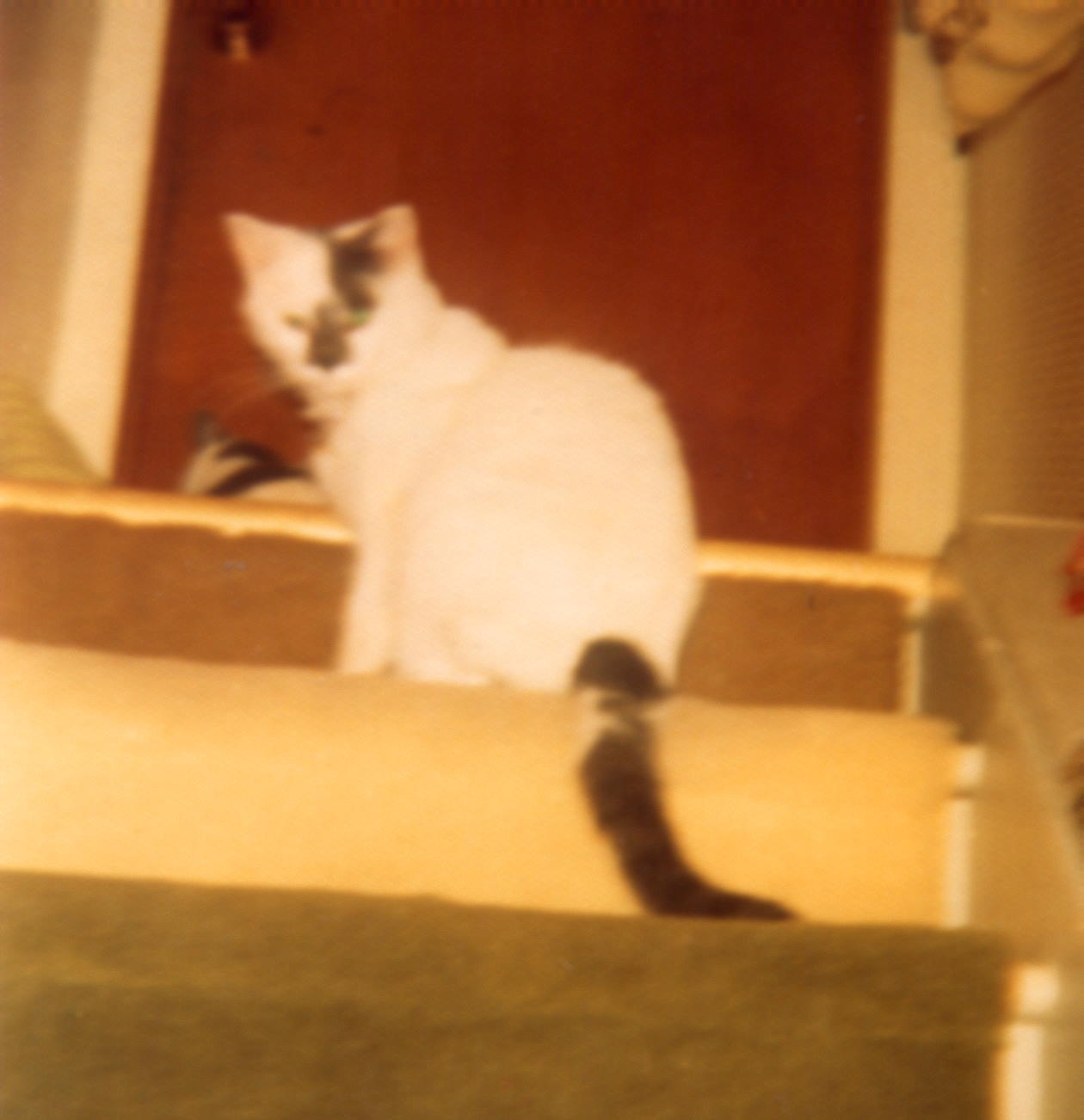
Fluffy was Schatzi's daughter. She was a medium-haired cat. I originally named her MarshmallowFluff, but her name was eventually shortened to Fluffy. Fluffy was born when I was 5 years old (and then we had Schatzi spayed). Schatzi is in this picture too, in the background.

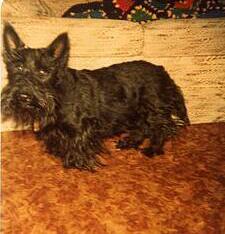
Silky was my childhood dog. She was a Scottish Terrier. Sadly, she died of cancer at a fairly young age.

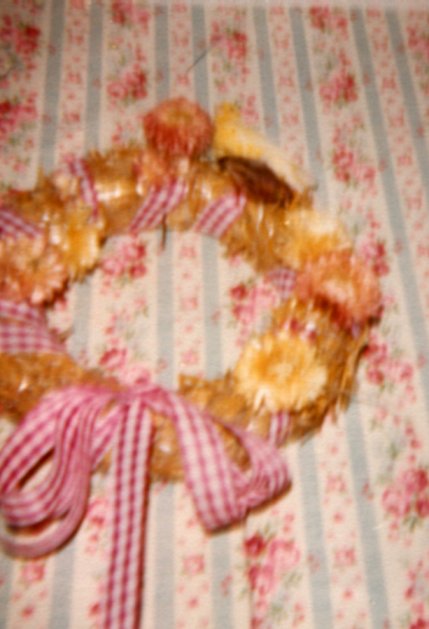
My canary, Sunny, perched on top of the wreath

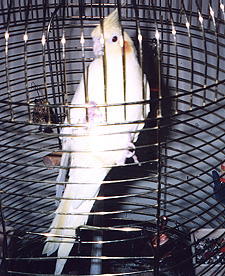
Star, my cockatiel

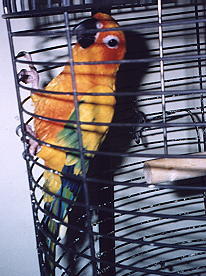
Rainbow, my sun conure

Saturday, September 13, 2014

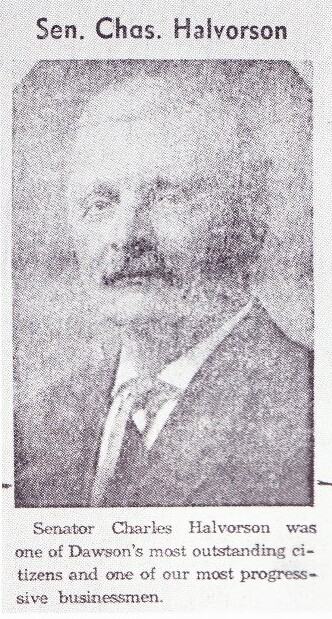
52 Ancestors: #37 Charles Halvorson, Minnesota State Senator

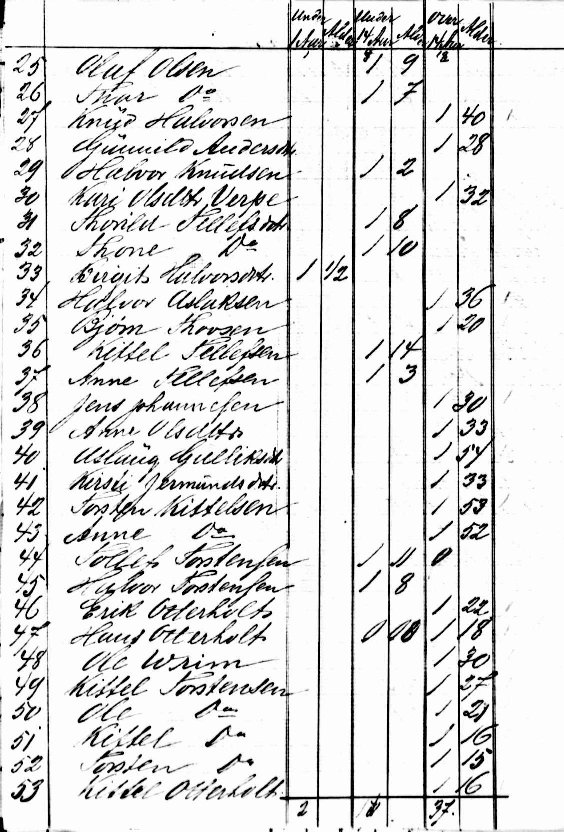
Kittel (or Kjetil) Halvorsen Otterholt, the brother of my great-great-grandmother Aaste Halvorsdatter Otterholt, was born on 11 September 1850 in Bø, Telemark, Norway. He was the son of Halvor Eriksen Otterholt and Guro Hansdatter Askilt. He was enumerated with his family in the 1865 census of Norway, living on the Otterholdt farm in Bø.

On 20 April 1867, he and his parents and siblings left Norway from Skien, Telemark on the Rjukan and arrived in Quebec, Canada on 30 May 1867. The family settled in Canisteo, Dodge County, Minnesota. They were enumerated there in the 1870 United States census. Kittel was listed as a farm laborer. He also clerked in a drug store from 1869 to 1873.

Kittel changed his name to Charles Halvorson. On 9 January 1878, he married Julia Baronette Olson in Dodge County, Minnesota. In 1879, they moved to Montevideo, Chippewa County, Minnesota. Charles was a bookkeeper for two years.

Charles and Julia's first child, daughter Ella Gurina, was born on 11 January 1880. Sadly, she died three weeks later. A second daughter, Ella Josephine, was born on 5 November 1880. In 1881, Charles became a partner in the general store Stone & Halvorson in Lac qui Parle Village, Lac qui Parle County, Minnesota.

On 24 November 1884, daughter Cora Elizabeth was born in Dawson, Lac qui Parle County, Minnesota. In December 1884, Stone & Halvorson left Lac qui Parle Village and split into two stores: Stone & Halvorson in Madison, Lac qui Parle County, Minnesota and Charles Halvorson in Dawson, Minnesota. The Madison store was only open for a short time.

Daughter Olga Beatrice was born on 13 January 1887. Daughter Effie Amanda was born on 31 December 1889. Twin sons were born on 19 June 1893, fifteen minutes apart: Charles Stanford and Walter Stanton.

In 1897, Charles' modified Queen Anne style home in Riverside, Dawson was built. It had seven stained glass windows and a wrap-around porch with columns. It cost $10,000 to build and was one of the finest homes in the area.

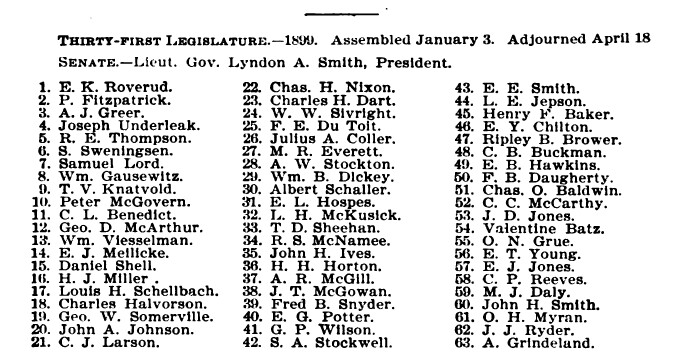
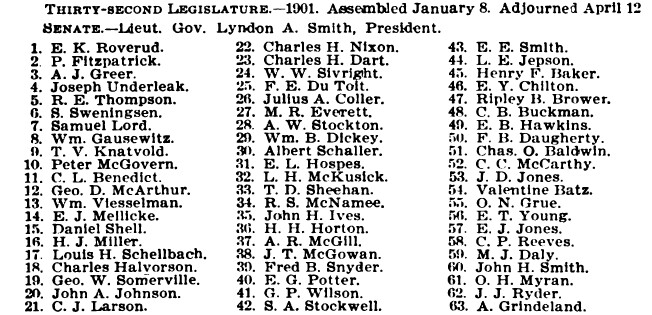
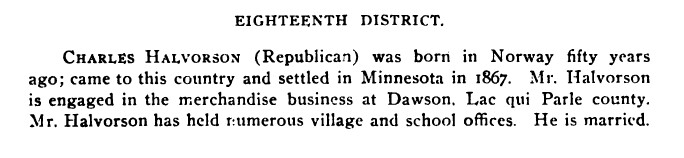
On 8 November 1898, Charles was elected to the Minnesota State Senate. He was a Republican and represented District 18, Chippewa and Lac qui Parle counties. During the 31st legislative session (1899-1900), he was chair of the Illuminating Oils committee and also served on the Forestry and Fire Protection, Internal Improvements, Public Parks, Railroads, State Prison, and Temperance committees. During the 32nd legislative session (1901-1902), he was chair of the Retrenchment and Reform committee and also served on the Forestry and Fire Protection, Grain and Warehouse, Public Lands, Public Parks, State Prison, and Temperance committees. His term ended on 5 January 1903.
   
On 27 February 1906, there was a fire in the Dawson business district. Charles' store there was burnt and did not reopen. However, he had other business enterprises. He was a partner in the men's clothing store Halvorson & Olson in Montevideo, Minnesota until 1908.

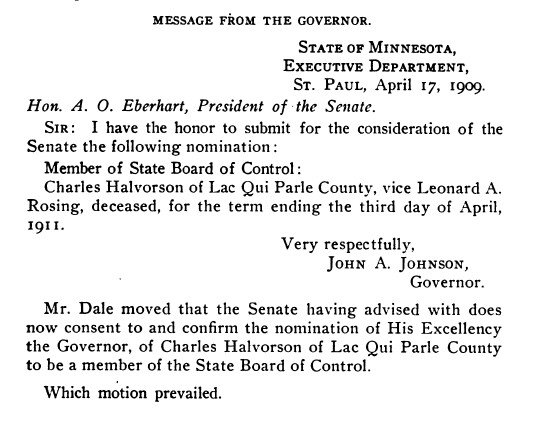
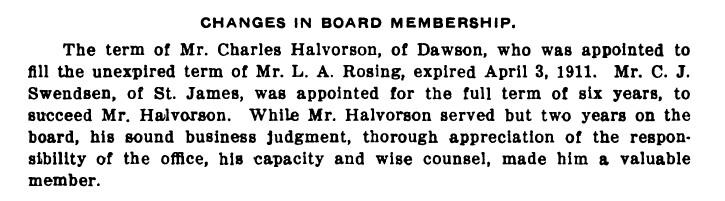
On 17 April 1909, Charles was appointed to the Minnesota State Board of Control. He replaced Leonard A. Rosing, who had died. Charles' term expired on 3 April 1911.

Charles was considered an honest, honorable, and dedicated man. He died in Hennepin County, Minnesota on 25 June 1913 and was buried in Grace Lutheran Cemetery in Dawson, Minnesota.

Telemark county, Bø, Parish register (official) nr. 8 (1849-1861), Birth and baptism records 1850, page 22. http://www.arkivverket.no/URN:NBN:no-a1450-kb20051011050470.jpg

Passenger list, Rjukan, 1867. Passenger Lists, 1865–1935. Microfilm Publications T-479 to T-520, T-4689 to T-4874, T-14700 to T-14939, C-4511 to C-4542. Library and Archives Canada, n.d. RG 76-C. Department of Employment and Immigration fonds. Library and Archives Canada Ottawa, Ontario, Canada.

The Legislative Manual of the State of Minnesota. State of Minnesota, 1901. Page 124.

The Legislative Manual of the State of Minnesota. State of Minnesota, 1901. Page 125.

 The Legislative Manual of the State of Minnesota. State of Minnesota, 1901. Page 671.

Journal of the Senate of the Thirty-Sixth Session of the State of Minnesota. St. Paul, Minnesota: McGill Warner, 1909. Page 1223.

Sixth Biennial Report of the Board of Control of State Institutions of Minnesota. Minneapolis, Minnesota: Syndicate Printing Co., 1912. Page 27.

From Boe (Bø) and Halvorson-Otterholt; Shared Roots in Telemark. Compiled by Melvin and Alpha M. (Boe) Brodshaug, 1984. Published by Arlene (Boe) Christensen and Marjorie (Boe) Bergee. Printed by Anundsen Publishing Co., Decorah, Iowa.

References
Boe (Bø) and Halvorson-Otterholt: Shared Roots in Telemark. Compiled by Melvin and Alpha M. (Boe) Brodshaug, 1984. Published by Arlene (Boe) Christensen and Marjorie (Boe) Bergee. Printed by Anundsen Publishing Co., Decorah, Iowa.
Journal of the Senate of the Thirty-Sixth Session of the State of Minnesota. St. Paul, Minnesota: McGill Warner, 1909. Available from Google Books.
The Legislative Manual of the State of Minnesota. State of Minnesota, 1901. Available from Google Books.
Minnesota Legislative Reference Library: Legislators Past and Present
Ronningen, Johan. "Charlie Halvorson." Telesoga 29(1) (May 2008): 26-28.
Sixth Biennial Report of the Board of Control of State Institutions of Minnesota. Minneapolis, Minnesota: Syndicate Printing Co., 1912. Available from Google Books.
Telelaget of America. Telemark to America: Volume II: Settlements. 2nd ed. Telelaget of America, 1992, 2009.